 The Singapore National Biodiversity Strategy and Action Plan (NBSAP) was launched on Saturday. It was exciting to read all about what we have done, and what we can yet accomplish for our biodiversity and natural heritage!
07 September 2009
Singapore's National Biodiversity Strategy and Action Plan (NBSAP)
Singapore HAS wildlife and we HAVE been looking at and after it! And will continue to do so.
 The Singapore National Biodiversity Strategy and Action Plan (NBSAP) was launched on Saturday. It was exciting to read all about what we have done, and what we can yet accomplish for our biodiversity and natural heritage!
The Singapore National Biodiversity Strategy and Action Plan (NBSAP) was launched on Saturday. It was exciting to read all about what we have done, and what we can yet accomplish for our biodiversity and natural heritage!
06 September 2009
13 Sep (Sun): Screening of "End of the Line"
Where have all the fish gone? See the world’s first major feature documentary film revealing the devastating impact of overfishing on the oceans!
WWF Singapore brings this exclusive free screening.
WWF Singapore brings this exclusive free screening.
05 September 2009
Caseolaris in the dark (with bats?)
Since the Berembang was blooming today at Sungei Buloh, I thought perhaps the wild Berembang at Woodlands might also be in bloom.
 I decided to have a look at the trees there at first dark. And wow, they were in bloom!
 I decided to have a look at the trees there at first dark. And wow, they were in bloom!
Colourful mangroves: Animals!
Brightly coloured crabs scuttled on the mud just below the Sungei Buloh Mangrove Boardwalk!
 I have no idea what they are!
 I have no idea what they are!
Colourful mangroves: Plants!
The mangroves are aflame today! The Buta-buta leaves are turning bright red adding splashes of colour to the usually drab green mangroves. Today, I saw lots of special plants during a VERY slow walk on the Mangrove Boardwalk at Sungei Buloh.
 Today, I saw lots of special plants during a VERY slow walk on the Mangrove Boardwalk at Sungei Buloh.
7 Sep (Mon): Talk on "In Darwin's pocket: The voyage of the beagle from Darwin's field notebooks"
Another record exists of Darwin’s voyage that has remained almost unknown until recently.
 Darwin’s pocket field notebooks reveal the intimate day-by-day life of Darwin as a practicing naturalist in the field, in the saddle, and on the way to becoming a highly experienced naturalist and theorist. The specimens and evidence that eventually convinced Darwin that life evolves were first recorded in these remarkable documents. They throw new light and detail on one of the most remarkable expeditions in the history of science.
 Darwin’s pocket field notebooks reveal the intimate day-by-day life of Darwin as a practicing naturalist in the field, in the saddle, and on the way to becoming a highly experienced naturalist and theorist. The specimens and evidence that eventually convinced Darwin that life evolves were first recorded in these remarkable documents. They throw new light and detail on one of the most remarkable expeditions in the history of science.
04 September 2009
Shoreline restoration at the East Coast continues until Dec 09
Work involves "topping up of sand" supplied via a barge. The work began in January will continue until December. Hopefully, these works will not affect the amazing marinelife there.
 What have we seen at the East Coast?
 Hopefully, these works will not affect the amazing marinelife there.
 What have we seen at the East Coast?
03 September 2009
New on Wildfacts: mangroves and coastal plants
With trepidation I've uploaded a bunch of new factsheets on these fascinating plants found on our shores. Needless to say, it's just a start and there's still many many more plants to do. And lots of missing photos of fruits and flowers as these are often seasonal.
 Needless to say, it's just a start and there's still many many more plants to do. And lots of missing photos of fruits and flowers as these are often seasonal.
The Big Why: Ocean sex gone awry
The fusion of two distinct evolutionary lines is not supposed to work – but the seas are teeming with chimeras that prove it can. With wanton external fertilisation going on in the ocean all the time, and so many different creatures leaving eggs lying around, sperm can sometimes be carried to the "wrong" egg. Occasionally, such misfertilisation can produce something totally unexpected.
 For example, sea squirts (or ascidians) are believed to be the morning-after consequence of the fusion of an ancient chordate with the ancestor of a sea urchin.
Another oddity is the starfish Luidia sarsi. It starts out as a small larva with an even smaller starfish inside. Eventually, the starfish moves to the outside of the larva. Then they go their separate ways. What started as one rather odd organism continues and ends life as two.
Biologists are now coming round to the idea that much of nature is not a product of neat family lines, but a messy mass of cross links.
This puzzle is listed among the 13 most perplexing mysteries that still confound us. Cracking any one of them could yield profound truths.
 For example, sea squirts (or ascidians) are believed to be the morning-after consequence of the fusion of an ancient chordate with the ancestor of a sea urchin.
Another oddity is the starfish Luidia sarsi. It starts out as a small larva with an even smaller starfish inside. Eventually, the starfish moves to the outside of the larva. Then they go their separate ways. What started as one rather odd organism continues and ends life as two.
Biologists are now coming round to the idea that much of nature is not a product of neat family lines, but a messy mass of cross links.
This puzzle is listed among the 13 most perplexing mysteries that still confound us. Cracking any one of them could yield profound truths.
A peek at marinelife at Marina at Keppel Bay
This evening Debby of the Hantu Bloggers and I met with Francis Olsen of Marina at Keppel Bay to discuss collaboration on showcasing the marine life at their Marina.
 And after that, we had a quick look at some of the marine life growing on their pontoons. Amazing stuff!
 And after that, we had a quick look at some of the marine life growing on their pontoons. Amazing stuff!
02 September 2009
What can nudibranchs tell us about climate change?
Phyllodesmium lizardensis is not a very attractive slug, but it can help us better understand how reefs might be affected by climate change.
Coral bleaching is a dreaded potential consequence of global warming. When corals lose their algae symbionts (zooxanthellae), they turn white and may get sick and die. Today, a report by the Great Barrier Reef Marine Park Authority warns that the Great Barrier Reef is under grave threat from climate warming and coastal development, and its prospects of survival are "poor".
To better understand the relationship between corals and zooxanthellae, a recent study turned to a similar relationship among nudibranchs!
Some nudis are solar powered. These slugs eat corals and incorporate the coral zooxanthellae in their own 'tentacles'. In the slug, the zooxanthellae carry out photosynthesis and share the food produced with the host, as they did with their original coral host.
Phyllodesmium lizardensis is one of the slugs being studied. The tricky part is finding the slugs!

Coral bleaching is a dreaded potential consequence of global warming. When corals lose their algae symbionts (zooxanthellae), they turn white and may get sick and die. Today, a report by the Great Barrier Reef Marine Park Authority warns that the Great Barrier Reef is under grave threat from climate warming and coastal development, and its prospects of survival are "poor".
To better understand the relationship between corals and zooxanthellae, a recent study turned to a similar relationship among nudibranchs!
Some nudis are solar powered. These slugs eat corals and incorporate the coral zooxanthellae in their own 'tentacles'. In the slug, the zooxanthellae carry out photosynthesis and share the food produced with the host, as they did with their original coral host.
Phyllodesmium lizardensis is one of the slugs being studied. The tricky part is finding the slugs!

01 September 2009
Assoc. Prof. Hugh Tan on "Cultivating the Native Plants of Singapore"
Today I attended another fascinating talk in the series in celebration of the Department of Biological Sciences' 60th anniversary.
 Prof Hugh Tan shared about our 'Cultivating the Native Plants of Singapore'. I didn't realise that so many of our rarey native plants are now restricted to our shores and offshore islands!
 Prof Hugh Tan shared about our 'Cultivating the Native Plants of Singapore'. I didn't realise that so many of our rarey native plants are now restricted to our shores and offshore islands!
Oysters of Singapore, new species of mud lobster, slug and more!
The Raffles Bulletin of Zoology Vol 57 (2009) Issue No. 2 is now online! As well as the Crustacean Supplement II Supplement Series No. 20 (2009): i, 1–307. Thanks to Marcus for the heads up.
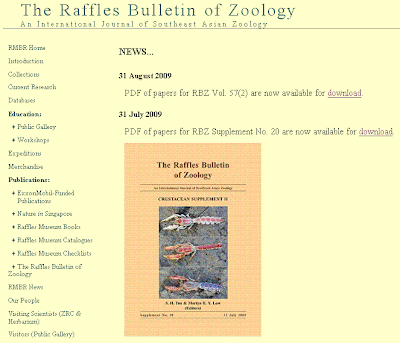 With lots of fascinating stuff to learn about our marine life from these papers!
 With lots of fascinating stuff to learn about our marine life from these papers!
2 Sep (Fri): Scene City Singapore - Semakau and Pulau Ubin
Photographing Semakau Landfill and Pulau Ubin, a programme on Channel NewsAsia tomorrow night.
The programme features Tom Ang, a UK-based photographer and writer of photobooks exploring places to shoot in Singapore. He is joined by two photographers in each episode ranging from amateurs to professionals. The group will then visit places of different photographic challenges, while trying to debunk the myth that there is nothing to shoot in Singapore.
The programme features Tom Ang, a UK-based photographer and writer of photobooks exploring places to shoot in Singapore. He is joined by two photographers in each episode ranging from amateurs to professionals. The group will then visit places of different photographic challenges, while trying to debunk the myth that there is nothing to shoot in Singapore.
Subscribe to:
Posts (Atom)
LinkWithin
