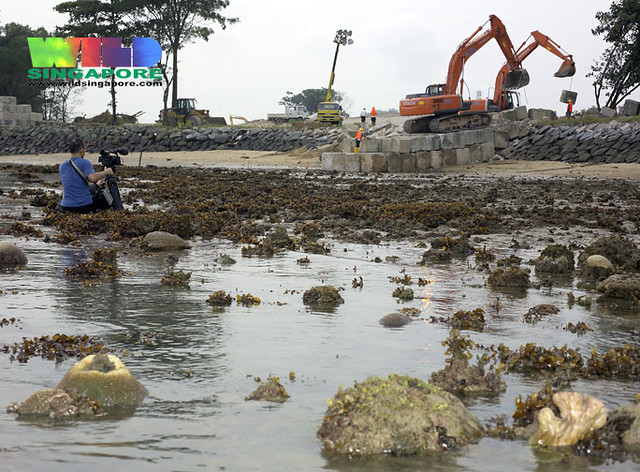
 |
| Living reefs at Sentosa, buried in reclamation for Resorts World Sentosa, Jan 2000. |

Showing posts with label issues-sand. Show all posts
Showing posts with label issues-sand. Show all posts
05 February 2018
Reclamation in Singapore - glimpses of plans ahead
Recent comments shed some light reclamation in Singapore in the future. National Development Minister Lawrence Wong and Urban Redevelopment Authority Chief Planner Hwang Yu-Ning spoke to the Straits Times on upcoming infrastructure plans that will take Singapore into the next phase of its urban development.
Key points that impact our shores include comments on reclamation plans and approaches for the future, ecological impact of our reclamation on sand source countries, and possibility of floating cities on the sea.

24 March 2014
Massive Malaysian reclamation off Western Catchment has begun?
"The project has since begun with sand barges dumping sand while the Detailed Environmental Impact Assessment (DEIA) has yet to be made available to the public." write Save our Seahorses (SOS) Malaysia, a group which has been working in the area for many years, in a letter to the press on 24 Mar.
Dubbed "Forest City", a massive reclamation project to build luxury homes (area in red) could entail "a few thousand acres" making it one of Iskandar Malaysia’s single largest projects, The Star reported on 19 Mar.
 |
| click on image for larger view |
12 August 2012
Where is soil excavated in Singapore dumped?
Minister Khaw Boon Wan explained the soil is reused in land reclamation, in a recent post on his blog.
But there is no mention of how much of this soil continues to be dumped at sea.
 |
| Photo from Minister Khaw's blog post. |
13 October 2011
Sea level rise and Singapore's response
For the first time, it was mentioned that Singapore "will need to raise minimum levels for land reclamation by at least 1m to create an adequate buffer against a potential rise in sea level". This, according to the Ministry of Environment and Water Resources (MEWR).
 In Mar 2010, a Singapore study revealed that sea levels could rise by between 24 and 65cm by 2100. At that time, the Ministry said existing regulations were sufficient. These included a requirement since the early 1990's for reclaimed land to be built at a height of 125cm above the highest measured tidal level, as a buffer against rising sea levels.
Why are rising sea levels a concern for Singapore?
Why are rising sea levels a concern for Singapore?
11 May 2010
Singapore rejects claims that it imports Cambodian sand illegally and without regard for the environment
The Ministry of National Development said it is not true that the Singapore Government imports sand without due regard to the laws or environmental impact of Cambodia.
 Barges piled with sand ply regularly along Pasir Ris.
The Ministry was responding to a Global Witness report Shifting Sand: how Singapore’s demand for Cambodian sand threatens ecosystems and undermines good governance.
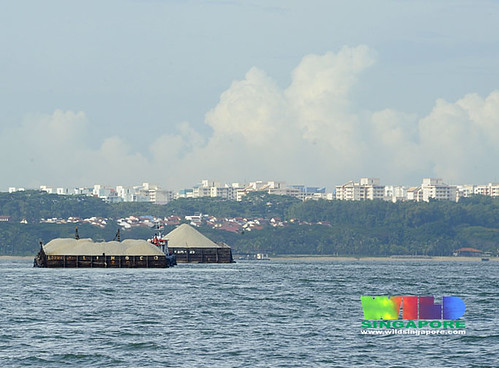 Barges piled with sand ply regularly along Pasir Ris.
The Ministry was responding to a Global Witness report Shifting Sand: how Singapore’s demand for Cambodian sand threatens ecosystems and undermines good governance.
24 February 2010
Dredging near Kusu Island continues until Aug 10
In front of the living reefs of Kusu Island, dredging that first started in Apr 09 (the Notice was then entitled 'Sand Mining') will continue until Aug 10. The working area is about four times the size of Kusu Island itself. Dredging stirs up sediments which make the water murky and affects the amount of sunlight that reaches the corals.
 Dredging stirs up sediments which make the water murky and affects the amount of sunlight that reaches the corals.
13 February 2010
Singapore accused of launching 'Sand Wars'
Sand smugglers are "making night-time raids on the picturesque sandy beaches of Indonesia and Malaysia, carving out millions of tons of coastline and leading to fears of an imminent environmental catastrophe on a swath of tropical islands" says an article in The Telegraph of the UK.

The article says recent bans on exporting sand introduced in Indonesia, Cambodia and Vietnam have cut off supplies and opened up a thriving smuggling trade.
"The situation has reached critical levels and the tropical islands of Nipah, the Karimun islands and many small islands off the coast of Riau are shrinking dramatically and on the brink of disappearing into the sea. The smugglers have no problem getting it into Singapore and these boats are rarely intercepted by customs boats or the navy. The supply is constant." Nur Hidayati, Greenpeace Indonesia spokesman is quoted as saying.
Sand piled on a barge off Pasir Ris.
The article says recent bans on exporting sand introduced in Indonesia, Cambodia and Vietnam have cut off supplies and opened up a thriving smuggling trade.
"The situation has reached critical levels and the tropical islands of Nipah, the Karimun islands and many small islands off the coast of Riau are shrinking dramatically and on the brink of disappearing into the sea. The smugglers have no problem getting it into Singapore and these boats are rarely intercepted by customs boats or the navy. The supply is constant." Nur Hidayati, Greenpeace Indonesia spokesman is quoted as saying.
10 December 2009
Sand mining off the East Coast for dumping off Labrador continues to Jun 10
Where does the sand come from, for the massive reclamation off Labrador?
 It appears, one of the sources is from massive dredging within the four points off our East Coast. This dredging has been going since March 2008.
 It appears, one of the sources is from massive dredging within the four points off our East Coast. This dredging has been going since March 2008.
11 November 2009
Impact of sand extraction in Cambodia and Vietnam
The sand is exported mainly to Singapore for "sea encroachment projects". Sand extraction is ostensibly done to relieve flooding and to deepen waterways for shipping, and the sand exported. But the extensive extraction is impacting locals in Cambodia and Vietnam.

Sand piled high at the Pasir Panjang Container terminal project, as at 4 Nov 09.
22 October 2009
Sand mining near Kusu Island Oct 09 to Feb 10
In front of the living reefs of Kusu Island, dredging that first started in Apr 09 will continue for another five months [update: extended to May 10]. The dredging area is about four times the size of Kusu Island itself.
 Dredging stirs up sediments which make the water murky and affects the amount of sunlight that reaches the corals.
08 October 2009
Vietnam halts sand exports to Singapore
Although some say the ban is not expected to affect construction in Singapore, one source said there will be an impact as 25% of our sand supply comes from Vietnam each month.

Unlike the Indonesian ban on sand exports, the Vietnamese ban did not appear to have political undertones. Instead, the ban is primarily due to the environmental degradation that sand extraction caused to the Mekong River, such as major landslips along rivers.
Where does the sand for Singapore's reclamation come from?
Where does the sand for Singapore's reclamation come from?
25 August 2009
Surge in Vietnam sand exported to Singapore
Sand exported to Singapore from Vietnam’s Mekong Delta in the first half of 2009 was equivalent to the total exports of the last ten years.
Barge full of sand seen off Pulau Ubin a week ago. Where does the sand come from?
The surge in exports from Vietnam followed Cambodia’s decision to ban further exports of its own river sand in order to reserve it for domestic use and limit further erosion of river banks.
This is despite a Vietnamese ban on sand and gravel exports.
Barge full of sand seen off Pulau Ubin a week ago. Where does the sand come from?
The surge in exports from Vietnam followed Cambodia’s decision to ban further exports of its own river sand in order to reserve it for domestic use and limit further erosion of river banks.
This is despite a Vietnamese ban on sand and gravel exports.
15 August 2009
Sand mining near Kusu Island Aug-Dec 09
In front of the living reefs of Kusu Island, dredging is expected to take place for the next five months. The dredging area is about four times the size of Kusu Island itself.
Dredging stirs up sediments which make the water murky and affects the amount of sunlight that reaches the corals.
Dredging stirs up sediments which make the water murky and affects the amount of sunlight that reaches the corals.
12 July 2009
Sand mining in Vietnam to be regulated
After Cambodia’s ban on sand exports, hundreds of barges have been working at full-blast dredging sand on a main branch of the Mekong causing irregular water flows and inflicting major environmental damage.
In addition, at least another 300 boats have been used to carry sand to foreign boats from Singapore, Malaysia, Indonesia or domestic construction firms.
As a result, the Mekong Delta City of Can Tho is to regulate sand dredging and selling.
In addition, at least another 300 boats have been used to carry sand to foreign boats from Singapore, Malaysia, Indonesia or domestic construction firms.
As a result, the Mekong Delta City of Can Tho is to regulate sand dredging and selling.
09 July 2009
Sub-committee to "Expand supply of land and space in Singapore"
Sub-Committee 8: Maximising Value from Land as a Scarce Resource. Recommend strategies to
- Optimise and prioritise land use to support sustained economic growth
- Expand supply of land and space in Singapore

- Public sector co-chair: Ms Grace Fu, Senior Minister of State (National Development, Education)
- Private sector co-chair: Mr Wong Fong Fui, Chairman and CEO, Boustead Singapore Ltd
01 July 2009
Sand mining off the East Coast for dumping off Labrador
Sand mining off the East Coast which started in Apr 08 continues until Jan 2010. The dredged sand will be dumped off Labrador. In the past, also at the Tuas reclamation site.
 The heavy industrial barges at the worksite near Labrador can be seen even from Cyrene Reef. Here they are in the background, of Collin and Jeff working on the fish survey last week.
 Related posts
Where is Area 1? This is where the sand mining takes place.
What is a TSHD? and what are the impacts of dredging.
 The heavy industrial barges at the worksite near Labrador can be seen even from Cyrene Reef. Here they are in the background, of Collin and Jeff working on the fish survey last week.
 Related posts
Where is Area 1? This is where the sand mining takes place.
What is a TSHD? and what are the impacts of dredging.
23 May 2009
Zoom in on biodiversity: a photo contest by the ASEAN Centre for Biodiversity
There is an urgent need to popularize biodiversity. A picture paints a thousand words. The photographic eye can encapsulate a very complex issue in a single image.
Thus the ASEAN Centre for Biodiversity is running this first ASEAN-wide photo contest on biodiversity. In the hope that powerful images can translate the difficult-to-grasp concept of biodiversity and its relationship with health, food security, climate change and other everyday human issues.
 The competition runs from 22 May 2009 to 30 August 2009. It is open to all residents of ASEAN Member States.
ASEAN Centre for Biodiversity invites photographers to zoom in on biodiversity
ASEAN Centre for Biodiversity press release 23 May 09
Thus the ASEAN Centre for Biodiversity is running this first ASEAN-wide photo contest on biodiversity. In the hope that powerful images can translate the difficult-to-grasp concept of biodiversity and its relationship with health, food security, climate change and other everyday human issues.
 The competition runs from 22 May 2009 to 30 August 2009. It is open to all residents of ASEAN Member States.
ASEAN Centre for Biodiversity invites photographers to zoom in on biodiversity
ASEAN Centre for Biodiversity press release 23 May 09
Calling all professional and amateur photographers, photography enthusiasts and students!
The ASEAN Centre for Biodiversity (ACB) has announced that it is now accepting entries to the First ASEAN-wide photo contest “Zooming in on Biodiversity” during the International Day for Biodiversity 2009 (IDB 2009) celebrations at the SEARCA Auditorium, Los Baños, Laguna on 22 May.
Conducted in partnership with the European Commission (EC), the Association of Southeast Asian Nations (ASEAN), and the Asian Institute of Journalism and Communication (AIJC), the photo contest seeks to popularize biodiversity among its stakeholders and the general public through the medium of photography.
“Among environmental issues and concerns regionally and globally, biodiversity conservation is among the least known, yet one of the most important. Unfortunately, only a small fraction of the global population, mostly scientists and environmentalists, understands the key role that biodiversity plays in humankind’s survival. This lack of knowledge often translates to the lack of care for the very environment that nourishes us,” ACB Executive Director Rodrigo U. Fuentes told about 100 scientists, ambassadors, students, and media practitioners who participated in the IDB 2009 programme.
He added that there is an urgent need to popularize biodiversity. “One effective way to accomplish this is to use the power of photos. An old cliché but still very true, a picture paints a thousand words. By translating biodiversity and its relationship with health, food security, climate change and other everyday human issues into powerful images, we can generate a greater awareness for this often-difficult-to-grasp concept,” Fuentes said.
For his part Delegation of the European Commission to the Philippines Delegation Ambassador Alistair MacDonald said the contest "is an excellent means of increasing public awareness on the importance and beauty of biodiversity. One's photographic eye can encapsulate a very complex issue in a single image."
The contest, which will run from 22 May 2009 to 30 August 2009, is part of ACB’s key thrust to promote regional public awareness on biodiversity conservation. It was also designed to increase the involvement of media practitioners, professional and amateur photographers, young photography hobbyists, and the business sector in generating awareness for biodiversity conservation.
Open to all residents of ASEAN Member States Brunei Darussalam, Cambodia, Indonesia, Lao PDR, Malaysia, Myanmar, Philippines, Singapore, Thailand, and Viet Nam, the contest welcomes entries which are exclusive to the contest, unpublished, and not submitted to previous contests.
Entries should capture various images related to biodiversity (plants, animals, marine life, ASEAN Heritage Parks) or the many benefits that biodiversity brings to human beings, its importance, the threats biodiversity face (deforestation, climate change), or how biodiversity affects lives. Photos showing initiatives to protect biodiversity resources such as plants, animals, and marine species are also welcome. Entries can also depict: biodiversity as source of food (food and agriculture); biodiversity as source of medicine (health and medicine); biodiversity as source of shelter; biodiversity and climate change; the aesthetic value of biodiversity; biodiversity as source of livelihood; and biodiversity and ecotourism.
For contest details and mechanics on the ACB website.
14 May 2009
Cambodia bans sand exports due to environmental impact of dredging
Cambodia's Prime Minister Hun Sen announced a ban sand exports citing the environmental effects of sand dredging on rivers, estuaries and marine areas.
River and marine sand dredging, much of it for export to Singapore, Thailand and Vietnam, has increased significantly in Cambodia in the past year.
Sand dredging frequently caused riverbanks and houses to collapse along the Mekong River and the Tonle Bassac River.
The Prime Minister also announced a blanket ban on marine dredging, citing its negative environmental effects, but said an exception would be made where sand gathered and replenished itself naturally.
124 dredging companies were operating in Cambodia, and some had received licences to export sand. None of the companies would stop dredging sand altogether. "Those companies still continue dredging sand to supply local demand," said a Ministry of Water Resources and Meteorology official. "We have just banned them from exporting sand outside the country."
Cambodia used to export 40,000 to 50,000 tons of sand per month from its coastal province of Koh Kong, and the annual value of this business stood at 35 million U.S. dollars. Vietnam and Singapore were the major destination countries.
Meanwhile, in April the Indonesia’s Trade Ministry began consultations with other Indonesian agencies on whether to lift the 2007 ban on the export of sea sand to Singapore.
The Ministry of Maritime Affairs and Fisheries strongly disagreed with lifting of ban on sea sand exports to Singapore, as "sand mining had negative effects on Indonesia".
In 2002, the Ministry of Trade allowed sand exports, with stringent conditions defining limits sets on exploitation areas. Aji supervised a team investigating sea sand mining control and supervision in 2002, which resulted in the ministry allowing partial sand quarrying at the time.
“However, the damage was greater than the benefits,” said a Ministry official, adding that although selling sand could boost exports, it could also lead to an environmental disaster.
The Foreign Affairs Ministry has expressed its objection, citing sovereignty reasons, while the Directorate General of Custom and Exercise also objected.
Although sand exports are said to have fallen dramatically, environmentalists say illegal dredging has hardly abated. They say that the entire Nipah and Sebaik islands have almost disappeared in the Riau region. Before the ban, Tulang in the Karimun Island chain, has lost 32 meters of beach to sand thieves.
Illegal activity in North Sumatra — particularly on the Cermin and Labu beaches — has continued despite the ban, with dredgers sucking up as much as 7,000 cubic meters of sand per hour. Dredging has also gone on unabated in Benkulu, Bangka Belitung, Lampung and West Sumatra, according to Walhi.
Media articles

River and marine sand dredging, much of it for export to Singapore, Thailand and Vietnam, has increased significantly in Cambodia in the past year.
Sand dredging frequently caused riverbanks and houses to collapse along the Mekong River and the Tonle Bassac River.
The Prime Minister also announced a blanket ban on marine dredging, citing its negative environmental effects, but said an exception would be made where sand gathered and replenished itself naturally.
124 dredging companies were operating in Cambodia, and some had received licences to export sand. None of the companies would stop dredging sand altogether. "Those companies still continue dredging sand to supply local demand," said a Ministry of Water Resources and Meteorology official. "We have just banned them from exporting sand outside the country."
Cambodia used to export 40,000 to 50,000 tons of sand per month from its coastal province of Koh Kong, and the annual value of this business stood at 35 million U.S. dollars. Vietnam and Singapore were the major destination countries.
Meanwhile, in April the Indonesia’s Trade Ministry began consultations with other Indonesian agencies on whether to lift the 2007 ban on the export of sea sand to Singapore.
The Ministry of Maritime Affairs and Fisheries strongly disagreed with lifting of ban on sea sand exports to Singapore, as "sand mining had negative effects on Indonesia".
In 2002, the Ministry of Trade allowed sand exports, with stringent conditions defining limits sets on exploitation areas. Aji supervised a team investigating sea sand mining control and supervision in 2002, which resulted in the ministry allowing partial sand quarrying at the time.
“However, the damage was greater than the benefits,” said a Ministry official, adding that although selling sand could boost exports, it could also lead to an environmental disaster.
The Foreign Affairs Ministry has expressed its objection, citing sovereignty reasons, while the Directorate General of Custom and Exercise also objected.
Although sand exports are said to have fallen dramatically, environmentalists say illegal dredging has hardly abated. They say that the entire Nipah and Sebaik islands have almost disappeared in the Riau region. Before the ban, Tulang in the Karimun Island chain, has lost 32 meters of beach to sand thieves.
Illegal activity in North Sumatra — particularly on the Cermin and Labu beaches — has continued despite the ban, with dredgers sucking up as much as 7,000 cubic meters of sand per hour. Dredging has also gone on unabated in Benkulu, Bangka Belitung, Lampung and West Sumatra, according to Walhi.
Media articles
- Saving The Seahorses and Cambodian sand to Singapore Ron Gluckman, Far Eastern Economic Review, The Wall Street Journal 19 Jun 09;
- No sand crisis after Cambodia bans exports Construction firms largely unaffected, but some suppliers are hit, Jessica Cheam, Straits Times 15 May 09;
- Cambodia praised for sand ban: most sand exports have gone to Singapore Straits Times 14 May 09;
- Retain Sea Sand Ban: Indonesian Fisheries Ministry Arti Ekawati, Janeman Latul & Teguh Prasetyo, Jakarta Globe 23 Apr 09;
- Tide Turning On Sea Sand Export Debate? Janeman Latul & Teguh Prasetyo Jakarta Globe 22 Apr 09;
13 March 2009
Sand mining at Changi East continues
Work that began in Mar 08 continues to Apr 09.
 More about the work and impact of dredging.
Sand Mining at Changi East
from Port Marine Notice No 35 of 2009 dated 12 Mar 09

More links
 More about the work and impact of dredging.
Sand Mining at Changi East
from Port Marine Notice No 35 of 2009 dated 12 Mar 09
This is a revision of Port Marine Notice No 170 of 2008. The working area, working period and working details have been revised.
With effect from 13 Mar 2009 to 12 Apr 2009. 24 hours daily, including Sundays and Public Holidays. At Changi East(see attached plan):

Sand mining will be carried out by the TSHD (trailing suction hopper dredger, what is this?) within the working areas. CSD will dredge the high spot in sector A and deposit the sand into rehandling areas 1 and 2. CSD will be held by spud legs and assisted by tug boat for movement within the working areas. Floating steel pipes will be anchored at 6 points with lighted buoys. There will be occasional survey work carried out by DHI survey vessel as required. Proper precautions will be in place and a safe distance of more than 250-metre from the dredger will be kept when such operations are carried out. Safety boats will be deployed to warn craft to keep clear of the working area. Further enquiries relating to operation can be directed to Mr S Y Yoon, the project coordinator, at Tel: 9795 5884, (email:bluewind0507@hdec.co.kr).
More links
11 March 2009
Sand for Singapore taken from Cambodian Wildlife Sanctuary?
The Peam Krasop Wildlife Sanctuary protects one of the last intact coastal mangrove ecosystems in the world. The area is described as an "environmental hotspot", and one of the "most active" aquatic breeding grounds in Southeast Asia. A 25,897-hectare protection zone established in 1993, the Sanctuary lies at the centre of extensive sand-mining operations in Cambodia.
The timing of a sand rush in the area "appears to coincide with the end of sand exports from Indonesia to Singapore," said Eleanor Nichol, a campaigner for corruption watchdog Global Witness.
Singapore is said to be the epicentre of a global sand industry worth more than US$6 billion annually, importing around 3.8 million tons of sand each year for land reclamation and construction projects.
The sharp increase in sand-mining activity has environmentalists worried that virgin coastal estuaries in Cambodia will meet a similar fate to Indonesia's Riau Islands, where intensive sand extraction resulted in serious environmental degradation and forced Jakarta to institute a blanket ban on the practice in January 2007.
At the time, the Jakarta Post quoted Indonesian Foreign Ministry spokesman Desra Percaya as saying sand extraction operations had caused "severe environmental damage" to several islands in the archipelago, including Sebayik and Nipah.
As the dredgers close in on Cambodia, local fishermen say they have noticed changes in the age-old patterns that govern life on the water.
Chun Doeun, 38, who has been fishing the Koh Pao River for 15 years, noted the strange behaviour of local crab species, which have floated to the water's surface since the arrival of the sand-dredgers last year.
Nao Thuok, director of the Fisheries Administration, acknowledged that sand-mining could harm fisheries by destroying sea-grass and spawning grounds, but said that the Administration was doing its best to advise authorities about the effects.
"If they ask our opinion about any project, then we will study [it]. If there are seahorses there, or sea-grass or coral reefs, we will inform them that they cannot mine," he said, adding that its recommendations had already helped stop proposed operations near Koh Tang and Koh Rong Samloem that would have seriously damaged marine ecosystems.
He added that the limited sand-mining operations currently in place would probably have little effect on the overall health of Cambodia's marine areas, provided they were restricted to 1 or 2 percent of the area.
from Sand mining spikes in Koh Kong estuaries Sebastian Stragio and Vong Sokheng The Phnom Penh Post 10 Mar 09;
See also
The timing of a sand rush in the area "appears to coincide with the end of sand exports from Indonesia to Singapore," said Eleanor Nichol, a campaigner for corruption watchdog Global Witness.
Reclamation at Pasir Panjang Container Port.
Singapore is said to be the epicentre of a global sand industry worth more than US$6 billion annually, importing around 3.8 million tons of sand each year for land reclamation and construction projects.
The sharp increase in sand-mining activity has environmentalists worried that virgin coastal estuaries in Cambodia will meet a similar fate to Indonesia's Riau Islands, where intensive sand extraction resulted in serious environmental degradation and forced Jakarta to institute a blanket ban on the practice in January 2007.
At the time, the Jakarta Post quoted Indonesian Foreign Ministry spokesman Desra Percaya as saying sand extraction operations had caused "severe environmental damage" to several islands in the archipelago, including Sebayik and Nipah.
As the dredgers close in on Cambodia, local fishermen say they have noticed changes in the age-old patterns that govern life on the water.
Chun Doeun, 38, who has been fishing the Koh Pao River for 15 years, noted the strange behaviour of local crab species, which have floated to the water's surface since the arrival of the sand-dredgers last year.
Nao Thuok, director of the Fisheries Administration, acknowledged that sand-mining could harm fisheries by destroying sea-grass and spawning grounds, but said that the Administration was doing its best to advise authorities about the effects.
"If they ask our opinion about any project, then we will study [it]. If there are seahorses there, or sea-grass or coral reefs, we will inform them that they cannot mine," he said, adding that its recommendations had already helped stop proposed operations near Koh Tang and Koh Rong Samloem that would have seriously damaged marine ecosystems.
He added that the limited sand-mining operations currently in place would probably have little effect on the overall health of Cambodia's marine areas, provided they were restricted to 1 or 2 percent of the area.
from Sand mining spikes in Koh Kong estuaries Sebastian Stragio and Vong Sokheng The Phnom Penh Post 10 Mar 09;
See also
- Singapore's sandy footprint for more links.
- Peam Krasop, Cambodia on the UNEPSCS website.
- Marine Protected Areas in Southeast Asia: Cambodia on the ASEAN Regional Centre for Biodiversity Conservation (ARCBC) website.
Subscribe to:
Posts (Atom)