07 January 2009

Singapore's nature: one of the new 7 wonders of the world?

Our Bukit Timah Nature Reserve is one of the 261 qualifying nominees in the global competition for the New 7 Wonders of Nature! More about the Reserve on the wildsingapore website.
Bukit Timah Nature Reserve rainforest
Unfortunately, our Reserve is listed as "This nominee is not yet officially supported". It ominiously adds that "Without an official supporting committee, a nominee cannot participate in the next stages of the New7Wonders of Nature campaign".

You can vote for your chosen seven, and share photos of your favourite on the My Wonder section. More details on the New7Wonders website.

Some of the other nominees in neighbouring countries include:
The Coral Triangle
Sipadan Island, Malaysia
Koh Phi Phi Island, Thailand
Komodo National Park, Indonesia
Puerto Princesa Subterranean River, the Philippines

Grand Canyon, Loch Ness compete as nature wonders
Eliane Engeler, Associated Press Yahoo News 7 Jan 09;
GENEVA – The Grand Canyon, Mount Everest and Loch Ness will vie with more than 200 other spectacular places in the next phase of the global competition for the New 7 Wonders of Nature, organizers said Wednesday.

The 261 nominees from 222 countries include some of the most famous mountain peaks, lakes, and other attractions, such as the Great Barrier Reef and Niagara Falls.

Over a billion people are expected to join in Internet voting that will nominate 77 semifinalists for the top natural wonders, which will share in the glory already enjoyed by the seven man-made wonders chosen 18 months ago.

"We are calling on people all over the world to actively show their appreciation for our ... natural world by joining together to celebrate the most extraordinary sites on our planet," said Tia Viering, spokeswoman of the New 7 Wonders campaign.

The Swiss-based nonprofit foundation collected 441 nominations over the Internet since it opened the selection process in 2007.

The foundation then chose the top vote-getter from each country, making a list of 222 sites. The overall list rose to 261 with the inclusion of sites shared by two or more countries — such as Niagara Falls and Lake Superior between Canada and the United States, and the Matterhorn, between Switzerland and Italy.

Votes can be cast until July 7. Registration on the Web site aims to prevent people from voting twice.

The quarterfinalists include some lesser known sites, such as Yasur Volcano on the south Pacific island of Vanuatu or Nigeria's Zuma Rock, a giant monolith in the middle of the African country.

A panel of experts in nature, chaired by Federico Mayor, former chief of UNESCO, the U.N. Educational, Scientific and Cultural Organization, will reduce the list to 21 finalists in July.

The seven winners will then be chosen in another round of public voting lasting until 2011, this time by Internet, telephone and text messages.

Around 100 million people voted in the selection of the seven man-made wonders. The winners were the Pyramids of Giza, Egypt; the Colosseum, Italy; the Great Wall of China; the Taj Mahal, India; Petra, Jordan; Christ the Redeemer Statue, Brazil; Machu Picchu, Peru; and the Pyramid at Chichen Itza, Mexico.

"The enthusiasm for the campaign, which brought culture out of dusty corners and back to life on front pages, TV screens and computers everywhere, crossed all social and economic lines," said Viering. "Everyone from schoolchildren to entrepreneurs eagerly participated."

Choosing world wonders has been a continuing fascination over the centuries. UNESCO keeps updating its list of World Heritage Sites, which now totals 878 places.

The New 7 Wonders campaign led by Swiss adventurer Bernard Weber aims to promote cultural diversity by supporting, preserving and restoring monuments and natural sites. It relies on private donations and revenue from selling broadcasting rights.

What can we learn from beach sand?

Understanding sandbars is critical to study of beach erosion and climate-related sea level rise. Rob Holman, coastal oceanographer at Oregon State University is known for his computerized photography system, called Argus, which allows researchers new ways to observe and measure beaches.
"The World, Grain by Grain", an interactive map on the New York Times.

He also collects sand from all over the world, and shares what we can learn from sand.

Scientist at Work | Rob Holman
So Much to Learn About the Oceans From Sand
Cornelia Dean, The New York Times 5 Jan 09;
CORVALLIS, Ore. — As a young geophysicist in the 1980s, Rob Holman attended a conference in San Francisco that included a field trip to a beach. Dr. Holman, who grew up inland, in Ottawa, stared at the ocean, assessing the strengths and vectors of the waves and currents. But when he looked around, everyone else was studying the sand.


He realized, he recalled, that “sand is not the same everywhere.” So he started collecting it. “I collected a few samples and put them in jars,” he said. “Then I had so many I built a rack. Then I built three more racks. Then I built four more.”

Today Dr. Holman is best known as a coastal oceanographer at Oregon State University whose computerized photography system, called Argus, has given researchers new ways to observe and measure beaches. But he still collects sand, which he displays on shelves in the corridor outside his office. By now he has almost a thousand samples. They come from his travels and from geologists and amateurs all over the world (including this reporter) who send him grainy shipments in envelopes, plastic bags, paper towels and other wrappings. Each offering is dried and transferred to glass laboratory jars a few inches high, which Dr. Holman labels by latitude and longitude of their site, as best he can determine them from the sometimes sketchy information his contributors provide.

The collection includes sand from all continents, including Antarctica. “Dutch colleagues are particularly good” at mailing in sand, Dr. Holman said. “Africa is lacking in samples,” a deficiency he attributes in part to an unfortunate accident. “Early on, I had a rack collapse,” he said.

Though these offerings have not necessarily ended up in the formal display, he has also received a bottle containing a gimmick portrait in purple sand, Hawaiian sand samples sold in packages to tourists, salt and pepper (“that was actually my secretary”) and all kinds of other things that were found on beaches, or might have been, including jelly beans and M&Ms. He accepts contributions of sand from inland riverbeds and places like Ayers Rock, in the Australian Outback, and even from hotel lobby ashtrays “if it’s a high-class place,” he said. These are listed as “miscellaneous.”

Occasionally offerings come from the community of psammophiles (formally, plants that live in sand) — people who collect sand for fun. There are more of them than one might think. Sand collecting “is not a new hobby or a passing fad,” according to the Web site of one group, the International Sand Collectors Society (www.sandcollectors.org). Its motto: “Discovering the World, Grain by Grain.”

Dr. Holman watches some sand sites, but from a distance. “I don’t participate in the chats,” he said.

For Dr. Holman, what started almost as a joke has become a valuable teaching tool. Geology students at the university study his collection, and they can learn a lot from it. “This row is a north to south transect along the East Coast,” he said one day recently, pointing to tubes containing samples collected at sites from Cape Cod to Key West. “It just gets lighter and finer.” That is because most of the time sand is not stationary on the beach. On the East Coast, “the big waves come in from the northeast, and they drive the littoral drift predominantly from north to south,” Dr. Holman said, referring to the longshore movement of sand.

By the time a grain of sand washes up on a beach in Florida, it has been battered by waves for a long time. “The physical action of being continually beaten causes the grains to break down, the angular corners to break off,” he said. “They become more rounded.”

And relatively dense mineral grains, like garnet, have settled out. The result is a row of samples shifting from the relatively dark, coarse grains of the Northeast to the fine white beach sand of the Southeast.

Dr. Holman keeps about two dozen especially telling samples in a portable “teaching rack” for use in classes and at lectures. Some are dark volcanic grains. One vial, from the Banzai Pipeline, a surfing mecca in Oahu, “is all broken up shells with rounded edges,” he said. “This sand cannot last very long.”

The rack “illustrates a lot of the things we need to know about how beach sands are different,” he said. “I have occasionally taken in sand to a student exam and said, ‘Tell me about this beach.’ A good person can do very well. There are a number of characteristics you can look at — the nature of the sand and the shape, where would the minerals come from, different transport and aging. Those all affect the sand you see on the beach.”

Dr. Holman also takes the teaching rack with him when he gives talks to the public, an effort to encourage people “to think about what they see on beaches.”

“Then I show them some Argus pictures, which always make them think about sandbars and how mobile they are,” he said.

Argus is the system Dr. Holman developed in research he began about 20 years ago at the Army Corps of Engineers research pier on the coast at Duck, N.C. Researchers assigned to the Duck pier regularly send instruments into the surf to make precise measurements of the underwater topography in the surf zone, particularly the formation and movement of sandbars along the beach.

Understanding these sandbars is critical to study of beach erosion and climate-related sea level rise, but the surf zone is a notoriously hostile research environment. Setting up and maintaining instruments there is almost impossible unless the equipment is so sturdy it distorts its own data, by interfering with the flow of water and sand. As a practical matter, the measurements made routinely at Duck are unobtainable almost anywhere else, and certainly not here in Oregon, where the wave climate is the harshest of any coastline in the Lower 48.

Dr. Holman used the Duck instrument data and time-lapse film from a camera he mounted on a tower at the Corps installation to figure out how to correlate photographic information to changes in the topography under the surf.

The results were surprising. For one thing, sandbars were not moving in simple patterns, as many coastal scientists had thought they did. “The biggest thing we learned is how much more complicated it is than we thought it was,” he said. “There is a richness of morphologies.”

Using Argus data, scientists can watch, almost in real time, as sandbars appear, disappear, curve, drift, breach and otherwise act up under the camouflage of breaking waves. The system can even be used to spot rip currents in real time. The lesson of Argus, he said, is “never give up observing”

S. Jeffress Williams, a coastal geologist with the United States Geological Survey, called the system “a critical piece of new technology.”

“The Argus system allows us to quantify and document visually the changes that take place along the coast on a variety of different time frames,” he said. Dr. Williams, a contributor to Dr. Holman’s collection, said that without the system, these observations would be difficult or even impossible. “A lot of the changes take place during storms and at times when it is difficult to have people out on the beach making observations and taking measurements.”

At one time, Dr. Holman said, coastal scientists thought that if they understood all the underlying physics, they would understand everything about beaches. “The pendulum has swung back,” he said. “Argus has been part of that. Argus helped us realize that our simple concepts were simple.”

While it is true that all beaches “live by the same rules” in that the movement of wind, water, waves and sand is always a matter of F = ma (force equals mass times acceleration), beaches behave differently. “We hope to figure that out,” he said.

Today, there are Argus installations at Duck and in Oregon, California, Hawaii, England, the Netherlands, Australia, New Zealand, Spain, Italy and Brazil.

Dr. Holman has also begun working with NATO in hopes of adapting routine reconnaissance images, most of which are discarded, to the Argus system.

Meanwhile, sand keeps piling up. When he first displayed the collection, Dr. Holman said, “the dean was a little queasy” about investing in shelving. But now it may be time for another infusion of money. Though he installed shelves with what he thought was ample room, he said, “we have run out of space.”

U.S. declares largest marine reserve

"The largest area of protected sea in the world" around the US Pacific islands territories will ban commercial fishing and mining.

The area totals 500,000 sq km of sea and sea floor and includes the Marianas Trench, the deepest area of ocean on the planet, and some of the islands most remote from the world's large populations centres, which have not so far encountered the intense fishing present across much of the oceans. It encompasses some of the most biologically diverse places on the planet, undersea volcanoes and hot seafloor vents, and submarine pools of sulphur thought to be unique on Earth.

While welcoming the protection package, environmental activists said that without curbing climate change, the other measures would be meaningless.

Some comments so far

Center for Biological Diversity


"Unless we deal with global warming, all other protective measures for coral reefs will be rendered meaningless," said Brendan Cummings, oceans programme director at the Center for Biological Diversity which has brought several court actions against the Bush administration on climate change. "Ultimately, Bush's legacy as a climate criminal will far outweigh his ocean legacy, as any benefit coral reefs receive from this monument designation will be bleached away by warming seas."

National Geographic

"We should be very happy because it's the largest marine area ever protected," said Enric Sala, a marine ecologist and National Geographic fellow and emerging explorer. "This is the only chance we have left to protect parts of the ocean that are still natural."

Conservation International

For scientists, the designations are "wonderful opportunities," said Roger McManus, vice president for global marine programs at the environmental group Conservation International. "You don't get a better natural laboratory than we have in these places."

IUCN

"This is a great way to start 2009,"exclaims Carl Gustaf Lundin, Head of the IUCN Global Marine Programme. "It demonstrates the ability of marine conservation to bring humanity together in protecting some of the most unique ocean areas in the world." He adds: "While we can’t forget that fighting climate change remains a major challenge to assure the future of the oceans, increasing the number of marine protected areas is an absolute must. Dramatically improving high seas governance should also be a top priority. We must now hope that the incoming U.S. Administration will build on today’s announcement and give our oceans the attention they deserve,"

Other blog posts on the issue

06 January 2009

10 Jan (Sat): Free screening of "The 11th Hour"

At the Botanic Gardens this Saturday
Humankind's 11th hour is here: the last moment when we can change course and stop our rush toward global ecological collapse. Actor Leonardo DiCaprio produces and narrates this urgent and transformational look at where we've been, where we're going and - most important - how we can change.

Thinkers from Mikhail Gorbachev to Stephen Hawking to sustainable-design expert William McDonough and dozens more reveal the current, critical state of life on planet earth. Astonishing images of floods, fires, hurricanes, collapsing ice cliffs and growing mountains of waste juxtaposed with images of a sustainable future urge us to take action. Will we employ exciting new technologies and change our behavior to save our planets? The crisis is now; but we do have the solutions to save this unique blue planet for future generations.

It's our generation that gets to change the world... forever!

Admission is free, on a first-come-first-served basis.

Time: 10.30am and 4pm
Venue: Function Hall, Botany Centre
Website and contact: http://www.nparks.gov.sg/

Stranded dugong saved by Filipino fishermen

A large dugong trapped by the low tide at Palawan island was released by local fishermen. Dugong populations are now protected and thriving in the Philippines' northern Isabela province, the southern Mindanao region and Palawan.
In this Jan. 1, 2009, photo released by the World Wide Fund Philippines, shown are local residents pushing back to the water a giant sea cow after it was stranded in a shallow waters of Puerto Princesa in western Philippines. (AP Photo/WWF Phils, Mavic Madillano)

Stranded sea cow saved by Filipino fishermen
Associated Press 6 Jan 08;
MANILA, Philippines (AP) — Filipino fishermen rescued an endangered sea cow, pushing it back into open water after it was stranded off a beach in the western Philippines, conservationists said Tuesday.

The World Wide Fund for Nature said two fishermen tied a rope around the refrigerator-sized mammal on Jan. 1, one day after it was trapped by low tide on the shore of Palawan island's Puerto Princesa city.

After recuperating in the waist-high water, the 8.5-foot-long (2.6-meter-long) animal was declared fit for release by WWF activists.

Onlookers cheered as the sea cow — nicknamed Enero, or January in the Tagalog language — was slowly coaxed out of the lagoon.

WWF said the gentle creatures, scientifically known as Dugong Dugon, had once plied the Philippine archipelago until hunting and habitat degradation wiped out most of the herds.

The International Union for Conservation of Nature has classified the species as vulnerable or facing a high risk of extinction. There are no estimates of how many still inhabit the shallow waters of the Indo-Pacific.

Thriving populations are now protected in the Philippines' northern Isabela province, the southern Mindanao region and Palawan, WWF said.

Sea cows are thought to live up to 70 years, but females give birth to a single calf every few years. It takes up to 15 years to mature, making the species particularly vulnerable to extinction.


‘Mermaid’ rescued in Philippines
WWF website 6 Jan 09;

Manila, Philippines - Two brave fishermen from the Philippines began the year by saving the life of a trapped dugong or sea cow, the ancient sea mammal generally credited with being the origin of the mermaid myth.

On the afternoon of 1 January Henry Barlas, from the coastal barangay of Maruyogon in Puerto Princesa, noticed something unusual as he gazed at the shallow lagoon fronting his home. Less than 10 metres from shore a 2.6m long dugong lay trapped and weakened by the tide, clearly fighting for life.

Without hesitation he called his colleague Paquito Abia and with the aid of volunteers pushed the refrigerator-sized animal to safety. Since the creature was too weak to fight the ebb tide, the two fishermen fastened a rope around its midriff - it was to survive the swells that drove it ashore the animal needed to recuperate in waist-high water.

In the morning Barlas immediately notified both local officials and WWF-Philippines of the stranding before heading off to check on the dugong. When WWF assessed that the animal was fit enough for release, its ropes were untied and the animal was gradually coaxed out of the lagoon. Cheering onlookers flocked ashore to bid farewell to the wondrous creature brought in by the tide.

WWF Project Manager Mavic Matillano said: “The best part was that we barely needed to do anything. Both Henry and Paquito acted out of instinct and for this we are doubly proud. It seems that the long years of conducting dugong awareness campaigns have once again paid off.”

Trapped under similar conditions, another dugong was rescued by a 15-year old boy in 2007. “Marine mammal strandings are uncommon occurrences but they do happen,” said resident WWF dugong expert Sheila Albasin. “Fortunately it seems people know what to do when a stranding does take place.”

The gentle dugong or sea cow inhabits shallow waters of the Indo-Pacific, wherever seagrass is most abundant. It is the fourth member of the order Sirenia, alongside the three manatee species. A fifth, the gigantic eight-metre long steller’s sea cow, was completely wiped out in 1768, just 30 years after being discovered.

Sizeable herds of dugong - the source of popular mermaid lore - once plied the Philippine archipelago until hunting and habitat degradation reduced overall numbers. When seen from above, the top half of a dugong can appear like that of a human woman. Coupled with the tail fin, this produced an image of what mariners often mistook for an aquatic human.

Thriving populations are now protected in Isabela, Southern Mindanao and Palawan, keeping seagrass meadows cropped, healthy and productive. Dugongs are thought to live up to 70 years, but give birth to a only single calf every three to five years. They are classified by the IUCN as vulnerable and it is one of the flagship species that WWF protects in the Philippines.

In the last decade WWF helped establish a Roxas-based marine-mammal rescue network which has been monitoring strandings and spearheading rescues of dugongs accidentally entangled in fishing gear. Awareness drives to protect not just dugongs, but dolphins and whales, are still conducted regularly.

Resorts World Sentosa plans "aggressive marketing campaign"

“Casting its net far” and aggressively promoting the resort to Malaysia, China, India, Indonesia and Thailand, the campaign planned by Resorts World at Sentosa Pte Ltd. has a budget that is a “sizeable amount running into the millions”. There's no mention of this, though on the Resorts World Sentosa website.

Meanwhile the Facebook group "I will boycott Resorts World Sentosa and its Marine Life Park" started about a week ago has nearly 900 members.

Resorts World at Sentosa to open in 2010
Eileen Hee, The Star 6 Jan 09;
PETALING JAYA: Genting International plc’s unit Resorts World at Sentosa Pte Ltd will embark on an aggressive marketing campaign to build awareness about its integrated resort in Sentosa Island slated to open in 2010.

Assistant vice-president Robin Goh said the company would be “casting its net far” and aggressively promoting the resort to Malaysia, China, India, Indonesia and Thailand.

“It will be robust as we have one year to the opening of our doors,” he told StarBiz.

While he did not elaborate on the amount allocated for the awareness campaign, he said it would be a “sizeable amount running into the millions.”

He said the advertising blueprint was still being reviewed.

“We will be heavy on advertising, be it basic or supporting media. We will organise roadshows and take part in trade shows organised by ourselves or parent company Genting.

“Of course by the second half of 2009, we will reveal our hotel and ride rates,” he said.

Goh said the company was forging ahead with confidence despite the lacklustre economy. “We need good reason for people to come to this part of the world,” he said.

The 49ha mega resort is on track to welcoming 15 million visitors in its first year of operations. The S$6bil Resorts World at Sentosa, developed by Genting International, will boast the first and only Universal Studios theme park in South-East Asia, Marine Life Park, Maritime Xperiential Museum and six world-class hotels.

Goh said the first four hotels to open would be Hotel Michael, Maxims Tower, The Hard Rock Hotel and Festive Hotel.

Will a recession ease over-consumption of threatened marinelife?

Apparently not tuna. Two sushi bar owners paid more than US$100,000 for the Japanese bluefin tuna in the photo, about ten times the average price and the highest in nearly a decade.

But there are suggestions of slowing demand in Singapore for abalone, sharks fins and sea cucumbers.

While the issues surrounding sharks fins are better known, it is not well known that abalone and sea cucumbers are also overharvested.

Abalone is actually a snail, with one species from South Africa being considered for CITES listing to protect it from overharvesting. For sea cucumbers, a species from Ecuador is also listed on CITES and the international trade in sea cucumber is considered a significant conservation issue.

CITES (the Convention on International Trade in Endangered Species of Wild Fauna and Flora) is an international agreement between governments. Its aim is to ensure that international trade in specimens of wild animals and plants does not threaten their survival.

Wholesalers dealing in dried seafood say business has been poor
Sok Hwee/ Lynda Hong, Channel NewsAsia 5 Jan 09;
SINGAPORE: The Lunar New Year is about a month away but wholesalers dealing in dried seafood do not have much to cheer about. They said business has been poor for the past half a year.

Dried seafood prices have been sliding. Compared to half a year ago, the price of canned abalone has dropped by five per cent. A can now costs between S$30 and S$50.

Dried scallops, mostly imported from Japan and China, are 15 to 25 per cent cheaper. Despite the strong yen, prices have dropped to S$105 to S$175 per kilogramme.

Prices of sharks' fins have also dropped by five per cent, costing S$300 to S$1,000 per kilo.

Prices of sea cucumbers have been volatile for the past few years but recently, prices have stabilised to between S$200 and S$400 per kilogramme.

Importers said that even though prices have dropped, consumers are still not buying.

Apart from the economic uncertainty, the merchants have another concern. They may have to move out of the centre at Victoria Street as their lease ends next September.

But the association said that no matter what happens, it plans to keep all importers together. - CNA/vm

Tuna swims against recession tide
Business Times 6 Jan 09;
(TOKYO) The Japanese passion for sushi is apparently immune to the global economic crisis.

A plump tuna on Monday fetched 9.6 million yen (S$151,245) at Tokyo's Tsukiji fish market, the second highest price ever. This year's first auction took place before dawn at the world's largest fish market, with 730 tunas lined up for bidding. The top-priced fish was a blue-fin tuna weighing 128 kilograms.

'I just wanted to bid on the best tuna of the day,' the winning buyer said, according to Jiji Press. He said he planned to sell the tuna to high-end sushi bars in Japan and China.

The highest price ever paid for a tuna at the market was 20 million yen in 2001. Tsukiji market has long topped must-see lists for foreign visitors to Tokyo.

But the auction was closed to tourists last month and may stay shut indefinitely after fishmongers complained that visitors were bad mannered. -- AFP

Premium tuna fetches $100,000 in Tokyo auction
Associated Press 6 Jan 09;
TOKYO (AP) — Two sushi bar owners paid more than $100,000 for a Japanese bluefin tuna at a Tokyo fish auction Monday, about ten times the average price and the highest in nearly a decade, market officials said.

The 282-pound (128-kilogram) premium tuna caught off the northern coast of Oma fetched 9.63 million yen ($104,700), the highest since 2001, when another Japanese bluefin tuna brought an all-time record of 20 million yen, market official Takashi Yoshida said.

Yoshida said the extravagant purchase — about $370 per pound ($817 per kilogram) — went to a Hong Kong sushi bar owner and his Japanese competitor who reached a peaceful settlement to share the big fish. The Hong Kong buyer also paid the highest price at last year's new year event at Tokyo's Tsukiji market, the world's largest fish seller, which holds near-daily auctions.

Typical tuna prices at Tokyo fish markets are less than $25 per pound ($55 per kilogram). But bluefin tuna is considered by gourmets to be the best, and when sliced up into small pieces and served on rice it goes for very high prices in restaurants.

Premium fish — sometimes sliced up while the customers watch — also have advertising value, underscoring a restaurant's quality, like a rare wine.

Thousands of tuna were auctioned at Monday's festive new year sale, which often brings unusually high prices.

"It was the best tuna of the day, but the price shot up because of the shortage of domestic bluefin," Yoshida said, citing rough weather at the end of December. Buyers vied for only three Oma bluefin tuna Monday, compared to 41 last year.

A similar size imported bluefin caught off the eastern United States sold for 1.42 million yen ($15,400) in Monday's auction.

Due to growing concerns over the impact of commercial fishing on the bluefin variety's survival, members of international tuna conservation organizations, including Japan, have agreed to cut their bluefin catch quota for 2009 by 20 percent to 22,000 tons.

05 January 2009

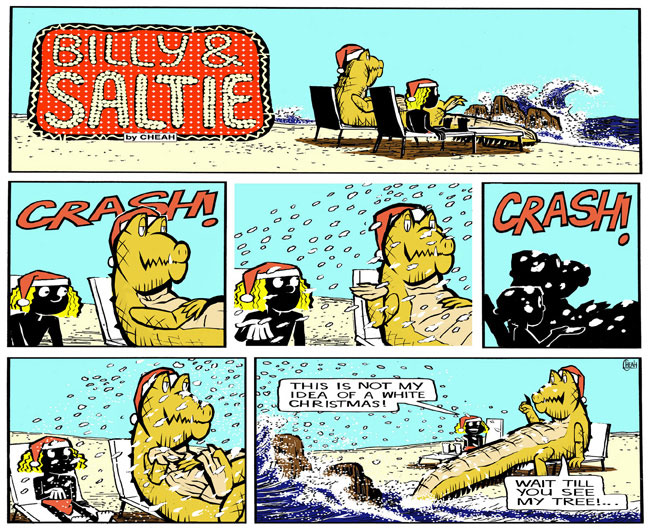
Billy & Saltie: A green-oriented cartoon strip

Produced by Cheah Sinann who lives and works in Singapore, Billy and Saltie explore life and wildlife in the land Down Under with a green twist.With a Gary Larsonesque touch, Cheah Sinann also educates about natural history and animal features.

Visit Cheah Sinann's homepage to find out more what Saltie does when he has to rely on a Komodo Dragon's bite for his next meal, and what Saltie's idea of a White Christmas in Australia is like and more.

More about Cheah Sinann.

Wildfacts updates: Goatfish, blue-eyed coral crab and more

Andy has fantastic video clips of our marine life on his sgbeachbum blog. I especially love this fabulous clip of a pair of anemone fishes frolicking in their anemone taken at Sisters Islands.
I finally got some time to embed his clips onto the appropriate wild fact sheets on wildsingapore, as he so kindly gave permission for me to do so. To see all the clips, it's easier to drop by Andy's blog.

I also finally got around to updating all the crab IDs that Crabhunter so kindly took the time to share on my flickr. From the comments, I've learnt that swimming crabs (Family Portunidate) are really tough to distinguish to species. Same goes for moon crabs (Family Matutidae).

But never mind! Even if we can't identify our marinelife precisely, we can still take photos of them, note down their behaviour and distribution and appreciate their beauty and amazing adaptations. I'm happy to have discussions about ID and to be proved wrong. That's how I learn!

Here's some of the new fact sheets I've just uploaded. As usual, any comments and corrections and additions are always most welcome!

What's a goatfish? Why such an odd name?

I don't really know but it could be something to do with the fact that these fishes have a pair of 'tentacles' (called barbels) under their chin. Which might remind some of goats, which have a beard under the chin.
Unidentified fish (Upeneus sp.?)
It's hard to see the barbels on the fishes we encounter on our shores as these are tucked away under the chin when not in use. The barbels are used to probe the sand and crevices for tasty titbits. These fishes come in a wide range of colours and patterns and I'm making a tentative id of it as the Freckled goatfish (Upeneus tragula).

I have often seen these hairy little crabs with blue eyes in branching hard corals. I thought they were just juvenile Hairy crabs (Family Pilumnidae) which are quite commonly seen on our reefs.
Tiny crab in acropora (Cymo andreossyi)?
But a closer look suggests these might be the threatened Hairy coral crab (Cymo andreossyi). It is listed as 'Vulnerable' in the latest Red List of our threatened animals. This crab is only found in Acropora and Pocillopora hard corals.

These little clams are also often seen in all kinds of branching hard corals.
Tiny clam in acropora
I'm not too sure what they are, but it is likely that they are some sort of scallop (Family Pectinidae) and possibly Pedum sp. I've just called them coral scallops.

If you have photos or video clips to share on the wild fact sheets, please do email me (hello@wildsingapore.com) with this information
(a) Your name
(b) URL of the location of your photo on your blog or flickr (please don't send me your photos)
(c) Location of your sighting
(d) Month and year of sighting
(e) Any observations of behaviour, etc.

Looking forward to having more of everyone's encounters on the wild fact sheets!

Earlier posts about previous updates on the wild fact sheets.

UPS not to ship live dolphins from the Solomons

UPS’s charter policy does not allow them to carry live animals from the wild to any aquarium or zoo. “They only realised this after the trip from the Solomons that the dolphins have been in the wild and were not been in any aquarium or zoo here.”

Airline says no more dolphin charters
Solomon Star 31 Dec 08;
AMERICA’S large cargo air transport service, United Parcel Service (UPS), has decided not to ship anymore live dolphins from the Solomon Islands in the future.

In a letter written by UPS to the Animal Welfare Institute obtained by Solomon Star; the airline’s CEO Scott Davis said they will to accept any more future charters to transport live dolphins.

UPS made the decision following pressure from animal welfare groups for the carrier to abide by its policy, which is not to transport wild and live animals.

The airline owned the cargo jet that transported seven live dolphins early this month from the Solomon Islands to the Philippines.

When contacted through email, Director of the Earth Islands Institute based in the United States Mark Berman said they have shown their disagreement with UPS, which the company respectfully adhered to.

“UPS is not shipping dolphins any longer due to our coalition showing that this type of trade must end,” Mr Berman said.

He said the international community would close markets if the Solomon Islands Government continues to allow live dolphin export.

“If your government refuses to end this disgusting trade, then we in the international community will close the markets for these dolphins,” he said.

He said he had also received green light from the SkyAirworld Chief Executive Officer on the issue.

“The CEO of SkyAirworld, David Charlton, personally told me when I was on his inaugural flight in March this year that he would not promote captive dolphin programmes at all. He would only promote true eco-tourism,” Mr Berman said.

SkyAirworld is set to redevelop the Anuha Island Resort in the new year.
Meanwhile, local environmental campaigner Lawrence Makili he also received confirmation that UPS has refuse to deal with any further charters for live animals here.

He said UPS’s charter policy does not allow them to carry live animals from the wild to any aquarium or zoo.

“They only realised this after the trip from the Solomons that the dolphins have been in the wild and were not been in any aquarium or zoo here,” Mr Makili said.

By EDNAL PALMER

More links

04 January 2009

Kampong Buangkok in the New York Times

"Urban Singapore Prepares to Gobble Up Its Last Village" the article headlines. When it is gone, one of the world’s most extreme national makeovers will be complete, it declares.
Photo by Jessdo from habitatnews flickr

Will Singapore school children then have to go to Johor to experience their natural heritage?

from Urban Singapore Prepares to Gobble Up Its Last Village
Seth Mydans, The New York Times 3 Jan 09;
Under the city’s master plan, at an unannounced date Kampong Buangkok will be “comprehensively developed to provide future housing, schools and other neighborhood facilities,” said Serene Tng of the Urban Redevelopment Authority in an e-mail message.

Ms. Sng, 55, is now the landowner, wheeling her bicycle among the metal-roofed, one-story homes of her tenants, who are also her friends and pay only nominal rents for their houses.

Fruits and flowers cluster in the village like endangered species in a vanishing ecosystem. There are tiny guavas and giant papayas, yams and tapioca plants, dill and edible bamboo shoots, bougainvillea and hibiscus. Snakes and lizards scurry through the undergrowth, and tiny fish swim in a tiny stream.

Through the trees in all directions, the people of Kampong Buangkok can glimpse the government housing blocks that represent their future.

In modern Singapore, few neighbors know each other, said Sarimah Cokol, 50, who grew up in Kampong Buangkok and now lives in one of the apartments that people here call pigeonholes. “Open door, close door,” she said in the terse speech of no-nonsense Singapore. “After work, go in. Close door.”


Other articles

Rush for land to sweep away last Singapore village
Melanie Lee, Reuters 21 Dec 07;
also in Business Times 22 Dec 07 as Singapore's last kampung
Built 60 years old ago on low-lying land, the kampong has weathered many floods. But the biggest danger it faces is not a natural disaster, but Singapore's voracious appetite for land.

In Singapore, history and heritage are often found at the receiving end of a wrecking ball. The space-starved island, about one third the size of Greater London, has one of the world's highest population densities. For decades it has reclaimed land from the sea and razed landmarks to make space for development.

"Given the need to optimize the use of land in land scarce Singapore, it may not be viable to retain the kampong in its current state," said a spokeswoman from the government redevelopment agency.

from Singapore's last kampung worth $33m but landowner won't sell
Bryna Sim Straits Times 5 Aug 07
Ms Sng Mui Hong is determined to sit tight on her sizeable piece of land in Punggol. 'My father bought this land, it has much sentimental value for me,' she said. 'I would feel trapped in a flat.'

The rent of the 20 families who live in the kampung's self-built zinc-roofed huts ranges from $6.50 to $30 a month. Their huts are an average of about 1,500 sq ft each, and range from three to five rooms, depending on how their dwellers chose to build them. They have basic utilities such as running water and electricity, and are surrounded by jackfruit and banana trees, as well as chilli padi and lime plants.

from Owner of $33m Kampung: My family ties are not for sale
Hedy Khoo New Paper 20 Aug 07
The 54-year-old feisty land owner has been in a foul mood since recent news reports suggested the land she co-owns in Lorong Buangkok is worth $33 million.

Said Ms Sng in Mandarin: 'Since the reports, all sorts of strangers have come to the kampung.' She wants one thing made clear: 'I am not rich, and I am not selling my land.'

She said: 'I take after my father in my philosophy of life. As long as I have enough to eat, I don't hunger after money or to be rich.'

'Even if the land is really worth much, and I can sell the land and move to a huge bungalow with a big backyard, I can never regain this feeling of simplicity and freedom, and be close to my childhood memories.'

But not all visitors are unwelcome. Ms Sng said: 'I love students who come to do projects or field trips, because they can learn so much about nature here.' And those interested to learn that family ties are not for sale may also want to drop by.


This New York Times article was also carried in the Jakarta Globe, 5 Jan 09.

More links

Will Singapore be embarrassed by marine aquarium deaths?

Three rare fishes have died at Ocean Park in half a year, causing embarrassment to Hong Kong.

The Chinese sturgeons are thought to have lived at the same time as dinosaurs and found only in China. The Ocean Park received five Chinese sturgeons from the Chinese mainland in June 2008 as a gift for the Olympic Equestrian events in Hong Kong. It was the first time the sturgeons has been sent outside the Chinese mainland.

"The survival rate for Chinese sturgeons in captivity is very low." said a fish specialist, "Ocean Park has never raised a Chinese sturgeon before, thus challenge and difficulty is expected for the park to nurse the fish properly."

Another rare Chinese sturgeon dies in Hong Kong's Ocean Park
Xinhua 3 Jan 09;
HONG KONG, Jan. 3 (Xinhua) -- The Hong Kong Ocean Park said here Saturday that another Chinese sturgeon died Friday, raising the death toll of the rare aquatic species in the park to three in half a year.

Tom Mehrmann, Chief Executive of the Ocean Park, told a press conference here Saturday that the Chinese sturgeon No. 1 had developed abnormal syndromes like the degradation of immunity and anorexia a few week ago. Mehrmann said the health condition of the Chinese sturgeon No. 1 suddenly deteriorated in the past two days and died Friday morning.

"We are sorry about another death of the Chinese sturgeon," Mehrmann said, "and we will have other seven alive Chinese sturgeons under our close monitoring."

He said five of the seven remaining Chinese sturgeons in the park were in good health but another two were in bad condition with similar anorexia syndromes. The theme park will shut down the sturgeon aquarium infinitely till further notice.

According to the anatomy results of the dead sturgeon No. 1, there were bruises in the fish head and extravasated blood inside, which might point to the park's salinating aquarium water for its death.

The Chinese sturgeons, which is thought to have lived at the same time as dinosaurs and found only in China, can live in both freshwater and saltwater, arrived in Hong Kong in freshwater in 2008 and have been undergoing a gradual transition to saltwater at Ocean Park.

Preliminary investigation showed improperly induced salination could have harmed the health of the fish and made them more susceptible to infection.

Wei Qiwei, a fellow researcher from the Yangtze River Fisheries Research Institute of the Chinese Academy of Fisheries Science, said at the joint press conference with the Ocean Park that more research was needed on keeping the species in different environments.

"The surviving rate for Chinese sturgeons in captivity is very low," Wei said, "thus it is hard for protecting the species."

"As the Ocean Park has never raised a Chinese sturgeon before," Wei said, "challenge and difficulty is expected for the park to nurse the fish properly. And the aquatic experts in the Chinese mainland will further cooperate with the park on further study and protection of the fish."

The latest death of the rare Chinese fish was the third of the rare Chinese sturgeon lost by the theme park in six months, after one was killed by a bite from a barracuda in June 2008 and another died of infection similar to the sturgeon No. 1 last month.

The Ocean Park received five Chinese sturgeons from the Chinese mainland in June 2008 as a gift for the Olympic Equestrian events in Hong Kong. It was the first time the sturgeons has been sent outside the Chinese mainland.

Hong Kong embarrassed by death of second rare fish from China
EarthTimes 12 Dec 08;
Hong Kong - Hong Kong was embarrassed Friday by the death of a second rare Chinese sturgeon months after it was presented to the city's Ocean Park theme park by the Beijing government. The death of the endangered fish from a bacterial infection follows the loss of another sturgeon in June which was savaged to death by a barracuda sharing the same tank.

The incident in June came only days after Hong Kong was given the 1.1-metre-long fish, along with two other sturgeon, by China, representing one of the five mascots of the 2008 Beijing Olympics.

It developed into a minor but acutely embarrassing diplomatic incident for the government of the former British colony, whose officials are all appointed by China and kow-tow to Beijing.

Hong Kong's leader Donald Tsang made a grovelling public apology for the three year-old sturgeon's death while Chinese officials were drafted in to advise Ocean Park on how to care for the other fish.

China eventually gave five more sturgeon to Ocean Park the following month to replace the dead fish. One of the eight surviving fish was Friday confirmed to have died, this time from a bacterial infection.

Ocean Park chairman Alan Zeman told a news conference that the fish fell sick last week and was given antibiotics but succumbed to its illness.

A thorough investigation was being carried out into the causes of the sturgeon's death while measures were being taken to protect the remaining seven fish from infection, he said.

Hong Kong reverted to Chinese rule in 1997 after 156 years as a British colony. The city of 6.9 million hosted the equestrian events of the Beijing Olympics.


More about the Chinese sturgeon on the National Geographic website.

Malaysian fishermen who caught whale shark may be fined

Deep-sea fishermen should immediately release endangered or protected marine wildlife that got entangled in their nets.

The whale shark that was towed back by a Malaysian fisherman and died was buried yesterday – minus its fins and part of its tail which would be sent to the Turtle and Marine Ecosystem Centre (Tumec) in Terengganu for research. “In about one month, we will take out the whale shark’s bones and send them to Tumec where they will be put on exhibition.”

Fishermen who caught whale shark may be fined
The Star 4 Jan 09;
GEORGE TOWN: The four fishermen who caught a juvenile whale shark by accident on New Year’s Day may be fined – the fish is an endangered and protected species.

Penang Fisheries Department director Mohd Najib Ramli said statements had taken from the four and forwarded to the department’s legal unit in Putrajaya for further action.

“It is up to the unit. They may be compounded for catching the fish,” he said.

Mohd Najib said deep-sea fishermen should immediately release endangered or protected marine wildlife that got entangled in their nets.

He said fishermen should be alert and ready to act quickly to release such wildlife.

“They should not leave it in the net.

“If the fish or animal had died while in the net, the Fisheries Department must be notified,” he said in an interview.

On Friday, the shark was caught in fishermen’s trawl nets 10 nautical miles off Teluk Ba- hang.

The 7m-long fish got entangled in the nets at 3am. The four fishermen later returned to shore in Teluk Bahang, with the fish, at 5.30am.

The two-tonne whale shark was surrendered to the state Fisheries Department and hauled to the tuna landing port in Batu Maung by fishing boats on Friday evening.

It was transported to the Fisheries Research Institute (FRI), where it was buried at 3.20pm yesterday – minus its fins and part of its tail.

Najib said the parts cut off would be sent to the Turtle and Marine Ecosystem Centre (Tumec) in Terengganu for research.

“In about one month, we will take out the whale shark’s bones and send them to Tumec where they will be put on exhibition,” he said.

The whale shark (Rhincodon typus) is a filter-feeding shark known for its playful character.

It is the largest living fish that poses no harm to humans.


Four whale shark fishermen could escape with warning
The Star 6 Jan 09;
GEORGE TOWN: The four fishermen who caught a juvenile whale shark by accident on Jan 1 might only be given a warning if their claims that they had no intention of catching the endangered fish are true.

Penang Fisheries Department director Mohd Najib Ramli said the department’s legal adviser would investigate the fishermen’s claims before determining the next course of action.

“It would normally take about three days for the compound directive from the headquarters but not in this case as this is a bit more complicated.

“We must make sure the whale shark was not caught intentionally,” he said in a telephone interview yesterday.

Citing an example of a similar case a few months ago, Mohd Najib said the fishermen were let off with a warning after the legal officer found that the catch had been unintentional.

Mohd Najib also said fines imposed by the department varied but would not exceed a maximum of RM30,000.

Fisherman Keh Chai Yang, when contacted, said it would be unfair to them if they are fined because they were not aware that the whale shark had become entangled in the net.

“It was only when we tried to pull up the net that we saw the fish but it was already dead. If we were to leave it in the sea, the carcass would surely pollute the water.”

Keh said they were already bearing the cost of repair for the net which was damaged when pulling the two-tonne whale shark up to the shore.

“Some of our fishing equipment was also damaged,” he said, adding that he hoped the authorities would be fair to them.

The 7m-long fish was caught in the fishermen’s net about 10 nautical miles off the Teluk Bahang coast.

03 January 2009

Return to Sungei Buloh

Sungei Buloh is the reason why I'm involved in the shores.I first started nature guiding at Sungei Buloh and I used to spend every weekend there.

Guiding and/or exploring. I made many friends at Buloh and learnt a lot from them. I started my first online journal based on these trips. This was before free blogging services and before digital cameras! It was real struggle printing, scanning photos and putting everything up manually as a webpage. Looking back, I really appreciate how easy it is to do field trip journals nowadays!

It was while I was at Sungei Buloh that I was introduced to Chek Jawa before deferment of reclamation. Since then, I started working intensively on our shores and spent less and less time at Buloh. It's been years since I actually strolled through my favourite mangroves.How nice to bump into Brandon when I arrived. He showed me the Mangrove pit viper (Trimeresurus purpureomaculatus) that had been hanging around near the Main Bridge for the last five days! It sure looks like it had eaten something very large and was slowly digesting it.

Brandon has been photographing since he was 10! He has a blog with links to fabulous shots on his flickr photos! Do check it out.There were Egrets in the trees at the stream and we heard all kinds of other birds. Huge and fat halfbeaks and archer fishes swam under the bridge as the tide streamed in. It was just like the good old days! Alas, no otters.

I was at Buloh today for a gathering of Buloh volunteers to discuss the Sungei Buloh Masterplan.There was an exhibition of the Plan at the Visitor Centre with lots of exciting details about how this special Nature Reserve will be enhanced and expanded. Here's a recent post about the Master Plan with more media reports about it on the wildsingapore news blog.

Before the meeting started, I thought I'd take a quick stroll through the Mangrove Boardwalk.
I was stopped in my tracks by this very lazy Malayan water monitor (Varanus salvator) that had sprawled right across the boardwalk.It barely moved as I snuck around it, merely lifting its head to glare at me. It too looks like it had a good meal recently.The boardwalks are still very popular with families, even with small babies. These two ladies were trying not to jostle the sleeping infant in the pram as they trundled down the boardwalk.The boardwalk was a lot shadier as all the trees that I remembered had grown much taller. But the familiar guiding stops were still there. Like this Torch ginger with its pink infloresence. What's new are these posts with little electronic things which are part of the Wireless Learning Trail @ Sungei Buloh. Wah, impressive!As in the good old days, there were huge webs of Tent spiders everywhere. Tent Spiders build three-dimensional webs which work differently from flat orb webs. The Red Tent Spider (Cyrtophora unicolor) builds a huge web usually with one or two curled up dried leaves in the centre. This suggests that the spider is a poor housekeeper. But this is far from the truth. The spider has carefully chosen and placed the leaf there and ingeniously hides inside. If you find a web that is built above eye level, you can easily spot this beautiful large red spider by looking up into the underside of the curled up leaf.
Sungei Buloh is one of the few places in Singapore where you can easily view the unique ecosystem of created by Mudlobsters (Thalassina sp.). The mounds of mud chucked up by these burrowing crustaceans provide shelter and food for a variety of animals, many of which are found nowhere else.
The Mangrove Boardwalk is a great, easy introduction to mangroves. You can walk right up to take a closer look at interesting plants such as these tall Nipah palms (Nypa fruticans).
And peer closely at pretty mangrove flowers such as the red ones of Tumu (Bruguiera gymnorrhiza) (left photo) and the white ones of Bakau putih (Bruguiera cylindrica).The Rhizophora tree that I remember and love has grown a lot taller. But its leaves are still full of these neat circular holes. To this day I still don't know what makes these neat hole-punched cutouts.Even at high tide like today, you can get up close to admire the special tree formations of mangrove roots. These roots not only keep the tree upright in soft unstable mud, and help it breathe, but also provide lots of places for small animals to cling to in the rising waters.Mudskippers (Family Gobiidae) of all shapes and sizes are commonly seen here. Tree climbing crabs (Episesarma sp.) crowd around the mangrove tree trunks to stay out of the rising waters where large predators might lurk, looking for a crabby snack.Some trees can have a lot of crabs! It can be hard to photograph the crabs as they often scuttle to the other side of the tree as soon as they detect you.
Alas, some familiar trees are no longer there, and this one has just fallen over. Mangroves are dynamic ecosystems that face the pressures of tidal movement, soft ground and of course old age. Change is a natural part of mangroves and other wild places.The diligent Sungei Buloh Wetland Reserve officers do give Mother Nature a hand. I could see replanting going on with some young trees, still attached to posts.Rare mangroves orchids were also tied in place on various trees.

After the meeting on the Master Plan, James brought us to take a look at some of the rare and special trees that are being nurtured and planted at Sungei Buloh. In particular, Dr Chua Ee Kiam (who is in the midst of writing a book about Sungei Buloh) wanted to see the Bruguiera haineseii.This tree is considered very rare indeed, and there were two small ones growing in the back mangroves.There was also a Barringtonia racemosa tree which is flowering! Its pink fluffy blossoms emerge in a long drooping stem. They bloom at night, so we only saw the remains of last night's flowering. The fruits are tear drop shaped (top left photo). This rare tree is also planted at Chek Jawa and there, I did once see the beautiful flowers.At the entrance to the Visitor Centre, Dr Chua points out the rare Mangrove trumpet tree (Dolichandrone spathacea). It has beautiful white trumpet shaped flowers (none today) which develop into long bean-like fruits, that split open to reveal small flat white seeds.And right in the middle of the pond at the Visitor Centre is a small Berembang (Sonneratia caseolaris) which is extremely rare in Singapore. Its flowers are like the more common Sonneratia alba but with a bright pink tinge! On the way out, what a treat to bump into Mr Tay who planted many of these rare trees at the Reserve. It was so nice to meet other old friends at Buloh too.

Sungei Buloh has always been a special place to me, and it has become even more precious with these rare plants now thriving in the Reserve. With a healthy mangrove, Buloh is also home to many other special animals both on land, in the sea and in the air.

The Master Plan is indeed exciting and provides hope that future generations can continue to enjoy and be inspired by this natural and national treasure.

"No clear rise in sea level in Singapore in last 12 years"

"Our data, based on a measurement of maximum tide levels, show no clear rise in sea level in Singapore over the last 12 years", said Associate Professor Ho Juay Choy, principle fellow at the Energy Studies Institute (ESI) at the National University of Singapore (NUS).
Super high tide at Chek Jawa boardwalk in Oct 08

Previous reports say that a metre-high rise in sea level is enough for several areas around the island to be submerged. 'The increased probability of flooding and coastal erosion as well as saltwater intrusion into fresh water reservoirs are some of the possible consequences,' said Associate Professor Matthias Roth of the department of geography at NUS.

While Singapore may not be drowning yet, it is getting hotter here and at a faster rate over the last two decades.

Last year's average temperature of 27.5 deg C, was 0.6 deg C higher than the average temperature over the last 50 years of 26.9 deg C, said the National Environment Agency (NEA).

From 1951 to 1979, average temperature levels were below this long-term average. But since 1983, they have been on the rise, hovering between 0.1 deg C and 0.6 deg C above the long-term mean.

The NEA said it was difficult to determine how much of the upward trend was due to global warming and how much to Singapore's rapid development and urbanisation over the past 30 years.

'But the trend is consistent with rising global temperature levels,' a spokesman added.

These findings will be part of a country report for Singapore on the Regional Review of the Economics of Climate Change for South-east Asia. The report is being prepared for the Asian Development Bank (ADB).

Singapore's carbon intensity - which measures the ratio of carbon emissions to economic activity - has improved from 0.28 kt/$m (kilotonnes/million GDP) in 1990 to 0.20 kt/$m in 2006.

'This is a direct result of Singapore's efforts to switch from fuel oil to natural gas for power generation and initiatives aimed at improving energy efficiency in various sectors of the economy,' said Prof Ho.

According to the International Energy Agency (IEA), Singapore's carbon intensity levels are below the world average.

From Singapore is hotter than before Amresh Gunasingham, Straits Times 3 Jan 09;

More links

LinkWithin

Related Posts with Thumbnails