Showing posts with label fun. Show all posts

02 April 2010

The Lion Finch: baby biter goes extinct

Once found throughout much of sub-Saharan Africa, the last two individuals of this charismatic species of bird were last seen in September 2009, in a Frangipani tree in Mrs Okeke’s back garden on the edge of Lake Naivasha, Kenya.
The Lion Finch, Leo fringilla, is listed as ‘Extinct in the Wild’ on the IUCN Red List of Threatened Species.

Once an extremely valuable commodity in the pet trade, the Lion Finch faced severe persecution following the discovery that its fiery temperament led to the loss of numerous infant extremeties.

29 July 2009

Your help needed for question on durians on Pulau Ubin

I'm not a big fan of durians. Actually, I can't stand them. So I'm totally clueless about durian seasons and such. However, I just received a really delightful email from a durian-would-be-fan from Tokyo who asks if durians and mangosteens will be in season at Pulau Ubin in December. (I know they are usually fruiting at the same time, but will they in December?)

Would any of you know? Please leave a comment. (Sorry the comments are moderated, I'll clear them as fast as I can).

Thank you!
Photo from judelittle.com


Here's the email from Tokyo...

10 July 2009

TGIF: A furry encounter

It's Friday and there's something hidden in Adelle's bag! We noticed after the talk by Dr Patrick Grootaert.
A peek under the newspaper! It's furry and lively!

23 June 2009

Bat in my belfry

I was packing for tomorrow's morning trip, when I got hit on the head by a nut!
I looked up and there was this little fellow.

03 March 2009

What manner of beast is the merlion?

Half fish half lion, what is the merlion? I wondered, after the attention it got since it was struck by lightning.
The beast, it appears, is a figment of imagination. But rather suitable that it is half a fish. Singapore is an island surrounded by living shores and depends on the sea. Alas, despite this reminder, many Singaporeans don't know much about our shores and the sea.

Here's what I found out about the mysterious merlion.

The merlion was designed as a logo for the Singapore Tourism Board (STB) in 1964. So it's about 40 years old. Its designer was also the curator of Van Kleef Aquarium, so that might explain the fishy bit. The formal story is that the tail represents Singapore’s humble beginnings as a fishing village.

The merlion statue that got hit by lightning was built by a Singapore craftsman and all his eight children. It was completed in 1972. Measuring nearly 9m tall and weighing 70 tonnes, it was originally located on Elizabeth Walk on the river-bank, at the mouth of the Singapore River.

Did you know the merlion had a cub?

A second and smaller merlion statue, measuring 2m tall and weighing 3 tonnes was also built by the same craftman. Apparently, its eyes were made of small red teacups! It is referred to as the 'cub' in the official stories.

The merlion and cub were relocated to their current location in 2002, with the merlion facing East (apparently auspicious) and the sea, and the cub behind it.

There are three other merlions officially recognised by STB. The hideous huge one on Sentosa (which gives me nightmares) and two smaller ones, one on Mount Faber and another at STB's office. But only the two at Fullerton spout water.

Alas, there are no descriptions of the beasts' biology. How do they reproduce? What do they eat? What are their predators? Is the Sentosa one a different subspecies? One comment on this blog suggests the merlion might not be doing well since the Marina Bay has been turned to freshwater. Does it need seawater? A marine creature and not brackish or fresh?

You can't anyhow use the merlion logo as it's trademarked. Among the rules on its use, the merlion has to "be used in good taste".

Although most Singaporeans pooh pooh the icon, apparently more than one million visitors a year trek to the Merlion Park just to take photos of the beast.

In fact, a would-be visitor left a comment on this blog to ask whether the merlion will be alright for an upcoming trip.

More links
  • The Merlion on Uniquely Singapore, history and origins, location and frequently asked questions (wow!)
  • The Merlion Statue on the National Library's infopedia
  • Merlion on wikipedia with lots of info including its appearance in overseas restaurants, in films, video games and more.
  • Rejoice! The Merlion has been smote! A Facebook group for anyone who's never been fond of the half-fish half-lion; who've been personally affronted that we seem to have nothing else to offer than a half-baked story about a fish-mammal hybrid and who've had to cringe when telling the story to their tourist friends. Let's cleanse our souls and not perpetuate a lie into eternity.


And here's what the soothsayers say of the lightning strike ...

Strike while the Merlion is hot?
Pessimists say incident a bad omen, optimists say worst is over
Liew Hanqing, The New Paper 4 Mar 09;
WITH exports down, jobs disappearing and the economy in the doldrums, we need more bad news like we need a hole in the head.

So what does Mother Nature do? It zaps the Merlion, leaving Singapore's iconic symbol with, well, a hole in the head.Coincidence? Bad omen? Mother Nature's sick sense of humour?

Why zap the Merlion? Why the head, of all places? Why now?

As can be expected of superstitious Singaporeans, chatrooms have been abuzz about the significance of Saturday's incident.

The doomsayers are convinced that the hit - which took a chunk off the Merlion's crown - is a bad omen.

As in three strikes and you're out!

The Toto optimists see it as a sign that the worst is over for Singaporeans, speculating that the Merlion could have - heroically - sucked the 'suay' (bad luck) out of our way forward.

Who you gonna believe? Who you gonna call?

We called the fengshui experts - and were left as dumbstruck (pardon the pun) as our precious Merlion.

The geomancy experts, too, were divided.

Geomancer John Lok, who runs Fengshui0011.com, said the event could have positive implications.

'As the Merlion was hit by light on its head, it could signify that Singaporeans will be able to see more clearly, as this is a wake-up call to all Singaporeans.

'This year - the (Chinese) zodiac Year of the Ox - has a sign which represents 'ugly' or 'clown'. As a result, there will be some superficial events occurring, such as the lightning strike on the Merlion.'

Not that bad

Another geomancer, Master Lim Koon Hian of San Yen Geomancy Centre, agreed. He said the event signified that Singaporeans would experience a wake-up call, and a greater understanding of events around them.

Fengshui master Gwee Kim Woon, who runs Fulu Geomancy Centre, told Lianhe Wanbao that the lightning strike had only damaged a small portion of the Merlion's head, and not the entire head.

'This could mean that it has averted a more serious disaster,' he said.

He added that, judging from the Merlion's position, it is possible that the lightning strike could bring about a release of good fortune in Singapore.

He explained that the lightning strike could be interpreted as the 'ignition' of wealth and luck for Singapore.

Others were less optimistic.

Fengshui master Lee Yuhon said the event marked the arrival of 'negative forces' from the south of Singapore.

He added that it was caused by negative forces which had accumulated in the area.

'The lightning strike could mean that something bad may happen in the southern part of Singapore.'

Master David Tong of CMG Consulting, too, felt it was 'not a good omen'.

'The Merlion is an icon of Singapore, and an icon getting struck by lightning is not a good thing.

'In Chinese metaphysics, we learn that everything happens for a reason. It could be that the recession we are already in could get worse.'

From a tourist-revenue standpoint, he may have a point. After all, what's a visit to Singapore without taking in the sight of a part-lion part-fish puking continuously into mouth of the Singapore River?

So contractors are doing brain surgery, trying to replace the scalp of the 36-year-old statue.

Temporary barricades have been erected around the statue for safety reasons - not necessarily in case lightning strikes twice.

The Singapore Tourism Board said it is waiting for a full assessment from contractors before deciding when to allow the public access to the statue, and whether to erect a lightning conductor to prevent a repeat incident.

Meanwhile, the verdict remains a toss of a coin - lion's head, fish's tail - a stroke that will leave the economy paralysed, or a stroke of good fortune, as in tio beh pio (strike it rich!).

15 February 2009

Wild Release: Octopus returned to the wild for love

Sid the Escape Artist Octopus was released to look for love in the wild. After several escape attempts worthy of Houdini, he finally tasted freedom, with his keepers returning him to the ocean just in time for Valentine's Day.Mating octopusesHere's a pair of our very own wild octopuses Doin' It. The male (who is pale) extends his special tentacle to insert his sperm packet into the female. More about octopuses on the wild fact sheets. Ivan has just done a fabulous blog post about wild animals doing the wild thing.

Here's more about Sid and other amazing octopus tricks.

Legging it: Evasive octopus who has been allowed to look for love
Kathy Marks, The Independent 14 Feb 09;
Visitors to the Portobello Aquarium loved Sid the octopus but all Sid wanted was to find a mate. After several escape attempts worthy of Houdini, he finally tasted freedom yesterday, with his keepers returning him to the ocean just in time for Valentine's Day.

The aquarium, near Dunedin, on New Zealand's South Island, was Sid's home for the past six months. At first, he seemed quite content there. He would move around his tank, exploring his new environment, and would change colour, as octopuses do. But, shortly after Christmas, he developed itchy feet – or tentacles.

Matthew Crane, Portobello's senior aquarist, came in one morning to find Sid gone. Staff looked high and low. One of his tank's sliding plastic doors was ajar but it was not clear whether someone had left it open by mistake, or whether he had opened it himself. Five days later, he was found inside a drainage system that pumps sea water through the aquarium. He was trying to sidle out through a door.

A few weeks later, Sid made a second dash for freedom. Again, his door was found ajar. Located a few hours later, he made several more escape attempts, usually when his tank was being cleaned. Staff would see one tentacle emerge from the tank, then another. "We thought he must be actively seeking a mate," said Mr Crane. "So we decided it might be best to let him go back to nature."

Yesterday afternoon, Mr Crane transferred Sid to a plastic bucket and carried him to the water's edge, 300 yards away. Even during that short walk, Sid was trying to lift the lid off the bucket. Then he was ceremoniously dumped in the ocean. "We watched him swim away," said Mr Crane. "He was a good healthy colour and he looked quite happy."

Octopuses live for about two years, and breed towards the end of their life cycle. So Sid, who was about nine months old when caught, would be of an age now to be looking for love. Mr Crane wishes him every success. "He's a common octopus, so we're pretty confident he'll find a mate. It's a species that's often seen in the harbour."

Mr Crane said that Sid might have watched the door to his tank being opened often enough to figure out how to do it himself. Or, after it was left ajar the first time, he might have realised it was a means of escape. "An octopus is quite intelligent, so it's not beyond the scope of believability," Mr Crane said. "Some people compare them with dogs, because you can train them to open a jar, for instance, particularly if it's got a crab in it."

A few years ago, he said, crayfish kept disappearing from the aquarium. Staff were perplexed, and blamed impecunious marine biology students. Then, one night, one of Sid's predecessors was caught in the act. He climbed out of his tank, stole the crayfish, replaced the lid on the crayfish tank, then returned to his own tank, shutting the door behind him.

A research laboratory reported a similar story, with a security camera filming an octopus stealing fish from a neighbouring tank and then covering his tracks. Ten years ago, an octopus escaped from the same tank that housed Sid, and was found halfway up a staircase. He was nicknamed Harry, after Harry Houdini. Octopus, like squid, have courtship rituals, which include changing colour. Mr Crane said he had seen squid "split themselves in half, colour-wise, with one half an attractive light colour to appeal to a mate and the other half an aggressive dark red colour to chase away other males".

The aquarium has put out fresh pots to catch a replacement for its wandering would-be Lothario.

The clever clogs of the ocean floor

*Octopuses are considered to be one of the most intelligent marine species. Their brain is the largest and most advanced of any invertebrate.

*Until recently, it was widely believed that they had eight arms. However, last year a European study discovered that they actually have six arms and two legs. They use their rearmost tentacles to push off from the surface of the sea bed before propelling themselves through the water with the other limbs.

*During the same experiment, it was discovered that the animals could perform complex tasks with their arms, such as manipulating a Rubik's cube. Uniquely, octopuses have more than half their nerves in their arms and even partially think with them.

*It is believed that an octopus's memory and learning capabilitycan be compared in complexity to that of advanced vertebrates – a number of octopuses have been taught to unscrew jars or bottles to get at food.

13 January 2009

Fahrenheit versus Celsius

Mr Fahrenheit and Mr Celsius and how they came up with the different scales to measure temperature. A fascinating bit of trivia.

Weather Eye: the story of how the temperature was measured
Paul Simons, The Times Online 12 Jan 09;
Three hundred years ago Daniel Gabriel Fahrenheit made his first thermometer in his home town of Danzig (now Gdansk in Poland). The thermometer was filled with alcohol and completely sealed, but it was not much use without some sort of scale to measure the temperature.

One story goes that, during the winter of 1708-09, Fahrenheit took a measurement of 0 degrees as the coldest temperature outdoors — which would now read as minus 17.8C. Five years later he used mercury instead of alcohol for his thermometers, and made a top reference point by measuring his own body temperature as 90 degrees. Soon afterwards he became a glassblower, which allowed him to make thinly blown glass tubes that could be marked up with more points on the scale and so increase accuracy.

Eventually he took the lowest point of his temperature scale from a reading made in ice, water and salt, and a top point made from the boiling point of water. The scale was recalibrated using 180 degrees between these two points and Fahrenheit was able to make much more accurate and more consistent measurements of temperature.

But in 1742 a rival challenged the Fahrenheit scale and eventually superseded it. Anders Celsius, in Sweden, invented a scale of 100 degrees between the freezing and boiling points of water and gradually won over many countries. However, the British remained wedded to Fahrenheit until well into the 20th century.

08 January 2009

The cutest cephalopod: always smiling

The Piglet squid just has to make your day! Especially with a permanently etched smiley under those adorably googly eyes and untidy tangle of leeeetle arms.
from The Telegraph (full article below).

A deep sea squid, we're not likely to come across this cutey on our intertidal trips. But here's more photos of the huggable ceph from my little trawl through the internet.

From the Tree of Life website article by Richard E. Young and Katharina M. Mangold (1922-2003)

Piglet squid is always smiling
An unusual pattern of skin pigmentation means that this piglet squid always has a smile on his face
The Telegraph 7 Jan 09;
The animal, named because of its tuft of bristle-like arms and tentacles and rotund shape, is normally found more than 320 feet (100m) below the surface of the ocean.

Because of its deep water habit, little is known of the behaviour of the squid, although not surprisingly, judging by its body shape, it is known to be a sluggish swimmer.

The squids' bodies are almost completely clear except for some pigment-containing cells, or chromatophores, which give this specimen its distinctive appearance.

Properly called Helicocranchia pfefferi, the animals are also noted for the light producing organs known as photophores located beneath each of their large eyes.

This specimen, about the size of an orange, was collected by the Cabrillo Marine Aquarium where director Mike Schaat managed to capture it on film.

05 January 2009

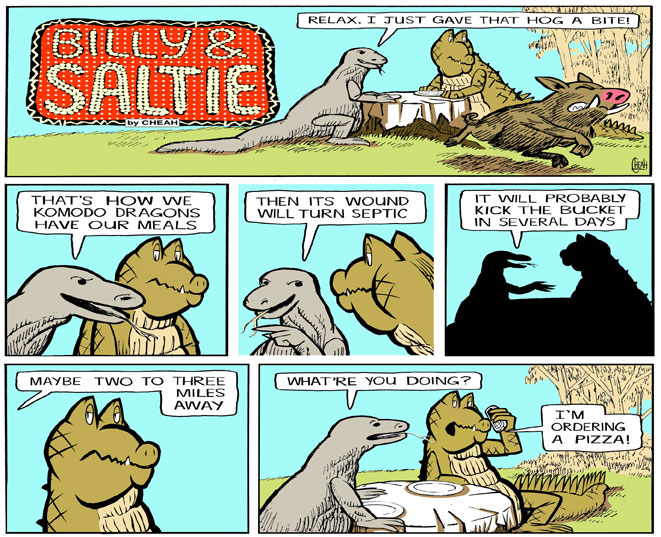
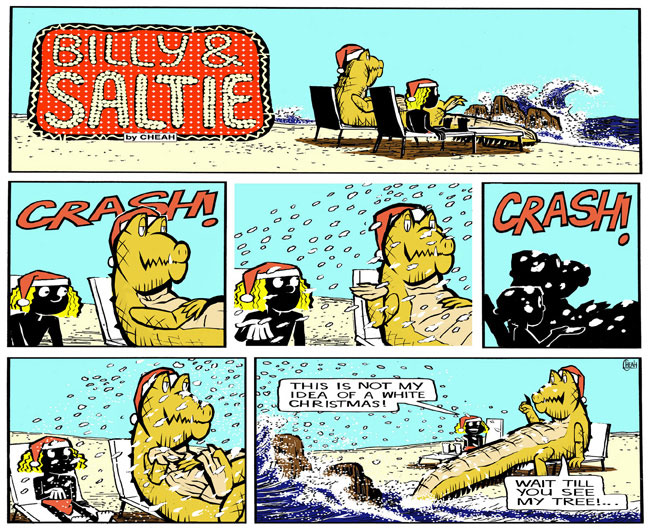
Billy & Saltie: A green-oriented cartoon strip

Produced by Cheah Sinann who lives and works in Singapore, Billy and Saltie explore life and wildlife in the land Down Under with a green twist.With a Gary Larsonesque touch, Cheah Sinann also educates about natural history and animal features.

Visit Cheah Sinann's homepage to find out more what Saltie does when he has to rely on a Komodo Dragon's bite for his next meal, and what Saltie's idea of a White Christmas in Australia is like and more.

More about Cheah Sinann.

09 October 2008

October Octopusday: Celebrating Cephalopods

My favourite animal group has its special day! (albeit unofficial). Thanks to the heads up from Rick MacPherson, with links to Jason Robertshaw's awesome Cephalopodcast blog with lots of details of how you can celebrate the day.

And Singaporeans will be pleased to know that among the Top 10 Things You Can Do on Cephalopod Appreciation Day is to Taste a Cephalopod. Can Eat! Although attempting to eat one alive can be tricky...
Burrowing snake-eel (Pisodonophis crancrivorous)

My favourite Top 10 is "Engage in Proper Cephalopod Pluralization": we say "one octopus", so do we say "two octopuses, octopi or octopodes"? And no, it's definitely NOT octopussies.

There's also lots of links to more info about cephalopods. And Jason also welcomes submissions of blog posts about cephalopods to celebrate the day. Visit cephalopodcast for all the details.

In Singapore, more info about our cephalopods in the Singapore Celebrates our Reefs blog
Happy Cephalopod Day!
An octopus in his garden

03 October 2008

The Ig Nobels: Coke, strippers and the inevitable tangled mess of strings

Is Coke an effective spermicide? How does fertility of exotic dancers affect their earnings? And the intriguing mathematical proof that hair, string, or anything else of the kind, will inevitably become tangled in knots -- a process termed "spontaneous knotting of an agitated string."

The Ig Nobel is a spoof on the more serious Nobel Prize. Science humor magazine Annals of Improbable Research organises the event (which has been going on for 18 years) in the hope that it will "make people laugh, and then make them think."

I particularly like that during the event, they had an eight-year-old girl tasked with stopping boring speeches. Excellent!

Strippers, armadillos inspire Ig Nobel winners
Mark Pratt, Associated Press Yahoo News 3 Oct 08;
Deborah Anderson had heard the urban legends about the contraceptive effectiveness of Coca-Cola products for years. So she and her colleagues decided to put the soft drink to the test. In the lab, that is.

For discovering that, yes indeed, Coke was a spermicide, Anderson and her team are among this year's winners of the Ig Nobel prize, the annual award given by the Annals of Improbable Research magazine to oddball but often surprisingly practical scientific achievements.

The ceremony at Harvard University, in which actual Nobel laureates bestow the awards, also honored a British psychologist who found foods that sound better taste better; a group of researchers who discovered exotic dancers make more money when they are at peak fertility; and a pair of Brazilian archaeologists who determined armadillos can change the course of history.

Anderson, a professor of obstetrics and gynecology at Boston University's School of Medicine, and her colleagues found that not only was Coca-Cola a spermicide, but that Diet Coke for some reason worked best. Their study appeared in the New England Journal of Medicine in 1985.

"We're thrilled to win an Ig Nobel, because the study was somewhat of a parody in the first place," Anderson said, adding she does not recommend using Coke for birth control purposes.

A group of Taiwanese doctors were honored for a similar study that found Coca-Cola and other soft drinks were not effective contraceptives. Anderson said the studies used different methodology.

A Coca-Cola spokeswoman refused comment on the Ig Nobel awards.

Duke University behavioral economist Dan Ariely won an Ig Nobel for his study that found more expensive fake medicines work better than cheaper fake medicines.

"When you expect something to happen, your brain makes it happen," Ariely said.

Ariely spent three years in a hospital after suffering third-degree burns over 70 percent of his body. He noticed some burn patients who woke in the night in extreme pain often went right back to sleep after being given a shot. A nurse confided to him the injections were often just saline solution.

He says his work has implications for the way drugs are marketed. People often think generic medicine is inferior. But gussy it up a bit, change the name, make it appear more expensive, and maybe it will work better, he said.

Charles Spence's award-winning work also has to do with the way the mind functions. Spence, a professor of experimental psychology at Oxford University in England, found that potato chips — "crisps" to the British — that sound crunchier taste better.

His findings have already been put to work at the world-famous Fat Duck Restaurant in England, where diners who purchase one seafood dish also get an iPod that plays ocean sounds as they eat.

Geoffrey Miller's work could affect the earning potential of exotic dancers everywhere.

Miller, an associate professor of psychology at the University of New Mexico, and his colleagues knew of prior studies that found women are more attractive to men when at peak fertility. So they took the work one step further — by studying earnings of exotic dancers.

In the 18 subjects Miller studied, average earnings were $250 for a five-hour shift. That jumped to $350 to $400 per five-hour shift when the women were their most fertile, he said.

"I have heard, anecdotally, that some lap dancers have scheduled shifts based on this research," he said.

Armadillos helped win an Ig Nobel for Astolfo Gomes de Mello Araujo, a professor of archaeology at the Universidade De Sao Paulo in Brazil, and a colleague earned.

Pesky armadillos, they found, can move artifacts in archaeological dig sites up, down and even laterally by several meters as they dig. Armadillos are burrowing mammals and prolific diggers. Their abodes can range from emergency burrows 20 inches deep, to more permanent homes reaching 20 feet deep, with networks of tunnels and multiple entrances, according to the Humane Society of the United States' Web site.

Araujo was thrilled to win. "There is no Nobel Prize for archaeology, so an Ig Nobel is a good thing," he said in an e-mail.

Dog fleas, string star in wacky science prizes
Yahoo News 3 Oct 08;
Scientists who unlocked the inner secrets of dog fleas, crisps and tangled string swept the tongue-in-cheek annual Ig Nobel Prizes on Thursday.

The awards, a light-hearted alternative to Scandinavia's Nobel Prizes for otherwise serious researchers, were presented at Harvard University in Massachussetts.

More than 1,000 people, including seven of the 10 laureates, attended a ceremony that in irreverent spirit also featured sword-swallowing, paper airplanes, and an eight-year-old girl tasked with stopping boring speeches.

Three French scientists from the Ecole National Veterinaire de Toulouse took the biology prize for establishing that fleas living on dogs jump further than those resident on cats -- 20 centimeters further, on average.

Potentially more controversial was the work of an Italian-British duo who won the nutrition prize for their study "Auditory Cues in Modulating the Perceived Crispness and Staleness of Potato Chips."

The ground-breaking study first published in the Journal of Sensory Studies involved "electronically modifying the sound of a potato chip to make the person chewing the chip believe it to be crisper and fresher than it really is," Ig Nobel organizers said.

The Ig event, produced by science humor magazine Annals of Improbable Research, honors the hair-brained efforts of a brainy profession in hope it can "make people laugh, and then make them think."

Winning an Ig is perhaps not every scientist's burning ambition. Winners even have to pay their own way to Harvard to accept the honor.

But after 18 years the event remains a hit among those who believe science needs a more popular image.

This year's physics Ig Nobel fell to US academics providing mathematical proof that hair, string, or anything else of the kind, will inevitably become tangled in knots -- a process termed "spontaneous knotting of an agitated string."

There was even more agitation over the chemistry prize, awarded jointly to rival teams -- one from the United States which determined Coca-Cola to be an effective spermicide and one from Taiwan which proved it is not.

Startling discoveries were also rewarded in the fields of peace, archaeology, medicine, cognitive science, economics and literature.

A team from the University of New Mexico, in the US south-west, ventured far from their desks for bizarre research that won the economics prize on the relationship between lap dancer's ovulatory cycles and earnings.

Meanwhile, the peace prize -- the most keenly watched in the real Nobel awards -- was awarded to the people of Switzlerland and their country's Ethics Committee on Non-Human Biotechnology "for adopting the legal principle that plants have dignity."

Handing out awards was William Lipscomb, the genuine 1976 Nobel laureate for chemistry, also doubling Thursday, at the age of 89, as the hero in the "Win-a-Date-With-a-Nobel-Laureate Contest."

The prizes themselves consist of dull plaques made up in keeping with the night's party theme -- redundancy.

"This Ig Nobel Prize is awarded in the year 2008 to an Ig Nobel Prize Winner, in recognition of the Ig Nobel Prize Winners' Ig Nobel Prize winning achievement," reads the plaque.

Previous prizes have been awarded to researchers who discovered that Viagra helps hamsters overcome jet-lag, studied how sheets wrinkle, and uncovered homosexual necrophiliac behaviour in the mallard duck.

Improbable Research publishes its magazine every two months and runs a blog on the website improbable.com, which also hosted a live webcast of Thursday's ceremony.

In a wry comment, the website noted that Americans were presented with two events -- back to back -- on Thursday "that might be surprisingly similar:" the wacky science event, then the televised debate between vice presidential candidates Joseph Biden and Sarah Palin.

More on the the Improbable Research blog Research that makes people LAUGH and then THINK.

24 September 2008

Naming a new species: some wacky stories

Who named the most new species? How did one scientist name species for his "romantic conquests"? And other glimpses into the naming of species.

What Goes Into Naming A New Species? A Lot
Krulwich on Science by Robert Krulwich, NPR 23 Sep 08;
There wasn't a whole lot to do in the Garden of Eden, as the Bible tells it. Adam, the original resident, just bided his time, snacked when he felt like it, avoided one particular tree, and hung out. Except once — just once — he was given an assignment: to name a vast array of "beasts of the field," plus "fowl of the air," after which, presumably, he rested. And people have been naming creatures ever since.

In the 1700s, the Swedish scholar Carl Linnaeus created a new way to classify creatures that is still in use today, genus plus species. He classified thousands of organisms.

But the all-time record may go to an American insect scientist by the name of Charles Paul Alexander, who specialized in crane flies. I'm not exactly sure what a crane fly is, but apparently they come in many, many flavors; Alexander is said to have named more than 10,000 species.

Naming Enemies, Lovers After Species

The rule is that anytime someone finds an animal, vegetable or mineral new to science, the discoverer, like Adam, has the privilege of giving it a name.

Most of the time, this is done soberly, responsibly and carefully — but not always. Linnaeus, for example, punished a critic by naming an ugly, insignificant weed after him: Siegesbeckia.

Richard Fortey, senior paleontologist at the Natural History Museum, tells of a colleague named Rousseau H. Flower who despised Communists and Communist Party chiefs, so he named a worm he discovered, Khruschevia ridicula, after former Soviet leader Nikita Khrushchev. On the other hand, Fortey had a friend who loved the '70s punk band The Sex Pistols and named some ancient trilobite species after Sid Vicious and Johnny Rotten: Sid viciousi and Johnny rotteni.

A bug scholar and lover of the ladies, G.W. Kirkaldy used his naming rights to celebrate his romantic conquests. He discovered a variety of plant insects that he named using the Greek suffix "chisme," pronounced "kiss me."

Kirkaldy then put "chisme" behind a long list of his girlfriends, so today there are bugs named Polychisme, Marichisme, Dollichisme — it's quite a long list.

George W. Bush And The Agathidium Bushi

In 2005, a beetle fancier, professor Quentin Wheeler, and his student Kelly Miller named a bunch of slime mold-eating beetles after President George W. Bush and some prominent members of his Cabinet: Agathidium bushi, A. rumsfeldi and A. cheneyi.

Some of Wheeler's liberal colleagues assumed that this was not a compliment — slime, after all, being slime. But Wheeler says he's been a lifelong Republican, and to prove his good intentions, he named one of the beetles after his wife.

One day, Wheeler was sitting in his office as Keeper of Entomology at London's Museum of Natural History — he'd moved to Britain for the job — when the phone rang. A female voice asked him to hold on for the president of the United States.

"No, can't be," Wheeler thought. But it was.

Bush said he was honored; Wheeler blushed — as well he might, because he had named another beetle in the series, a small, black one with a helmet-like head, A. vaderi, after Darth Vader, Dark Lord of Sith.

When you name beetles, you can honor whom you please.

Richard Fortey's new memoir, Dry Storeroom No. 1: The Secret Life of the Natural History Museum, contains many of these stories. Fortey spent most of his life in London's world famous museum, and he writes about scientists, rocks, gems that carry curses, enormous diamonds, dinosaurs, trilobites (ancient sea creatures that Fortey studied) and very, very odd colleagues.

10 September 2008

Who's the cuddliest on our shores?

The Power of Cuddly: Is it cute enough to be saved? I came across this intriguing concept today on blogfish which has a link to a Newsweek article on Puffins (which are quite cute for birds), and photos of cute and cuddly verts.

Does Singapore have anything cute and cuddly on our shores? Something that will score high on the "oooo"-meter and make you want to tickle it under its chin (if it has a chin). Cute enough to save? And to save our shores?

Here's some of my favourite cuddly shore critters. Do you have any favourites?

Babies are cute, so baby sea stars must surely be cute, right? While sea stars have no eyes and no chins, they do make up for this in arms.
Knobbly sea star babies (Protoreaster nodosus)
And the cuddle-score rises when they are cartoonish, like these baby Knobbly sea stars (Protoreaster nodosus) on Cyrene Reef.

We've found that our Knobblies are certainly cute enough to get adopted by humans! More about Star Adoption on the Star Trackers blog.

Sea cucumbers are a little hard to love, except perhaps the little rotund and colourful ones.
Warty sea cucumber (Cercodemas anceps)
Like these Warty sea cucumbers (Cercodemas anceps) sometimes found on Changi and our Northern shores. But I think we got to change the unattractive common name.

Sand dollars are actually furry! And if they're small too, they do provoke a few 'ooo's. But first, got to help ordinary people realise they are animals in the first place.
Sand dollars and button shells
Tiny sand dollars (Arachnoides placenta) carpet areas of Tanah Merah, intermingled with the equally adorable Button snail shells (Umbonium vestiarum).

While it may be hard to hug an urchin, I do think our bunny-rabbit white sea urchin is quite cuddly.
White sea urchin (Salmacis sp.)
Especially since it has an endearing habit of clutching bits of rubbish over itself. These white sea urchins (Salmacis sp.) are seasonally common on many of our Northern shores, sometimes dotting the seagrass meadows like many white furry balls.

Our feather stars or crinoids are rather too fragile to even think of touching. And while some might be bright red, most of those on the intertidal have rather more sombre colours.
Feather star
But divers do see some spectacularly beautiful ones at our wild reefs.
Like these ones in ice-cream colours seen at Sisters Islands shared by Chay Hoon on her colourful clouds blog.

Same problem of too many bristly arms for brittle stars. But I think this brittle star can just make into cute.
Tiny brittle stars in flowery soft coral
This tiny commensal brittle star found on our colourful soft corals must surely trigger off the 'ooo'-meter a little. I mean, it's small, wriggly and comes in candy colours including the kind of 'Hello-Kitty' pink that screams "cute". Right?

OK, I ran out of steam after doing these echinoderms.

I'll leave the rest to YOUR suggestions for cute :-)