22 November 2008

Acid oceans confirmed in the Caribbean and Gulf of Mexico

A new study confirms significant ocean acidification across much of the Caribbean and Gulf of Mexico.

It also reports strong natural variations in ocean chemistry in some parts of the Caribbean. Such short-term variability has often been underappreciated. “Organisms from highly variable environments are often better adapted to changes like we have seen in the last 20 years. The real question is how far corals can adapt and if this natural variability will be enough to protect them."

The study supports other findings that ocean acidification is likely to reduce coral reef growth to critical levels before the end of this century unless humans significantly reduce carbon dioxide emissions.

Ocean Acidification In The Caribbean Significant, Yet Variable
ScienceDaily 21 Nov 08;
A new study, which confirms significant ocean acidification across much of the Caribbean and Gulf of Mexico, reports strong natural variations in ocean chemistry in some parts of the Caribbean that could affect the way reefs respond to future ocean acidification.

Such short-term variability has often been underappreciated and may prove an important consideration when predicting the long-term impacts of ocean acidification to coral reefs.

Conducted by scientists from NOAA and the University of Miami's Rosenstiel School of Marine and Atmospheric Science, the study was published in the Oct. 31, 2008 issue of the Journal of Geophysical Research – Oceans.

Previous NOAA studies have shown that a quarter of the carbon dioxide that humans place in the atmosphere each year ends up being dissolved into the ocean. The result is the ocean becomes more acidic, making it harder for corals, clams, oysters, and other marine life to build their skeletons or shells. A number of recent studies demonstrate that ocean acidification is likely to harm coral reefs by slowing coral growth and making reefs more vulnerable to erosion and storms.

In the new study, NOAA scientists used four years of ocean chemistry measurements taken aboard the Royal Caribbean Cruise Line ship Explorer of the Seas together with daily satellite observations to estimate changes in ocean chemistry over the past two decades in the Caribbean region. The resulting new ocean acidification tracking products are available online along with animations of the changes since 1988.

"Ocean acidification has become an important issue to coral reef managers and researchers,” said Tim Keeney, deputy assistant secretary for oceans and atmosphere and co-chair of the United States Coral Reef Task Force. “These new tools provide these communities with better information to guide future research. This is the first time that anyone has been able to track ocean acidification on a monthly basis."

The study supports other findings that ocean acidification is likely to reduce coral reef growth to critical levels before the end of this century unless humans significantly reduce carbon dioxide emissions. While ocean chemistry across the region is currently deemed adequate to support coral reefs, it is rapidly changing as atmospheric carbon dioxide levels rise.

“The study demonstrates a strong natural seasonal variability in ocean chemistry in waters around the Florida Keys that could have important consequences for how these reefs respond to future ocean acidification," says NOAA's Dwight Gledhill, Ph.D., lead author of the study.

C. Mark Eakin, Ph.D., coordinator of NOAA’s Coral Reef Watch, said “Organisms from highly variable environments are often better adapted to changes like we have seen in the last 20 years. The real question is how far corals can adapt and if this natural variability will be enough to protect them."

Co-authors of the paper are Rik Wanninkhof, Ph. D., NOAA Research's Atlantic Oceanographic and Meteorological Laboratory, Frank J. Millero, Ph. D, University of Miami's Rosensteil School of Marine and Atmospheric Science, and Eakin, NOAA National Satellite and Information Service's Coral Reef Watch.

21 November 2008

Wildfacts updates: flatworms, bristleworms and more worms

With grateful thanks to Leslie Harris, I've sorted out some of our worms!
Family CirratulidaeIt all started with her very kind ID of this wondrous worm. She remarked on my flickr photo: "See the pointed head on the right? That's typical for family Cirratulidae. Cirratulids have multiple branchiae going down the body but the filaments are often concentrated at the anterior end which makes them look like terebellids." and shared her own awesome photo of this worm.

She later very promptly provided lots of details and corrections to the Wildfacts pages on worms! Here's all the changes.

Leslie points out that this flatworm looks more like Maritigrella virgulata. It has a dashed red line along the centre of the body. My lame common name for this is Red-line flatworm. As you can see, I need help with better suggestions.
It does look similar to the Punctuated flatworm (Maritigrella fuscopunctata) below
which does not have this red line and has a broader plain portion along the centre of the body. I had earlier grouped both these Maritigrella flatworms together.

Leslie points out that this flatworm might be Pseudobiceros uniarborensis. I had earlier labelled them as Pseudobiceros hancockanus.
Leslie points out that the outer margin in P. hancockanus is solid bright white; the outer margin of P. uniarborensis is translucent gray with a white line on the outside.

Leslie suggests that these blue-edged flatworms with three lines along the body length are Pseudoceros tristriatus, which naturally translates to the common name of Three stripe flatworm. 'Tri' meaning 'three' and 'striatus' meaning stripes. I must have been blind to miss this photo ID in the nature guidebook...haha.
I had just lumped these together with the other blue-edged flatworms with only one blue stripe along the body length, the Blue-lined flatworm.
Leslie says these are probably Pseudoceros sp. Even the ones with the orange and blue central line is possibly the same as the ones with just a blue central line. But she adds that some of these with orange on either side of the central line, might be a pale version of Pseudoceros concinnus.

This small white flatworm with blue spots around its body edges, which I call the Blue-spotted flatworm, Leslie says is similar to Pseudoceros indicus.I had labelled these worms in pajamas as Pseudobiceros fulgor, the Fine-lined flatworm. But Leslie does not think this is Pseudobiceros fulgor. She comments that the arrangement and size of the lines and the margin are too different. On the other hand she couldn't match it to anything else. Thus this flatworm shall remain as "awaiting identification". I've rarely seen this flatworm and will try to take a better photo the next time I do see it.

While this commonly seen Brown strip flatworm is indeed Pseudobiceros gratus,Leslie points out that those with white lines on the inside of the margin and outside the dark central line are listed as Pseudobiceros cf gratus.The Very long ribbon worm, can indeed get very VERY long.Leslie suggests this is Baseodiscus delineatus.

While the black phoronid worm, Leslie suggests this is Phoronis australis. She adds that according to Emig this is the only species which attaches to cerianthid (peacock anemone) tubes. Thus, a change of common name seems in order, I've decided to call it the Peacock anemone phronoid worm. Too much of a mouthful?

Leslie's specialty is polychaetes and these need super awesome photos for identification. The photos taken by her show the standards needed, like this one done by her!and MORE of her wondrous photos on the Natural History Museum of Los Angeles County website.

So I am very grateful for the time she took with my rather poor polychaete photos.

The Beautiful fireworms, Leslie says the ones with clearly outlined round or oval spots on each segment are probably Chloeia flava.
But she does not know what the ones with the triangles on each segment are.I had lumped these green and sometimes pink worms together and called them Reef worms as that's where they are generally found.
Leslie says these are from Family Amphinomidae. She says they appear to be Eurythoe complanata and adds that there’s some debate over whether this is one widespread species or a complex of morphologically similar species.

As for our Giant reefworm, she remarked "?? I’d need specimens to confirm the id". Oops.
Well, it looks like there's much to learn even from this, our most humungous and quite commonly encountered bristleworm!

These worms that build thin tubes very close together, I called Gregarious tubeworms and labelled Family Capitellidae (from the Guide to Mangroves of Singapore).
Leslie's remarks were "No. None of the species in family Capitellidae build tubes like this." She identified one of the tubes as possibly from Family Chaetopteridae.

We sometimes see a long worm on Chek Jawa that is red or pink, with feathery appendages on the side of the body, and often without a head!
Leslie says this is "Family Onuphidae, genus Diopatra. This is the only genus in the family whose branchiae have spiraled filaments around a central stem."
AHA! And these are the tube of Diopatra sp. which I call Solitary tube worms. So we now know what the worms look like too! So how did they get out of their tubes and lose their heads? Were they yanked out by shorebirds? There sure is a lot more we need to observe and learn about our shores.

I am very grateful to Leslie Harris not only for taking the time to share comments and identification of these worms, but also for her encouragement and inspiring thoughts. Her fabulous photos makes me want to do better for the worms on our shores.

Leslie has subsequently emphasised that her identifications are all tentative since many worms can not be identified just from photos. I really love her comment that "animals don't read books so they don't know what they're supposed to look like!".

Leslie Harris is active on the net and contributes to many forums. Here's one write up about her on Nudi Pixel.

I really look forward to learning more from her about worms and life and everything else.

How to study mangrove fishes in murky waters?

Use an acoustic underwater camera! Similar to the sophisticated sonar of dolphins, the acoustic camera can "see" individual fish species and the surrounding habitat by using sound waves, without the need of light or good visibility conditions.

The resulting image resembles a medical prenatal ultrasound used for monitoring the development of human babies. In a way, it is an ultrasound of Mother Nature.

The device is being used in Florida to better understand the critically endangered Goliath grouper juveniles who spend their time in the mangroves. It has previously been used to monitor salmon migrations entering rivers and detecting fish under ice.

Finding Baby Critically Endangered Goliath Grouper Fish Hiding In Mangroves With Help Of High-tech Sonogram
ScienceDaily 19 Nov 08;
The Ocean Research & Conservation Association (ORCA) and its collaborators have announced the world's first use of an acoustic underwater camera to survey juveniles of goliath grouper in mangrove habitats.

Goliath grouper (Epinephelus itajara), currently is listed as critically endangered by the IUCN (International Union for the Conservation of Nature). The largest grouper fish in the Atlantic Ocean, goliaths can exceed six feet (2 meters) in length, weigh more than 1,000 pounds and can live more than 40 years. Juveniles (up to 3 feet, or 1 meter in length) spend almost the first decade of their lives in red mangrove nurseries.

ORCA adjunct scientist Dr. Sarah Frias-Torres and her colleagues at the University of Miami successfully demonstrated how this camera system, originally developed for the U.S. Department of Defense, can be used to conduct visual underwater surveys to evaluate the recovery of the species in the US (where it is protected) or the decline of the species in the Caribbean (where protection is lacking). In the past, such observations were often hindered by murky waters and low visibility typical of red mangrove habitat.

Similar to the sophisticated sonar of dolphins, the acoustic camera (referred to as DIDSON, or dual-frequency sonar) can "see" individual fish species and habitat by using sound waves, without the need of light or good visibility conditions. The resulting image resembles a medical prenatal ultrasound used for monitoring the development of human babies. In a way, it is an ultrasound of Mother Nature.

"This technology allows me to see where human eyes can't," said Dr. Sarah Frias-Torres, ORCA adjunct scientist and lead author of the study. "It's important to be able to show how the babies hide in the mangrove roots, because it provides critical information for protecting the species and a much stronger argument for protecting the habitat."

The study was conducted in the fringing red mangrove shorelines of the Florida Keys National Marine Sanctuary. This technique has previously been used to monitor salmon migrations entering rivers and detecting fish under ice. This is the first time this system has been used in mangrove habitat.

Coastal mangroves are an important nursery and habitat for many fish and invertebrate species that eventually migrate to nearby coral reefs. Mangrove habitat is often threatened by coastal development and pollution.

DIDSON offers great potential to complement underwater fish surveys in low visibility conditions, due to high turbidity, or during nocturnal surveys.

"This is a wonderful example of how cutting edge technology can be used to protect the ocean and the species that live there," said Dr. Edith Widder, ORCA president and senior scientist.

The research was funded by NOAA's Coral Reef Conservation Program, and conducted by researchers from the Ocean Research & Conservation Association (ORCA) and the University of Miami's Rosenstiel School of Marine and Atmospheric Sciences.

Massive dredging off Cyrene Reef continues until May 09

Work which began in Jul 08 will continue to May 09, right next to Cyrene Reef which we just visited last week.
In addition to the dredging, the massive construction for the Pasir Panjang Container Port extension is also near Cyrene Reef.

Dredging Works from Jurong Island to Pulau Ular
from Port Marine Notice No. 204 of 2008 dated 20 Nov 08;
This is a revision of Port Marine Notice No 161 of 2008. The working period has been extended.

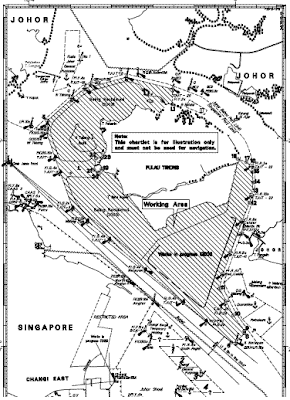
With effect from 01 Dec 08 to 31 May 09 at Selat Pandan, Sinki Fairway and West Keppel Fairway (see attached plan):

Dredging works will be carried out by the grab dredger “Pandora” within the sectors as indicated in the chartlet. The grab dredger will be held in position by a 4-point anchor mooring system within the working area. The anchors will be marked by marker buoys. The safety working zone is a circular area of 200-metre radius centred at the dredger. A safety boat will be deployed in the immediate vicinity of the working area to warn other craft of the project work. Further enquiries relating to the project can be directed to Mr P Bogers, the project manager, at Tel No: 9139 6094 or email bog@vanoord.com

A closer look at Cyrene Reef and the dredging site.

Upcoming works near Pulau Jong?

Marine Soil Investigation is being conducted at Pulau Sebarok, the location of Singapore's bunkering facilities.
Pulau Sebarok (with the large white storage structures) is just off Pulau Jong, an amazing wild shore with a special giant clam and other marine life.

Maine Soil Investigation at Pulau Sebarok
from Port Marine Notice No. 201 of 2008 dated 20 Nov 08
With effect from 25 Nov 08 to 03 Jan 09 at Pulau Sebarok (see attached plan):
Soil investigation works will be carried out by means of marine boring using jack-up barges. Tug boats will be used for the shifting of the jack-up barges. The safety zone is a circular area of 20-metre radius centred at the locations of the jack-up barges. A safety boat will be deployed to warn other vessels to keep clear of the barges for the whole duration of the works. Further enquiries relating to the project can be directed to Mr Udaya Kumar, the senior engineering geologist, at Tel: 8168 3515, email: udayakumar@sf.com.sg

Shore construction at Sungei Punggol continues until May 09

Installation of a temporary cofferdam; and construction of gate house, spillway and dam began in May 08 and will continue to May 09. The work area is opposite western Pulau Ubin.

Dredging and Marine Construction Works at Sungei Serangoon
Port Marine Notice No. 202 of 2008 dated 20 Nov 08
This is a revision of Port Marine Notice No. 107 of 2008. The working period has been extended.

With effect from 26 Nov 08 to 25 May 09, at Sungei Serangoon, (see attached plan):
Dredging works will be carried out by grab dredgers. The grab dredgers will be held by 4-point anchoring system and each anchor position will be marked by a yellow buoy, Fl Y 3s.

Installation of temporary cofferdam; and construction of gate house, spillway and dam will be carried out within the working area. Further enquiries relating to the project can be directed to Mr Mok Chin Ket, the project director, at Tel. 9628 7370, email: mokck@koon.com.sg.

20 November 2008

Why do some corals glow in the dark?

Flourescent corals are often seen on our shores, like this one seen during our field trip to Sentosa a few days ago.
What's going on?

Many corals harbour microscopic, single-celled algae (called zooxanthellae) inside their bodies. The zooxanthellae undergo photosynthesis to produce food from sunlight. The food produced is shared with the coral, which in return provides the zooxanthellae with shelter and minerals.

A study in 2000 suggests that in shallow water corals, flourescence acts like a sunscreen to prevent harmful UV light from damaging the zooxanthellae.

How does it work? It's a bit technical, and this is the simple version:

“During fluorescence, the electrons inside the coral’s colour pigment molecules become excited. They jump higher and emit energy. The blue colours come from high energy emissions, then as the energy decreases the colours change to greens, then yellows and reds. Basically, the coral pigment cells break up solar radiation into the same energy wavelengths seen in the colours of the rainbow and by absorbing higher energy - UV and blue light - and emitting it in green to red fluorescent colours, they transform damaging light into less energetically damaging wavelengths.”

Corals may actually fluoresce continually under sunlight but the sunlight is so strong you can’t see it.

The study also found that corals that contained the highest density of fluorescent pigments tended to survive coral bleaching!

Another finding was that 70-90% of shallow-water corals have fluorescent colour pigments, this proportion falling to about 50% in deeper waters.

In deeper waters, flourescence have a different purpose. Because light is scarce in deep water, the corals' fluorescent proteins absorb UV light and reemit it in the blue and green spectrums. This amplifies the light available for photosynthesis.

In deep-water corals, the pigments are packed among or below the zooxanthellae, acting like tiny mirrors, reflecting some of the light back to the zooxanthellae.

But in shallow-water corals, the pigments are stacked above the zooxanthellae, shielding them from the sun.

A ray of hope for coral reefs
ABC Science 15 Dec 00;

Australian researchers have shown how some reef-building corals might protect themselves against the double threat of global warming and ozone depletion.


Publishing in this week's issue of Nature, Dr Anya Salih and colleagues at the University of Sydney have found that certain varieties of corals use fluorescence to take the sting out of intense UV light, which otherwise acts together with warmer water temperatures to cause coral bleaching.


Corals depend on microscopic algae which live in symbiosis inside the coral tissues, providing a steady supply of sugars for the host coral. While the algae require light, too much of it shuts photosynthesis down - a process called photoinhibition. When this happens, the coral expels its damaged symbiont and dies.


It had been observed for some time that corals fluoresced green when blue light was shone on them - but no one knew why. Although these corals had a compound similar to GFP (green fluorescent protein) found in luminescent jellyfish, they did not glow in the dark like the jellyfish do. So what was the function of the fluorescent pigment?


Salih and team postulated that the fluorescence played a role in protecting algae from damaging UV radiation and so set out to test the hypothesis.


"Our results show that in well-lit environments these fluorescent pigments act as 'sunscreens', protecting coral symbionts from photoinhibition by transforming excess light to wavelengths which are not absorbed by the algae and therefore will not damage them," say the researchers.


The research team transplanted corals in the laboratory and observed them under different light intensities and water temperatures. They found that the algae in fluorescent corals were able to continue photosynthesising while those in non-fluorescent corals shut down photosynthesis.


Their laboratory findings were confirmed by field work that showed that in massive bleaching events, fluorescent corals were damaged less than their non-fluorescent neighbours.


"This has important implications in the light of current climatic changes," say the researhcers. "Many species have fluorescent morphs - will these become predominant as temperatures and ultraviolet radiation increase? If so, they may offer the reef environment a partial buffer against global climate change."


"We do not suggest that we should be complacent about global warming or ozone depletion, but our studies may provide a ray of hope for the reef ecosystem."


The researchers are currently funded by an Australian Research Council SPIRT Fellowship (Stragetic Partnerships in Industry, Research and Technology) award.

Coral cover
Rachel Nowak, New Scientist 13 Dec 00;
Fluorescent pigments in the skin of corals act as sunscreens that could help some reefs survive the worst ravages of global warming, say researchers from the University of Sydney.

The pigments were known to enhance visible light levels in gloomy conditions but this is the first evidence of a blocking action when the light is bright.

"It seems that corals don't just have to sit there and take it when it comes to bleaching. It's great," says David Barnes of the Australian Institute of Marine Science in Townsville.

Gavin Greenoak, a director of the melanoma and skin cancer research institute at the University of Sydney, told New Scientist: "These coral sunscreens are certainly interesting with respect to their absorption profiles, especially in the UVA region. They could be potential sunscreens for humans."

Corals depend on the photosynthetic powers of microscopic algae that live within them to provide them with carbohydrates. But light is scarce in deep water so the corals contain fluorescent proteins that absorb light in the ultraviolet A to violet spectrum and reemit it in the blue and green spectrums. This amplifies the light available for photosynthesis.

But Anya Salih of the University of Sydney and her colleagues also found fluorescent pigments in 97 percent of shallow-water corals, even though those corals were actually at risk of being damaged by too much sun. That suggested that the pigments were also acting as a sunscreen.

The team created cross-section images of individual polyps using confocal laser scanning microscopy. These revealed how the same pigment could do two very different jobs.

In deep-water corals, the pigments are packed among or below the microalgae in the polyp's endoderm. "They act like broken mirrors, reflecting some of the light back to the microalgae," says Salih.

But in shallow-water corals, the pigments are stacked in the polyp's ectoderm, above the algae and shielding them from the sun.

When corals are exposed to slight increases in heat or light over the usual summer maximums, they often spit out their microalgae and become "bleached". This has raised fears that global warming will destroy coral communities like the Great Barrier Reef, where substantial bleaching has recently occurred.

However, Salih found that coral that contained the highest density of fluorescent pigments tended to survive.

"Maybe not all coral are destined to die. Maybe some will survive and repopulate the reef," says Salih. But she cautions that it is unclear how long even heavily pigmented coral can survive extreme conditions. She also notes that even if some coral survives, diversity will still be lost.

Colourful key to coral survival
Heidi Gibson www.undersea.com
While speculation continues over the impact of global climate change on the world’s tropical reefs, Dr Anya Salih, marine biologist with Australia’s University of Sydney, is working to identify the capability of the Great Barrier Reef to adapt to the warming of the world’s oceans.

“When corals are stressed by changes like increased water temperature or exposure to sunlight, they can lose their colours or ‘bleach’,” says Anya. “Bleaching, is a sign that the coral is unwell. It may recover but if the bleaching is too severe it will die.”

Over the last 20 years, a rise in mass coral bleaching throughout the world has been linked to the increased frequency of El Nino Southern Oscillation - a phenomenon that, in turn, has been linked to global warming.

“As a result, the world’s mean ocean temperature has increased by about 0.5 degrees,” says Anya, “and it is predicted that it will warm by another one to three degrees worldwide by the middle of this century.

“For corals, a change as little as one to three degrees can lead to bleaching so we are greatly concerned about their survival.”

When stressed, a coral will expel the zooxanthellae - the microscopic algae or tiny plants that live in its tissue - causing the loss of colour known as “bleaching”. Zooxanthellae use photosynthesis to transform sunlight into energy and help corals to survive by creating an extra source of carbohydrates or energy.

“We had already noticed that some corals didn’t bleach and some did so only partially,” said Anya, “[and] during night dives, I had also observed that some coral colours had glow-in-the-dark or fluorescent properties.”

“I wondered if there could be a relationship between the two phenomena.”

To investigate, Anya and her team joined the crew of Undersea Explorer - a combined scientific research and adventure dive vessel based in Port Douglas, Queensland - for an expedition to the remote outer regions of the Great Barrier Reef.

Anya estimates that about 70 to 90 per cent of corals in shallow waters have the fluorescent colour pigments with the number decreasing to about 50 per cent at lower depths.

“These coral’s fluoresce continually under sunlight but the sunlight is so strong you can’t see it,” she says.

“We believe that the fluorescent pigments in some coral tissues act like a kind of sunscreen by dissipating excessive sunlight as fluorescence before it damages the zooxanthellae.”

By placing special light filters on their underwater torches at night, Anya and her team identified a range of fluorescent coral shades from intense blues to brilliant reds, and most significantly, they found that fluorescent corals did seem to survive bleaching better.

Back in the lab, Anya explains: “During fluorescence, the electrons inside the coral’s colour pigment molecules become excited. They jump higher and emit energy. The blue colours come from high energy emissions, then as the energy decreases the colours change to greens, then yellows and reds. Basically, the coral pigment cells break up solar radiation into the same energy wavelengths seen in the colours of the rainbow and by absorbing higher energy - UV and blue light - and emitting it in green to red fluorescent colours, they transform damaging light into less energetically damaging wavelengths.”

In the long term, Anya hopes their research will be used to help protect coral from the damaging effects of continued global warming.

Related links

Fluorescent pigments in corals are photoprotective
Anya Salih1, Anthony Larkum, Guy Cox, Michael Kühl and Ove Hoegh-Guldberg
Abstract from Nature 408, 850-853 (14 December 2000)

Marine worms shed light on eye evolution

By studying how simple eye spots guide larval worms, scientists are learning more about how eyes evolved.
The larvae of marine ragworm Platynereis dumerilii have the simplest eyes that exist. They resemble the first eyes that developed in animal evolution and allow the larvae to navigate guided by light. (Credit: Copyright EMBL)

The larvae of marine creatures, the first form that emerges from the egg, are tiny and swim with the plankton in the ocean. These larvae have the simplest eyes that exist. No more than two cells: a photoreceptor cell and a pigment cell. These minimal eyes are called eyespots.

Eyespots cannot form images. But can sense the direction of light. This ability is critical in helping these tiny animals to swim with changing light conditions towards good feeding conditions and away from dangerous zones. These movements drive the biggest transport of biomass on earth.

When Darwin's skeptics attack his theory of evolution, they often focus on the eye. Darwin himself confessed that it was "absurd" to propose that the human eye evolved through spontaneous mutation and natural selection.

Understanding how simple eyes work "unravels the first steps of eye evolution." In fact, an earlier study of the eyes of a marine worm suggests how eyes could have evolved through natural selection. So we have lots to learn even from our most humble marine creatures.

Simple Eyes Of Only Two Cells Guide Marine Zooplankton To The Light
ScienceDaily 19 Nov 08;
Researchers unravel how the very first eyes in evolution might have worked and how they guide the swimming of marine plankton towards light.

Larvae of marine invertebrates – worms, sponges, jellyfish - have the simplest eyes that exist. They consist of no more than two cells: a photoreceptor cell and a pigment cell. These minimal eyes, called eyespots, resemble the 'proto-eyes' suggested by Charles Darwin as the first eyes to appear in animal evolution. They cannot form images but allow the animal to sense the direction of light. This ability is crucial for phototaxis – the swimming towards light exhibited by many zooplankton larvae. Myriads of planktonic animals travel guided by light every day. Their movements drive the biggest transport of biomass on earth.

"For a long time nobody knew how the animals do phototaxis with their simple eyes and nervous system," explains Detlev Arendt, whose team carried out the research at EMBL. "We assume that the first eyes in the animal kingdom evolved for exactly this purpose. Understanding phototaxis thus unravels the first steps of eye evolution."

Studying the larvae of the marine ragworm Platynereis dumerilii, the scientists found that a nerve connects the photoreceptor cell of the eyespot and the cells that bring about the swimming motion of the larvae. The photoreceptor detects light and converts it into an electrical signal that travels down its neural projection, which makes a connection with a band of cells endowed with cilia. These cilia - thin, hair-like projections - beat to displace water and bring about movement.

Shining light selectively on one eyespot changes the beating of the adjacent cilia. The resulting local changes in water flow are sufficient to alter the direction of swimming, computer simulations of larval swimming show.

The second eyespot cell, the pigment cell, confers the directional sensitivity to light. It absorbs light and casts a shadow over the photoreceptor. The shape of this shadow varies according to the position of the light source and is communicated to the cilia through the signal of the photoreceptor.

"Platynereis can be considered a living fossil," says Gáspár Jékely, former member of Arendt's lab who now heads a group at the MPI for Developmental Biology, "it still lives in the same environment as its ancestors millions of years ago and has preserved many ancestral features. Studying the eyespots of its larva is probably the closest we can get to figuring out what eyes looked like when they first evolved."

It is likely that the close coupling of light sensor to cilia marks an important, early landmark in the evolution of animal eyes. Many contemporary marine invertebrates still employ the strategy for phototaxis.
View to a krill: Secrets of plankton eyes
Yahoo News 19 Nov 08;
PARIS (AFP) – Biologists on Wednesday explained how the larvae of marine zooplankton can see with just two cells, using what is believed to be the world's simplest vision system.

Zooplankton are tiny creatures such as copepods and krill that drift in the ocean's water columns, swimming up from the depths towards the light in order to graze on marine plants called phytoplankton near the surface.

This movement, called phototaxis, is the biggest biomass displacement in the world.

In a study published by the British-based journal Nature, European scientists looked at the larvae of the marine ragworm Platyneris dumerilii to try to explain how plankton are able to do the phototaxis trick.

The larva has just two eye cells, consisting of a pigment cell and a light-sensitive cell, say the investigators.

The cells are unable to form images but enable the plankton to sense the difference between light and dark and send appropriate signals to its swimming mechanism, say the investigators.

First, the pigment cell absorbs light and casts a shadow over the photoreceptor cell. The shape of the shadow varies according to the position of the light source.

The photoreceptor cell then converts this light signal into electricity, sending it in a signal along a nerve that connects to a band of cells endowed with thin hairs, called cilia, that beat to displace water.

The basic but effective system could explain how the very first eyes in evolution may have worked, say the team from the European Molecular Biology Laboratory (EMBL) and the Max Planck Institute.

"For a long time, nobody knew how the animals do phototaxis with their simple eyes and nervous system," said EMBL's Detlev Arendt.

"We assume that the first eyes in the animal kingdom evolved for exactly this purpose. Understanding phototaxis thus unravels the first steps of eye evolution."
Darwin's Greatest Challenge Tackled: The Mystery Of Eye Evolution
ScienceDaily 1 Nov 04;
When Darwin's skeptics attack his theory of evolution, they often focus on the eye. Darwin himself confessed that it was "absurd" to propose that the human eye evolved through spontaneous mutation and natural selection. Scientists at the European Molecular Biology Laboratory (EMBL) have now tackled Darwin's major challenge in an evolutionary study published this week in the journal Science. They have elucidated the evolutionary origin of the human eye.

Researchers in the laboratories of Detlev Arendt and Jochen Wittbrodt have discovered that the light-sensitive cells of our eyes, the rods and cones, are of unexpected evolutionary origin – they come from an ancient population of light-sensitive cells that were initially located in the brain.

"It is not surprising that cells of human eyes come from the brain. We still have light-sensitive cells in our brains today which detect light and influence our daily rhythms of activity," explains Wittbrodt. "Quite possibly, the human eye has originated from light-sensitive cells in the brain. Only later in evolution would such brain cells have relocated into an eye and gained the potential to confer vision."

The scientists discovered that two types of light-sensitive cells existed in our early animal ancestors: rhabdomeric and ciliary. In most animals, rhabdomeric cells became part of the eyes, and ciliary cells remained embedded in the brain. But the evolution of the human eye is peculiar – it is the ciliary cells that were recruited for vision which eventually gave rise to the rods and cones of the retina.

So how did EMBL researchers finally trace the evolution of the eye?

By studying a "living fossil," Platynereis dumerilii, a marine worm that still resembles early ancestors that lived up to 600 million years ago. Arendt had seen pictures of this worm's brain taken by researcher Adriaan Dorresteijn (University of Mainz, Germany). "When I saw these pictures, I noticed that the shape of the cells in the worm's brain resembled the rods and cones in the human eye. I was immediately intrigued by the idea that both of these light-sensitive cells may have the same evolutionary origin."
The "living fossil," Platynereis dumerilii. (Credit: Maj Britt Hansen, Photolab, EMBL heidelberg)

To test this hypothesis, Arendt and Wittbrodt used a new tool for today's evolutionary biologists – "molecular fingerprints". Such a fingerprint is a unique combination of molecules that is found in a specific cell. He explains that if cells between species have matching molecular fingerprints, then the cells are very likely to share a common ancestor cell.

Scientist Kristin Tessmar-Raible provided the crucial evidence to support Arendt's hypothesis. With the help of EMBL researcher Heidi Snyman, she determined the molecular fingerprint of the cells in the worm's brain. She found an opsin, a light-sensitive molecule, in the worm that strikingly resembled the opsin in the vertebrate rods and cones. "When I saw this vertebrate-type molecule active in the cells of the Playtnereis brain – it was clear that these cells and the vertebrate rods and cones shared a molecular fingerprint. This was concrete evidence of common evolutionary origin. We had finally solved one of the big mysteries in human eye evolution."

19 November 2008

Coral forecast for climate: drier for Australia and Indonesia

A study of long-lived corals reveals Australia and Indonesia are likely to experience more frequent and intensified droughts, while eastern Africa is likely to get wetter. Drier weather is likely in western Indonesia and southern Australia and heavy rains to eastern Africa and southern India, leading to severe impacts on societies and ecosystems.

Corals reveal Australia's parched future
Australian National University
Science Alert 17 Nov 08;
New coral records have revealed that Australia and Indonesia are likely to experience more frequent and intensified droughts, while eastern Africa is likely to get wetter.

Scientists studying the history of tropical weather patterns stored in long-lived corals have discovered that climate variability in the Indian Ocean has intensified during the 20th century, with implications for drought in Australia and the region. The findings are published in the journal Nature Geoscience.

The ANU-led international research team analysed corals from tropical waters northeast of Australia to build a continuous picture of climate change going back to 1846. They’ve found a recent increase in the frequency and severity of the Indian Ocean Dipole – a climate engine that has a dramatic effect on rainfall in the countries surrounding the Indian Ocean.

“To date, we’ve only had reliable instrumental records of the Indian Ocean Dipole (IOD) going back 50 years,” explains Dr Mike Gagan from the Research School of Earth Sciences at ANU. “But our technique of using oxygen isotopes from coral skeletons allows us to analyse sea-surface temperature and salinity for hundreds, sometimes thousands, of years.

“We’ve found that the IOD has lately been occurring every four years, as opposed to every 20 years around the turn of the century. We’re seeing a clear trend towards these events becoming stronger and more frequent.”

The researchers say that IOD events occur when the ocean temperature gradient and winds along the equatorial Indian Ocean reverse from their normal state – in a way, it is the Indian Ocean’s equivalent of the El Niño Southern Oscillation. These changes bring drought to western Indonesia and southern Australia and heavy rains to eastern Africa and southern India, leading to severe impacts on societies and ecosystems.

“All sorts of modelling suggests that greenhouse warming will lead to strengthened Asian monsoon rainfall and more persistent El Niño-like conditions during the 21st century,” Dr Nerilie Abram says. “Our research now indicates that this is also likely to be accompanied by an increase in IOD events. This means the picture is grim for southern Australia in particular, but it also shows just how important learning more about the link between the Indian Ocean and global climate will be for our future.”

Reclamation at Pulau Tekong extended to May 09

These massive works are just opposite Chek Jawa, indicated by the Chek Jawa front beacon in the diagram below. The reclamation has been ongoing for some years, and will continue until May next year.
This is a photo of the Chek Jawa front beacon from the Chek Jawa boardwalk. It's the structure with the triangle at the top.
And a wider view of this.
Reclamation at Pulau Tekong
from Port Marine Notice No. 199 of 2008 dated 18 Nov 08
This is a revision of Port Marine Notice No. 92 of 2008. The working period has been extended.

With effect from 29 Nov 08 to 28 May 09, 24 hours daily including Sundays and Public Holidays, off Pulau Tekong, within a working area in attached plan.
Reclamation works at Pulau Tekong will involve dredging, construction of revetment, soil investigation and soil improvement works. Soil improvement works will entail sand piling and deep cement mixing. Trailer-suction-hopper dredgers (TSHD) will be used for transporting and pumping sand into the working area. Safety boats will be deployed in the vicinity to warn other craft of the operations in the area. Further general enquiries relating to the project can be directed to Mr. R Kamata, the construction manager, at Tel: 9624 8603, email: ryuji_kamata@tjput.com.sg.

25 Nov (Tue): Broadcast of "City Footprints" featuring volunteers for our shores

Recently the Star Trackers and TeamSeagrass were filmed by threesixzero for the City Footprints series on Channel U.
Here's Sijie explaining the Star Tracker programme on our way to Cyrene Reef, while Siti was filmed during our TeamSeagrass monitoring at Sentosa, and both Star Trackers and TeamSeagrass were filmed again at Chek Jawa during the seagrass monitoring.

The programme broadcasts next week, and here's the synopsis and details.

Synopsis of City Footprints Episode 11
City Footprints is a social documentary series that tells the heartwarming stories of individuals or communities in our city- stories that mirror and reflect how individuals and community responds and reacts to paradigm shifts as a result of rapid social urbanization.

A green tide is swelling as a new generation of young Singaporeans leads the next wave of environmentalism.
Meet the Star Trackers: 26-year-old Chen Sijie and his partner, Chim Chee Kong, 31, as they brave irregular tide timings and errant weather to track and monitor sea stars on Cyrene Reefs – a mysterious coral colony that only surfaces for a few hours during the low tide period each month. The two are not alone in their roles as guardians of the seas.
As early as 2005 Siti Maryam, 27, has spearheaded a campaign to conserve an overlooked slice of nature through the volunteer group TeamSeagrass. On a little-known side of Sentosa, look at how volunteers survey local sea grass habitats before pollution and pressure overwhelm them.

As the three join hands to nurture the next wave of conservationists, find out how their efforts converge on the shorelines of Chek Jawa.

Time: 9.30pm repeats 11.30pm on Channel U
Website: http://u.mediacorptv.sg/


A review of the episode! Jun has done a super instant review of the episode on her Ashira blog. Thanks Jun!

Plan for artificial reef at Mabul near Sipadan

Echoing the reclamation of an existing reef on Sentosa to build an aquarium and resort, an "oceanarium resort" is planned at Mabul near Sipadan in Sabah, Malaysia.
Touted as "Malay­sia’s first and biggest oceana­rium resort of luxury chalets in Mabul", Malaysian environmentalists are protesting the plans.

What do the plans include?
  • An oceanarium with artificial reef, fake seagrass and other devices to attract fish.
  • Five clusters of more than 200 sea-view bungalows and semi-detached villas, with side pools and spa villas
  • Research facilities and scientist quarters.
What are the concerns?
  • Environmental impact: the project is on a 33ha parcel of shallows which are a 20-minute boat ride from the eco-sensitive coral reefs of Pulau Sipadan.
  • Barge transport of tonnes of construction materials, with fears of a repeat of the 2006 accident on Sipadan when a construction barge ran aground, destroying a coral reef patch the size of three tennis courts.
  • Dislocation of 2,000 traditional Bajau villagers who have have been using the area for fishing, transport and passage for hundreds of years, but are considered squatters by the local land office.
Is it necessary?

According to Sabah Environment Protection Association president Wong Tack.
  • "The whole idea of an oceanarium seems quite strange given that people can already see all the fish and sealife in the pristine clear waters without the need for such a facility,"
  • The existing four resorts for higher-bracket tourists and five to 10 homestay places for backpackers with a total of more than 250 rooms, provided enough accommodation for the 120 divers given permits to dive in Sipadan waters daily.
According to State Tourism, Culture and Environment Minister Datuk Masidi Manjun
  • Sabah needed more high-end tourism products such as resorts “to value add what nature has endowed us.”
  • But he added that the developers would need to get approval for the project’s environmental impact assessment (EIA) before it can get off the ground.
More links

18 November 2008

Artificial reef restoration in Japan

Japan is making a second attempt to artificially restore a reef within 10 years by planting 6,000 baby corals.
The attempt is the world's only large-scale project to restore a coral reef artificially, rather than trying to clean the environment for corals or nipping off branches of living corals for transplanting elsewhere.

If experiments are successful, the Japanese team wants to try the method in other countries. Preparations in Indonesia have already being made.

Scientists try to revive Japan's biggest coral reef
AFP 16 Nov 08;
TOKYO (AFP) — Scientists are in an unprecedented project to restore Japan's largest coral reef by planting thousands of baby corals growing on tiny ceramic beds.

Corals in Sekisei Lagoon stretching between the Okinawan islands of Ishigaki and Iriomote have plunged by 80 percent over the past two decades due to rising water temperatures and damage by coral-eating starfish.

"No projects in the world have ever restored a coral reef artificially... but we aim to restore the lagoon in some 10 years," said Mineo Okamoto, associate professor at the Tokyo University of Marine Science and Technology.
The isles of Okinotori, 1,700km south of Tokyo
In a joint project with Japan's environment ministry, scientists will plant some 6,000 baby corals in the seabed in December over a 600 square-metre (6,450 square-foot) district.

The corals are 18 months old and grow on round ceramic beds that measure four centimetres (1.6 inches) in diameter and have single legs for planting.

It follows the implantation of 5,300 baby corals in 2006. Only one-third of them have survived, with many dying off or damaged by dead and collapsed corals stirred up in the sea by typhoons, Okamoto said.

"We have learned lessons from the previous planting regarding what are the best places to plant and other conditions for survival. We'll make a fresh try," he said.

The attempt is the world's only large-scale project to restore a coral reef artificially, rather than trying to clean the environment for corals or nipping off branches of living corals for transplanting elsewhere, Okamoto said.

If experiments are successful, the Japanese team wants to try the method in other countries, Okamoto said, adding preparations in Indonesia have already being made.

"Corals are marine creatures but are functioning like seaweed in southern seas as they engage in photosynthesis to disperse oxygen," Okamoto noted.

"They invite plankton and then plankton-feeding fish, creating an ecosystem and fishing ground," he said.

Related articles

17 November 2008

Rare sand dollars and other surprises

We decided to explore a new shore today and were astounded by the amazing marine life there.Some parts of the silty soft shore were covered thickly in seagrasses; mainly Spoon seagrasses (Halophila ovalis) and Needle seagrasses (Halodule sp.).The seagrasses were teeming with tiny snails, which also dotted the soft silty sand so that it was impossible to walk without stepping on them.A closer look reveals that they are the delightful Dubious nerites (Clithon oualaniensis)! These are among my favourite snails and I so rarely get to see them.Here's a look at the underside (photo on the left) and a tiny bit of the body (photo on the right). The body is striped too, just like the other bigger Nerites (Family Neritidae).I find these snails fascinating because they come in an astonishing variety of patterns.The designs look like they've been patiently drawn with a tiny black marker!Some of the designs are really intricate.And colourful too! The variety seems endless.

The soft shore was also home to lots of moon snails! There were many Tiger moon snails (Natica tigrina) with their spotted shells. Many were in huddles: mating or fighting over food?There was also one Lined moon snail (Natica lineata). I seldom see this moon snail (although we just saw one yesterday at Changi).Indeed, it's been a moon snail fiesta recently and I saw this other moon snail that I've not seen before. It wouldn't come out of its shell so I couldn't see its body. I have no idea what it is!Another mystery snail was this beautiful snail that was ploughing through the soft sand. I saw several of them today! I've seen them in the past at Chek Jawa, but not in recent times. I also have no idea of its identity, but it sure is pretty. Another delightful surprise was this snail. From Tan, K. S. & L. M. Chou, 2000. A Guide to the Common Seashells of Singapore, it's possibly a Bufonaria sp. (Family Bursidae). I've so seldom seen one alive that I've not even done a page for this snail on Wildfacts. From Tan and Chou, "this undetermined species is rare intertidally and usually only seen in dredge samples taken offshore. Very little is known about them." WOW!And among the seagrasses was this Onyx cowrie (Cypraea onyx) which is listed among our threatened animals. Other snails that were abundant on the shores were the Banded creeper snails. There were lots of shells of the Gong gong (Strombus canarium) and of the Black lipped conch (Stombus urceus), inhabited by hermit crabs, but I couldn't find any live ones.

On the soft silty sand was this tiny flatworm.It looks like mobile phlegm. I have no idea what it is. On firmer sand were lots of tubeworms.

The sand was also dotted with little Striped bead anemones (photo on the left). There were several of the large Plain sea anemones (photo on the right). I seldom see more than one of these Plain sea anemones on a trip.There were several Haddon's carpet anemones (Stichodactyla haddoni) and those that were submerged had tiny anemone shrimps living on them. I saw one peacock anemone with its tentacles tucked into its tube, and only one Peachia sea anemone (Peachia sp.).

Soft sand is great for fishes like this flathead (Family Platycephalidae).
There was also one Whiting (Family Sillaginidae), and Andy saw a flatfish. Strangely, I didn't see any little gobies.

The soft sand was dotted with the burrows of snapping shrimps (Family Alpheidae). But I didn't see any other kinds of shrimps. There were a few small swimming crabs, though; and one large Stone crab (Myomenippe hardwicki) in a stone.On the high shore, I chanced upon this gaggle of Land hermit crabs (Coenobita cavipes). They were literally queueing to try out a new empty shell! Well, the queue quickly collapsed into an all out tussle.Here's a closer look at them. There were also lots of Striped hermit crabs (Clibanarius sp.) and lots of tiny little hermit crabs too.

Alas, though I looked, I couldn't find any sea stars. Not even the Sand star or the Common sea star.But there were lots of sea cucumbers. Only one of the Warty sea cucumber (Cercodemas anceps) (photo on the left), but many Thorny sea cucumbers (Colochirus quadrangularis) (photo on the right). I also saw buried Ball sea cucumbers (Phyllophorus sp.) but no Garlic bread sea cucumbers (Holothuria scabra).And I saw this strange sea cucumber. Perhaps it's the Orange sea cucumber? I have no idea.

But the best surprise was to see several Laganum sand dollars (Laganum depressum) of various sizes.Some were a pale pink, and all had a large and prominent petalloid in the centre. This rather pentagonal sand dollar is thick at the edges and at the centre, and thinner elsewhere.In this one, the structures on the undersides were clearer. The spines are longer at the edges.Here's a photo of another of these rarely seen sand dollars. The only time I saw them was on the Sentosa shore that has since been reclaimed for the IR. So it was a real treat to see them today!

Our shores are very much alive! Alas, all too often, raising awareness of our shores often leads to large groups of people going to these special shores. Careless trampling can hurt marine life. Other more destructive behaviour can be even more damaging. So perhaps, for the time being, we should leave this special shore alone.

LinkWithin

Related Posts with Thumbnails