05 January 2009

Billy & Saltie: A green-oriented cartoon strip

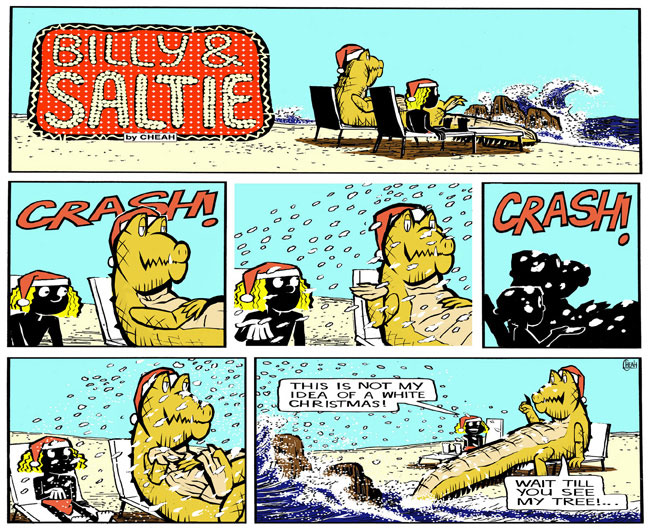
Produced by Cheah Sinann who lives and works in Singapore, Billy and Saltie explore life and wildlife in the land Down Under with a green twist.With a Gary Larsonesque touch, Cheah Sinann also educates about natural history and animal features.

Visit Cheah Sinann's homepage to find out more what Saltie does when he has to rely on a Komodo Dragon's bite for his next meal, and what Saltie's idea of a White Christmas in Australia is like and more.

More about Cheah Sinann.

Wildfacts updates: Goatfish, blue-eyed coral crab and more

Andy has fantastic video clips of our marine life on his sgbeachbum blog. I especially love this fabulous clip of a pair of anemone fishes frolicking in their anemone taken at Sisters Islands.
I finally got some time to embed his clips onto the appropriate wild fact sheets on wildsingapore, as he so kindly gave permission for me to do so. To see all the clips, it's easier to drop by Andy's blog.

I also finally got around to updating all the crab IDs that Crabhunter so kindly took the time to share on my flickr. From the comments, I've learnt that swimming crabs (Family Portunidate) are really tough to distinguish to species. Same goes for moon crabs (Family Matutidae).

But never mind! Even if we can't identify our marinelife precisely, we can still take photos of them, note down their behaviour and distribution and appreciate their beauty and amazing adaptations. I'm happy to have discussions about ID and to be proved wrong. That's how I learn!

Here's some of the new fact sheets I've just uploaded. As usual, any comments and corrections and additions are always most welcome!

What's a goatfish? Why such an odd name?

I don't really know but it could be something to do with the fact that these fishes have a pair of 'tentacles' (called barbels) under their chin. Which might remind some of goats, which have a beard under the chin.
Unidentified fish (Upeneus sp.?)
It's hard to see the barbels on the fishes we encounter on our shores as these are tucked away under the chin when not in use. The barbels are used to probe the sand and crevices for tasty titbits. These fishes come in a wide range of colours and patterns and I'm making a tentative id of it as the Freckled goatfish (Upeneus tragula).

I have often seen these hairy little crabs with blue eyes in branching hard corals. I thought they were just juvenile Hairy crabs (Family Pilumnidae) which are quite commonly seen on our reefs.
Tiny crab in acropora (Cymo andreossyi)?
But a closer look suggests these might be the threatened Hairy coral crab (Cymo andreossyi). It is listed as 'Vulnerable' in the latest Red List of our threatened animals. This crab is only found in Acropora and Pocillopora hard corals.

These little clams are also often seen in all kinds of branching hard corals.
Tiny clam in acropora
I'm not too sure what they are, but it is likely that they are some sort of scallop (Family Pectinidae) and possibly Pedum sp. I've just called them coral scallops.

If you have photos or video clips to share on the wild fact sheets, please do email me (hello@wildsingapore.com) with this information
(a) Your name
(b) URL of the location of your photo on your blog or flickr (please don't send me your photos)
(c) Location of your sighting
(d) Month and year of sighting
(e) Any observations of behaviour, etc.

Looking forward to having more of everyone's encounters on the wild fact sheets!

Earlier posts about previous updates on the wild fact sheets.

UPS not to ship live dolphins from the Solomons

UPS’s charter policy does not allow them to carry live animals from the wild to any aquarium or zoo. “They only realised this after the trip from the Solomons that the dolphins have been in the wild and were not been in any aquarium or zoo here.”

Airline says no more dolphin charters
Solomon Star 31 Dec 08;
AMERICA’S large cargo air transport service, United Parcel Service (UPS), has decided not to ship anymore live dolphins from the Solomon Islands in the future.

In a letter written by UPS to the Animal Welfare Institute obtained by Solomon Star; the airline’s CEO Scott Davis said they will to accept any more future charters to transport live dolphins.

UPS made the decision following pressure from animal welfare groups for the carrier to abide by its policy, which is not to transport wild and live animals.

The airline owned the cargo jet that transported seven live dolphins early this month from the Solomon Islands to the Philippines.

When contacted through email, Director of the Earth Islands Institute based in the United States Mark Berman said they have shown their disagreement with UPS, which the company respectfully adhered to.

“UPS is not shipping dolphins any longer due to our coalition showing that this type of trade must end,” Mr Berman said.

He said the international community would close markets if the Solomon Islands Government continues to allow live dolphin export.

“If your government refuses to end this disgusting trade, then we in the international community will close the markets for these dolphins,” he said.

He said he had also received green light from the SkyAirworld Chief Executive Officer on the issue.

“The CEO of SkyAirworld, David Charlton, personally told me when I was on his inaugural flight in March this year that he would not promote captive dolphin programmes at all. He would only promote true eco-tourism,” Mr Berman said.

SkyAirworld is set to redevelop the Anuha Island Resort in the new year.
Meanwhile, local environmental campaigner Lawrence Makili he also received confirmation that UPS has refuse to deal with any further charters for live animals here.

He said UPS’s charter policy does not allow them to carry live animals from the wild to any aquarium or zoo.

“They only realised this after the trip from the Solomons that the dolphins have been in the wild and were not been in any aquarium or zoo here,” Mr Makili said.

By EDNAL PALMER

More links

04 January 2009

Kampong Buangkok in the New York Times

"Urban Singapore Prepares to Gobble Up Its Last Village" the article headlines. When it is gone, one of the world’s most extreme national makeovers will be complete, it declares.
Photo by Jessdo from habitatnews flickr

Will Singapore school children then have to go to Johor to experience their natural heritage?

from Urban Singapore Prepares to Gobble Up Its Last Village
Seth Mydans, The New York Times 3 Jan 09;
Under the city’s master plan, at an unannounced date Kampong Buangkok will be “comprehensively developed to provide future housing, schools and other neighborhood facilities,” said Serene Tng of the Urban Redevelopment Authority in an e-mail message.

Ms. Sng, 55, is now the landowner, wheeling her bicycle among the metal-roofed, one-story homes of her tenants, who are also her friends and pay only nominal rents for their houses.

Fruits and flowers cluster in the village like endangered species in a vanishing ecosystem. There are tiny guavas and giant papayas, yams and tapioca plants, dill and edible bamboo shoots, bougainvillea and hibiscus. Snakes and lizards scurry through the undergrowth, and tiny fish swim in a tiny stream.

Through the trees in all directions, the people of Kampong Buangkok can glimpse the government housing blocks that represent their future.

In modern Singapore, few neighbors know each other, said Sarimah Cokol, 50, who grew up in Kampong Buangkok and now lives in one of the apartments that people here call pigeonholes. “Open door, close door,” she said in the terse speech of no-nonsense Singapore. “After work, go in. Close door.”


Other articles

Rush for land to sweep away last Singapore village
Melanie Lee, Reuters 21 Dec 07;
also in Business Times 22 Dec 07 as Singapore's last kampung
Built 60 years old ago on low-lying land, the kampong has weathered many floods. But the biggest danger it faces is not a natural disaster, but Singapore's voracious appetite for land.

In Singapore, history and heritage are often found at the receiving end of a wrecking ball. The space-starved island, about one third the size of Greater London, has one of the world's highest population densities. For decades it has reclaimed land from the sea and razed landmarks to make space for development.

"Given the need to optimize the use of land in land scarce Singapore, it may not be viable to retain the kampong in its current state," said a spokeswoman from the government redevelopment agency.

from Singapore's last kampung worth $33m but landowner won't sell
Bryna Sim Straits Times 5 Aug 07
Ms Sng Mui Hong is determined to sit tight on her sizeable piece of land in Punggol. 'My father bought this land, it has much sentimental value for me,' she said. 'I would feel trapped in a flat.'

The rent of the 20 families who live in the kampung's self-built zinc-roofed huts ranges from $6.50 to $30 a month. Their huts are an average of about 1,500 sq ft each, and range from three to five rooms, depending on how their dwellers chose to build them. They have basic utilities such as running water and electricity, and are surrounded by jackfruit and banana trees, as well as chilli padi and lime plants.

from Owner of $33m Kampung: My family ties are not for sale
Hedy Khoo New Paper 20 Aug 07
The 54-year-old feisty land owner has been in a foul mood since recent news reports suggested the land she co-owns in Lorong Buangkok is worth $33 million.

Said Ms Sng in Mandarin: 'Since the reports, all sorts of strangers have come to the kampung.' She wants one thing made clear: 'I am not rich, and I am not selling my land.'

She said: 'I take after my father in my philosophy of life. As long as I have enough to eat, I don't hunger after money or to be rich.'

'Even if the land is really worth much, and I can sell the land and move to a huge bungalow with a big backyard, I can never regain this feeling of simplicity and freedom, and be close to my childhood memories.'

But not all visitors are unwelcome. Ms Sng said: 'I love students who come to do projects or field trips, because they can learn so much about nature here.' And those interested to learn that family ties are not for sale may also want to drop by.


This New York Times article was also carried in the Jakarta Globe, 5 Jan 09.

More links

Will Singapore be embarrassed by marine aquarium deaths?

Three rare fishes have died at Ocean Park in half a year, causing embarrassment to Hong Kong.

The Chinese sturgeons are thought to have lived at the same time as dinosaurs and found only in China. The Ocean Park received five Chinese sturgeons from the Chinese mainland in June 2008 as a gift for the Olympic Equestrian events in Hong Kong. It was the first time the sturgeons has been sent outside the Chinese mainland.

"The survival rate for Chinese sturgeons in captivity is very low." said a fish specialist, "Ocean Park has never raised a Chinese sturgeon before, thus challenge and difficulty is expected for the park to nurse the fish properly."

Another rare Chinese sturgeon dies in Hong Kong's Ocean Park
Xinhua 3 Jan 09;
HONG KONG, Jan. 3 (Xinhua) -- The Hong Kong Ocean Park said here Saturday that another Chinese sturgeon died Friday, raising the death toll of the rare aquatic species in the park to three in half a year.

Tom Mehrmann, Chief Executive of the Ocean Park, told a press conference here Saturday that the Chinese sturgeon No. 1 had developed abnormal syndromes like the degradation of immunity and anorexia a few week ago. Mehrmann said the health condition of the Chinese sturgeon No. 1 suddenly deteriorated in the past two days and died Friday morning.

"We are sorry about another death of the Chinese sturgeon," Mehrmann said, "and we will have other seven alive Chinese sturgeons under our close monitoring."

He said five of the seven remaining Chinese sturgeons in the park were in good health but another two were in bad condition with similar anorexia syndromes. The theme park will shut down the sturgeon aquarium infinitely till further notice.

According to the anatomy results of the dead sturgeon No. 1, there were bruises in the fish head and extravasated blood inside, which might point to the park's salinating aquarium water for its death.

The Chinese sturgeons, which is thought to have lived at the same time as dinosaurs and found only in China, can live in both freshwater and saltwater, arrived in Hong Kong in freshwater in 2008 and have been undergoing a gradual transition to saltwater at Ocean Park.

Preliminary investigation showed improperly induced salination could have harmed the health of the fish and made them more susceptible to infection.

Wei Qiwei, a fellow researcher from the Yangtze River Fisheries Research Institute of the Chinese Academy of Fisheries Science, said at the joint press conference with the Ocean Park that more research was needed on keeping the species in different environments.

"The surviving rate for Chinese sturgeons in captivity is very low," Wei said, "thus it is hard for protecting the species."

"As the Ocean Park has never raised a Chinese sturgeon before," Wei said, "challenge and difficulty is expected for the park to nurse the fish properly. And the aquatic experts in the Chinese mainland will further cooperate with the park on further study and protection of the fish."

The latest death of the rare Chinese fish was the third of the rare Chinese sturgeon lost by the theme park in six months, after one was killed by a bite from a barracuda in June 2008 and another died of infection similar to the sturgeon No. 1 last month.

The Ocean Park received five Chinese sturgeons from the Chinese mainland in June 2008 as a gift for the Olympic Equestrian events in Hong Kong. It was the first time the sturgeons has been sent outside the Chinese mainland.

Hong Kong embarrassed by death of second rare fish from China
EarthTimes 12 Dec 08;
Hong Kong - Hong Kong was embarrassed Friday by the death of a second rare Chinese sturgeon months after it was presented to the city's Ocean Park theme park by the Beijing government. The death of the endangered fish from a bacterial infection follows the loss of another sturgeon in June which was savaged to death by a barracuda sharing the same tank.

The incident in June came only days after Hong Kong was given the 1.1-metre-long fish, along with two other sturgeon, by China, representing one of the five mascots of the 2008 Beijing Olympics.

It developed into a minor but acutely embarrassing diplomatic incident for the government of the former British colony, whose officials are all appointed by China and kow-tow to Beijing.

Hong Kong's leader Donald Tsang made a grovelling public apology for the three year-old sturgeon's death while Chinese officials were drafted in to advise Ocean Park on how to care for the other fish.

China eventually gave five more sturgeon to Ocean Park the following month to replace the dead fish. One of the eight surviving fish was Friday confirmed to have died, this time from a bacterial infection.

Ocean Park chairman Alan Zeman told a news conference that the fish fell sick last week and was given antibiotics but succumbed to its illness.

A thorough investigation was being carried out into the causes of the sturgeon's death while measures were being taken to protect the remaining seven fish from infection, he said.

Hong Kong reverted to Chinese rule in 1997 after 156 years as a British colony. The city of 6.9 million hosted the equestrian events of the Beijing Olympics.


More about the Chinese sturgeon on the National Geographic website.

Malaysian fishermen who caught whale shark may be fined

Deep-sea fishermen should immediately release endangered or protected marine wildlife that got entangled in their nets.

The whale shark that was towed back by a Malaysian fisherman and died was buried yesterday – minus its fins and part of its tail which would be sent to the Turtle and Marine Ecosystem Centre (Tumec) in Terengganu for research. “In about one month, we will take out the whale shark’s bones and send them to Tumec where they will be put on exhibition.”

Fishermen who caught whale shark may be fined
The Star 4 Jan 09;
GEORGE TOWN: The four fishermen who caught a juvenile whale shark by accident on New Year’s Day may be fined – the fish is an endangered and protected species.

Penang Fisheries Department director Mohd Najib Ramli said statements had taken from the four and forwarded to the department’s legal unit in Putrajaya for further action.

“It is up to the unit. They may be compounded for catching the fish,” he said.

Mohd Najib said deep-sea fishermen should immediately release endangered or protected marine wildlife that got entangled in their nets.

He said fishermen should be alert and ready to act quickly to release such wildlife.

“They should not leave it in the net.

“If the fish or animal had died while in the net, the Fisheries Department must be notified,” he said in an interview.

On Friday, the shark was caught in fishermen’s trawl nets 10 nautical miles off Teluk Ba- hang.

The 7m-long fish got entangled in the nets at 3am. The four fishermen later returned to shore in Teluk Bahang, with the fish, at 5.30am.

The two-tonne whale shark was surrendered to the state Fisheries Department and hauled to the tuna landing port in Batu Maung by fishing boats on Friday evening.

It was transported to the Fisheries Research Institute (FRI), where it was buried at 3.20pm yesterday – minus its fins and part of its tail.

Najib said the parts cut off would be sent to the Turtle and Marine Ecosystem Centre (Tumec) in Terengganu for research.

“In about one month, we will take out the whale shark’s bones and send them to Tumec where they will be put on exhibition,” he said.

The whale shark (Rhincodon typus) is a filter-feeding shark known for its playful character.

It is the largest living fish that poses no harm to humans.


Four whale shark fishermen could escape with warning
The Star 6 Jan 09;
GEORGE TOWN: The four fishermen who caught a juvenile whale shark by accident on Jan 1 might only be given a warning if their claims that they had no intention of catching the endangered fish are true.

Penang Fisheries Department director Mohd Najib Ramli said the department’s legal adviser would investigate the fishermen’s claims before determining the next course of action.

“It would normally take about three days for the compound directive from the headquarters but not in this case as this is a bit more complicated.

“We must make sure the whale shark was not caught intentionally,” he said in a telephone interview yesterday.

Citing an example of a similar case a few months ago, Mohd Najib said the fishermen were let off with a warning after the legal officer found that the catch had been unintentional.

Mohd Najib also said fines imposed by the department varied but would not exceed a maximum of RM30,000.

Fisherman Keh Chai Yang, when contacted, said it would be unfair to them if they are fined because they were not aware that the whale shark had become entangled in the net.

“It was only when we tried to pull up the net that we saw the fish but it was already dead. If we were to leave it in the sea, the carcass would surely pollute the water.”

Keh said they were already bearing the cost of repair for the net which was damaged when pulling the two-tonne whale shark up to the shore.

“Some of our fishing equipment was also damaged,” he said, adding that he hoped the authorities would be fair to them.

The 7m-long fish was caught in the fishermen’s net about 10 nautical miles off the Teluk Bahang coast.