Our annual survey to this reefy northern flat is bitter-sweet. Like visiting our favourite grandma and watching her painfully, slowly fade away. I feel privileged to have seen her at her best.
Despite the ongoing reclamation works on Pulau Tekong nearby, and flaring at Penggerang Johor, it remains alive. Seagrasses remain abundant as much of the shore has become very soft and silty. The small patch rich with delicate colourful animals is still there although faltering a bit. The rest of the team spot special sea stars, sea horses, moray eel and many other interesting marine life.
The rest of team had lots of seahorse sightings. After trying my best to deconflict the photos of the same individual (difficult for the plain brown ones), it seems they saw at least 10 different individuals! Most seem to be the
Estuarine seahorse, and one seems to be the
Tiger-tailed seahorse more commonly seen in the south. Adriane saw the most number: 4 individuals including a pair - we do often see yellow and brown seahorse close to one another.
Lots of small frogfishes were seen! Zen alone saw 10. In various colours and patterns. There was also a Brown spotted moray eel as well as the Estuarine moray eel. Colourful fishes associated with reefs were also seen: two different kinds of butterflyfish, damselfish, gobies. Also the spotted scat, and lots of rabbitfishes, filefishes.
Good to know Beting Bronok remains quite starry. The team found 3 Bordered sea stars - these pale blue stars with narrow arms are only commonly seen on Beting Bronok. They also saw some Cake sea stars large and small, some Painted sand stars and Red scaly sea stars. It was a relief to know the Biscuit sea stars are still there - hope these small ones grow up to be big and strong. Unfortunately, we have not seen the Knobbly sea stars here for some years already.
A northern reefy shore will usually have a wider variety of nudibranch and slugs than a southern one. Among the special nudis seen was the Sibogae nudibranch that eats hydroids, the Armina nudibranch that eats sea pens, lots of Bushy slugs which suck the sap of seaweeds. Also many colourful flatworms.
Adriane encountered an explosion of small Swimming anemones among the seagrasses. Here's his awesome
video of them swimming. The team also saw a Haeckel's anemone, a Snaky anemone, many transparent Glass anemones and one with reddish tentacles. One anemone had captured a small fish. All the usual sea pens were seen but most abundant were Spiky sea pens, some with the very cute porcelain crabs that are only found in these sea pens. There was also a Black mouth cerianthid that we usually only see in the south.
There is small reefy patch on Beting Bronok that I call the 'sponge garden'. In
Jun 2024, there was mass dying of sponges in this area. In
Jun 2025 there seemed to be some recovery with a wide variety of healthy sponges, especially on the seaward side. Today, the area with healthy sponges seems smaller and I saw fewer clumps of healthy sponges elsewhere on the reef flat.
Yellow bumpy sponges remain the most abundant kind but most were heavily coated in silt.
The most abundant cnidarian remains
Button zoanthids which still cover large areas of the flat, very densely in some parts. The
stinging hydroids were particularly abundant and large, many standing upright out of water like shrubs with evil intent. There were a lot of Spangled flatworms, individual sprinkled all over the reef flats. I saw one Ball flowery soft coral, one Pink flowery soft coral and one sea fan. Also one spiky sea pen, a few Haddon's carpet anemones. I saw one large Cake sea stars, but the rest of the team saw echinoderms of all kinds. I will update with their observations later.
I still saw small healthy
Boulder pore corals colonies, but much fewer. In
Jun 2024 at the height of
mass coral bleaching, I saw about 40 corals: 100% were bleaching. In
Jun 2025, I saw about 20 corals, half were okay, the rest were stressed or had large dead portions and even a bit of bleaching. Today, I saw 10 corals all okay except 2 that were very pale. I also saw a
Small goniopora coral, and some tiny
Neat hexa corals.
The rest of the team saw several different kinds of corals that I totally missed! Including Anemone corals and other kinds of Merulinid corals. They all seemed fine.
Recently, I sensed that we have been seeing much fewer
Noble volutes that in the past. So we are now going to document every live Noble volute that we see. As a team, we saw only 6 live volutes at Beting Bronok today - mostly large ones, no egg masses seen. This large beautiful snail is restricted to our part of the world, in particular, Singapore and Peninsular Malaysia. We have a duty to protect them. Hopefully, our sightings will help encourage further study into whether the populations on our shores are okay. We didn't see any live
Bailer volutes, only a few empty shells.
Thick layers of soft sediments have built up even more compared to our previous visits. Over the years, I sense that Beting Bronok has gradually become larger. With 'new' soft silty areas growing on the south-west edge, where seagrasses have started to grow. Since
Jun 2025, I noticed the 'stingray' lagoon to the north-west has become shallower.
Seagrasses seem to thrive on this sediment layer and now dominate all parts of the reef. They continue to grow on large areas of the southern tip and elsewhere. All
Spoon seagrasses (with most large leaf blades but also some small) grow lush and fresh and green (no epiphytes). I have seen this since
Jun 2018. Since our last survey in
Jun 2024, I noticed more of them in the lagoon in the middle of the reef flat, today, there are even more. There were also many large patches of Parasol green seaweed.
Thanks to the team for also taking much better photos of the lush seagrasses that have settled on the shore. And the birds that turned up at daybreak to forage on the shore.
Over the years, the reefy patch on Beting Bronok seems to wax and wane. Beting Bronok remains a pale shadow of itself. Here's what Beting Bronok looked like twenty years ago in 2003.
 |
| Beting Bronok in 2003. |
 |
| Beting Bronok in 2003. |
There used to be a wondrous variety of
sea fans.
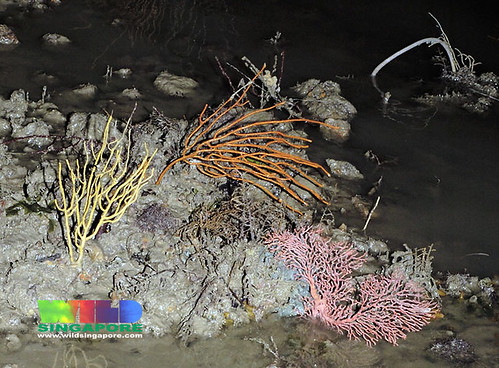 |
| Sea fans on Beting Bronok in 2004. |
Here's more
old photos of marine life at Beting Bronok. Lost forever probably are the wonderful
Sunflower mushroom corals and other corals that we used to see here.
Where is Beting Bronok? What is its status and future?When the
2030 landuse plan by the Ministry of National Development was announced, it was also announced that Beting Bronok and Pulau Unum have been
granted 'Nature Area' status. As I understand it, this status means the area "will be kept for as long as possible until required for development". Here's
an earlier about 'Nature Area' status seem to mean.
Today, we started our survey before dawn. And throughout, there was massive flaring at petrochemical plants at
Pengerang Johor. This has been going on for years now. This petrochemical complex that was rejected in Taiwan for environmental and health reasons.
The flaring is so intense, it looks like a 'false dawn'. Real dawn on the left.
We will continue to keep watch over this special little reef and hope for the best.
Photos by others on this survey
Loh Kok ShengJianlin LiuTammy LimAdriane LeeRichard KuahJayden KangRui Quan OhZen Xuan HeDylan SngJason OoiOthers on this survey: Lester Tan


-small.jpg)
-small.jpg)
-small.jpg)
-small.jpg)
.jpg)
.jpg)
.jpg)
-small.jpg)
-small.jpg)

.jpg)
-small.jpg)


