Wong Hoong Wei has discovered yet another new record. It is Semele sinensis a white clam. This was from animals collected among debris at the high tide line near Bedok Jetty, East Coast Park! So we should really pay attention even to stuff that gets washed up on our reclaimed land!
From Wong Hoong Wei's article "According to historical records, only one member of the genus Semele has been recorded in Singapore". And this was from a specimen taken from Sentosa in 1981 at the time when it was still called Pulau Blakang Mati.
According to Greek mythology, Semele was seduced by Zeus and was the mother of Dionysus. More about this complicated affair on the wiki entry on Semele.
Read the article on the Raffles Museum of Biodiversity Research's Nature in Singapore website: "A new record of Semele sinensis A. Adams, 1853 (Bivalvia: Tellinoidea) in Singapore". H. W. Wong. Pp. 113-115. [PDF, 164 KB]

27 September 2008
26 September 2008
Memories of Priscilla the Pig of Chek Jawa
Meeting Priscilla the Pig was one of the highlights of a visit to Chek Jawa in the early days.
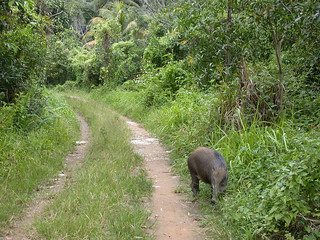 This is one of my earliest photos of her. It was just Pris and me at Chek Jawa. I even spent one afternoon sharing Punai Hut with Priscilla as we both waited out the wet weather. Eventually, I took her good advice and had a nap as well.
Here's more about our dear beloved pig of Chek Jawa.
Chek Jawa was Priscilla's home. And larder too, where a bit of rootin' around would quickly unearth edible tit bits. It was also her lounge where she would happily take a snooze, oblivious to visitors.
 Visitors would often miss her entirely because she looked just like one of the grey rocks on the shore. But once noticed, visitors could never resist a paparazzi shot with this famous beast.
 When she felt a little more lively, she would accompany the visitors on the public walks at Chek Jawa.

But being a long-time resident, she didn't have to pay too much attention during guide training.
A heart-stopping moment for those of us who loved this beast was when Priscilla sustained a deep wound on her rump, early in the week of 26 May 2003.
 Photo by How Choon Beng
On 7 June, Priscilla made her usual appearance during a public walk with about 100 people. Walking with a slight limp, she was still the simple, trusting and gentle creature that we have all grown to love. Fortunately, her injury did not seem to have made her fearful of people.
On 7 June, her wound appeared better. Here is a closer look at the wound. It appears to be healing nicely after tender treatment by NParks officers. The location of the wounds suggest it was inflicted by a slash of a large knife. NParks officers had been regularly applying medication to her wound. Apparently, some kind Thai workers had also prepared and applied herbs to her wound.
 By 20 June, Priscilla's wound is completely healed! She made her usual appearance during the recent public walks and was as good natured as always.
 In the hope of preventing prevent similar injuries to Priscilla, NParks and Chek Jawa volunteers put up a poster about her. The hope was that the poster would help people understand Priscilla and why she should not be disturbed or harmed.
 In addition this information was conveyed by guides during walks and circulated on the net and posted to the wildsingapore website.
Too cruel
Someone slashed this wild boar. So rangers, vets go on week-long search in Pulau Ubin to find and treat it
Teh Jen Lee, The New Paper 9 Jun 03 (PDF file on the habitatnews blog)
Alas on 27 May 2004, Priscilla was found dead by NParks rangers. There was no obvious cause of death aside from "a small festering wound, and blood coming from her nostrils". She was buried where she was found, next to the access to Chek Jawa's shoreline. Her final resting place may be unmarked, but her mark on many of our hearts remains till this day.
This was my last photo of Priscilla taken on 2 May 04, patiently putting up with shutterbugs as she tried to cool off her butt in the mud.

These were among the tributes to her passing:

Desmond Wong, The New Paper 9 Jun 04
But there have since been no other pig like Priscilla.
I'm revamping the Chek Jawa factsheets on the wildsingapore website. And thus re-posting and consolidating some info onto this blog instead.
Here's more about our dear beloved pig of Chek Jawa.
Chek Jawa was Priscilla's home. And larder too, where a bit of rootin' around would quickly unearth edible tit bits.
 It was also her lounge where she would happily take a snooze, oblivious to visitors.
 When she felt a little more lively, she would accompany the visitors on the public walks at Chek Jawa.
But being a long-time resident, she didn't have to pay too much attention during guide training.
A heart-stopping moment for those of us who loved this beast was when Priscilla sustained a deep wound on her rump, early in the week of 26 May 2003.
She was not seen again until 3 June, when this picture was taken and NParks officers treated her.
 Photo by How Choon Beng
On 7 June, Priscilla made her usual appearance during a public walk with about 100 people.
 Walking with a slight limp, she was still the simple, trusting and gentle creature that we have all grown to love. Fortunately, her injury did not seem to have made her fearful of people.
On 7 June, her wound appeared better. Here is a closer look at the wound.
 It appears to be healing nicely after tender treatment by NParks officers. The location of the wounds suggest it was inflicted by a slash of a large knife. NParks officers had been regularly applying medication to her wound. Apparently, some kind Thai workers had also prepared and applied herbs to her wound.
 By 20 June, Priscilla's wound is completely healed! She made her usual appearance during the recent public walks and was as good natured as always.
 In the hope of preventing prevent similar injuries to Priscilla, NParks and Chek Jawa volunteers put up a poster about her. The hope was that the poster would help people understand Priscilla and why she should not be disturbed or harmed.
 In addition this information was conveyed by guides during walks and circulated on the net and posted to the wildsingapore website.
What can you do?Priscilla's inury was also featured in the New Paper by Jen Lee, a Chek Jawa volunteer and journalist with the Paper.
If you are at Chek Jawa and you see Priscilla, do say hello and admire her. But please don't touch her; she may get alarmed if too many people get near her.
Also please don't feed her. Our food may be harmful to her. She is well able to find her own food on the seashore and in the coastal forest. Here, there are plenty of crabs, fruits, roots and other titbits. In fact, you might see her dig up edibles from the shore with her sturdy nose! If you want to feed her anything, you may give her some freshwater, which may be in short supply especially during the dry season.
If you do see anyone harassing or hurting her, please explain to them that she means no one any harm and shouldn't be disturbed. If she is seriously hurt, do call NParks Info Kiosk at: 6542-4108.
Too cruel
Someone slashed this wild boar. So rangers, vets go on week-long search in Pulau Ubin to find and treat it
Teh Jen Lee, The New Paper 9 Jun 03 (PDF file on the habitatnews blog)
IT was a call about a slash-and-dash. A close contact called me with disturbing news. 'Priscilla has been slashed with a knife. Don't know who did it, we're looking for her tomorrow.'Priscilla rest in peace
The next day, I found myself on Pulau Ubin, 10 of us piled into two rough-terrain vehicles, bumping along a dirt road until we reached Chek Jawa beach. A motley crew of National Parks Board (NParks) rangers, photographers, researchers, vets and a journalist - looking for
Priscilla.
Who is Priscilla?
Priscilla is a Chek Jawa native. A friendly wild boar who doesn't hesitate to push her snout through the sand, chomping noisily on roots, fruits and even crabs. She is used to humans because a former Chek Jawa villager Chu Yok Choon, 58, hand-raised her for five years.
When the village was cleared for reclamation, he left the 50kg oinker behind, but would check on her every now and then. Mr Chu was the first person to see the gash about 15cm long and 2cm deep on her left buttock on May 26th. Her short tail, which she usually wags like a dog, also suffered a cut.
The taxi driver said in Mandarin: 'I don't know who would be so cold-hearted. I was afraid the wound may get infected with maggots, so I told NParks.'
And that's how a 10-strong search-and-rescue team came to be on the island - looking for one lone pig.
Singapore Zoo veterinary director Paolo Martelli happened to go to Chek Jawa on the same day. He found out about Priscilla's injury. 'It was my day off, I was asked to help. In case she needed anaethesia, I brought the drugs which had to be kept in a cooler,' said Dr Martelli. His girlfriend, also a vet, came along.
We walked up and down the beach, shouting 'Priscilla!'.
Normally, the perky porker would appear when she hears voices. But even after three hours, there was no sign of her.
Dr Martelli left instructions and medication with NParks rangers, who continued to look out for her hairy shadow over the next week.
One ranger said: 'It's the island's pig, we have to help.'
There were fleeting sightings but finally last Tuesday, the rangers were able to bring her into a fenced area for treatment.
Poor Pris walked with a slight limp, but she allowed the rangers to get close so they could clean her wound with sterile saline and iodine. They also gave her the anti-maggot tablets and antibiotics to fight off infections.
Dr Martelli was e-mailed a picture of the wound. He said it seems to be healing nicely, but he will make a piggy-call soon to be sure.
Volunteer guides will soon be putting up signs asking visitors not to feed or touch Priscilla, who has since returned to being a beach babe.
While there are other wild boars on the island, they shy away from people - unlike Priscilla.
Maybe she should be more careful too.
Mr Joseph Lai, a botanist who helps in research at Chek Jawa, said: 'She's special but let her be as wild as possible. She's very capable of finding her own food, so don't make her dependent on people.'
This little piggy got lost and found... at sea
THEY'RE used to spotting illegal immigrants trying to enter Singapore by sea. But a wild boar swimming in the sea?So when the Police Coast Guard spotted this little fellow swimming near the SAF jetty in Changi last Thursday, they promptly rescued it and called NParks Ubin.
An Ubin volunteer said: 'We didn't know if it's a boy or a girl and we wanted a name starting with P-R-I after Priscilla the Pig, so this is Pringles the Piglet.'Wild boar are born with white stripes down their backs that fade as they grow older. Measuring only 30cm across, Pringles is being kept in a safe place on the island to rest and recover. So far it is feeding well, and can be seen munching on coconut chunks. No potato chips for Pringles though.
SAVING CHEK JAWA
THE tidal flats of Chek Jawa on the eastern tip of Pulau Ubin were slated for reclamation at the end of 2001. Luckily, a groundswell of public awareness about its diverse plants and animals resulted in a deferment by the Ministry of National Development.
A lot of work is still needed to protect this piece of Singapore's natural coast, said dentist and nature photographer Dr Chua Ee Kiam in his book, Chek Jawa: Discovering Singapore's Biodiversity.
Some problems are over-exposure to visitors and exploitation by souvenir hunters and fishermen. While researchers monitor the impact of trampling on organisms like the carpet anemone, NParks and volunteers organise guided walks to minimise damage.
Visitors must pre-register through the NParks Ubin Hotline (6542-4108) for a walk. The dates are released every three months at www.nparks.gov.sg


Alas on 27 May 2004, Priscilla was found dead by NParks rangers. There was no obvious cause of death aside from "a small festering wound, and blood coming from her nostrils". She was buried where she was found, next to the access to Chek Jawa's shoreline. Her final resting place may be unmarked, but her mark on many of our hearts remains till this day.
This was my last photo of Priscilla taken on 2 May 04, patiently putting up with shutterbugs as she tried to cool off her butt in the mud.
These were among the tributes to her passing:

I was sadden when I heard that "Priscilla" had died. I knew Priscilla the friendliest wild boar on Ubin long before Chek Jawa became famous. To some people Priscilla was much an attraction as Chek Jawa.The much loved babe of Chek Jawa
Grant W. Pereira
Characteristically bubbly when asked about Priscilla's early 'childhood', Mr Yeo offered his first impression of Priscilla like any proud father. 'She was only 7 kilo!' he said when I first interviewed him in 2003. 'She like to eat coconuts and, very cute and clever... she could open durians with her jaws and she could swim.' he added proudly.
Mr Yeo to Joseph Lai from Joseph Lai's Priscilla in Mr Yeo's heart. See also In Priscilla's Honour: The Grain that made the Pearl on Joseph Lai's www.eart-h.com
This true resident of Chek Jawa was an old friend, turning up at every trip, venturing out even as far as the sandbanks to nuzzle out edible creatures in the sand. When she was missing, we'd ask each other, "Have you seen Priscilla today?"
N. Sivasothi in Priscilla of Chek Jawa is no moreon the habitatnews blog
Desmond Wong, The New Paper 9 Jun 04
There was something in the way she smiled and wagged her tailWild boars can still be seen in large numbers at Pulau Ubin and Chek Jawa. Here's recent sightings by the Naked Hermit Crabs during their guided walk on the Chek Jawa boardwalk.
PRISCILLA, the much-loved wild boar of Pulau Ubin's coastal reserve, Chek Jawa, has died. Her passing touched a group of Chek Jawa volunteers so much that they have even set up memorial web postings. 'May she forever be remembered as the gentle First Lady of Chek Jawa, and may her spirit ring the vesper-bell of hope for Chek Jawa at every sunset,' wrote Joseph Lai on one website.
Mr Mark Lim, a National Parks Board (NParks) ranger, found her body on the beach on May 27 during a routine patrol of the area. He immediately told his supervisor about the sad news.
The NParks rangers and Chek Jawa volunteer guides, who knew Priscilla well, were saddened to hear of her death. 'It is a loss to us, as Priscilla was a friendly wild boar and was a familiar sight at Chek Jawa,' said Mr Lim.
Mr Tom Chong, 25, a guide for the Ubin Volunteer Programme, said Chek Jawa wouldn't be the same without her. 'For me, Priscilla has always been one of the faces of Chek Jawa, a way to connect people to a place,'he said. 'She was more than a mascot, more than a symbol. 'The walks will be that much harder to conduct now that she will no longer be expected to turn up with a smile and a wag of her tail,' he added.
Even those who had only known Priscilla for a short while were touched by her loss. A Chek Jawa volunteer guide-to-be, Ms Yeo-Choo Poh Lian, 39, only encountered Priscilla - also known as Wei Wei - a few times while she was training to become a guide. But the impression the wild boar made on her was unforgettable.
ENJOYED HUMAN COMPANY 'She didn't look very friendly at first, being a wild boar,' said Ms Yeo-Choon. 'But soon, you realised she enjoyed the company of human beings, and she even let you stroke her. Now, she won't coming out to greet visitors any more.'
An NParks spokesman said Priscilla was found with a small festering wound, and blood coming from her nostrils. The cause of her death is not known.
Priscilla made headlines in June last year when it was discovered someone had slashed her with a knife. A rescue party was sent out to find Priscilla and nurse her back to health. Fortunately, the resilient porker made a quick recovery, her welcoming nature intact despite the attack.
Priscilla was warmly disposed towards people due to the fact that she was hand-raised by one Mr Yeo, a former Chek Jawa native, as a piglet after he found her about seven years ago.
Mr N Sivasothi, researcher for the Raffles Museum of Biodiversity Research at NUS, said the wild boar was always on the minds of the volunteers. 'Whenever one of us did not see Priscilla during the day, we would ask amongst ourselves, 'Hey, have you seen her today?',' said Mr Sivasothi.
Priscilla was buried at Chek Jawa, returning to the coastal reservation that was her playground.
But there have since been no other pig like Priscilla.
I'm revamping the Chek Jawa factsheets on the wildsingapore website. And thus re-posting and consolidating some info onto this blog instead.

"Utterly, generally or mostly barren"
Is what 44 per cent of the population thought of the seas near where they lived. Almost one in five people were unaware of their spectacular underwater heritage.
Sounds like Singaporeans and Singapore?
(Actually, I'd be happy if this was the current state of awareness for Singapore).
No, this was a study done in the UK. Here's more details, and what is being done to raise awareness there.
The Rich Sea Life We Know Nothing About
Red Orbit 25 Sep 08;
Sounds like Singaporeans and Singapore?
(Actually, I'd be happy if this was the current state of awareness for Singapore).
No, this was a study done in the UK. Here's more details, and what is being done to raise awareness there.
The Rich Sea Life We Know Nothing About
Red Orbit 25 Sep 08;
Almost one in five people in the South West are blissfully unaware of the basking sharks, multi-coloured coral and fields of seagrass that lurk beneath the surface of the sea, a new report claims.
Environment body Natural England has carried out research showing that just 18 per cent of people living in the South West believe the region's seas contain diverse populations and landscapes.
To coincide with an awareness-raising publicity campaign, the organisation has produced a series of maps to underline the "beauty and variety" of England's undersea landscapes.
Janette Ward, regional director of Natural England, said this was despite the region's seas boasting forests of kelp, soft meadows of seagrass, rocky cliffs smothered with jewel anemones, corals and sponges, and open waters which were the haunt of basking sharks, turtles and dolphins.
"We are fortunate, there is an incredible medley of landscapes and marine life around the South West," she went on.
"Our undersea environment has dramatic landscapes with valleys, hills, plains and cliffs and is a source of intrigue and fascination.
"There are all these great places under the waves. For example, spectacular undersea cliffs around the Eddystone, and seagrass meadows in Torbay."
Lack of awareness of the natural environment in the South West prevailed elsewhere in the country, the survey suggested. Nationally, less than one per cent of the population could name a feature of the landscape under English seas. Furthermore, 44 per cent of the population thought the underwater was "utterly, generally or mostly barren" in the seas near to where they lived.
A map charting England's undersea landscapes will be published this week in the BBC Wildlife Magazine.
It will accompany an article called Discover England's Super Seas written by Tooni Mahto, one of the presenters of BBC 2's forthcoming series, Oceans.
Natural England has also created five regional maps, including one for the seas off South West, which highlights a level of environmental diversity that is among the highest in Europe.
The maps form part of Natural England's undersea landscapes campaign which, throughout the summer, has been encouraging people to find out more about the richness of their local marine habitats and wildlife by attending free marine-themed events.
Natural England intends to run more events next year. To find out about the campaign and to download the South West map, visit www.naturalengland.org.uk/campaigns/marine
25 September 2008
Awesome power of the tsunami
Demonstrated by the discovery of the world's largest tsunami debris on Tonga.
 The house-sized boulders were likely flung ashore by a wave estimated to have towered 35 meters high.
World’s Largest Tsunami Debris Discovered
ScienceDaily 25 Sep 08;
 The house-sized boulders were likely flung ashore by a wave estimated to have towered 35 meters high.
World’s Largest Tsunami Debris Discovered
ScienceDaily 25 Sep 08;
A line of massive boulders on the western shore of Tonga may be evidence of the most powerful volcano-triggered tsunami found to date. Up to 9 meters (30 feet) high and weighing up to 1.6 million kilograms (3.5 million pounds), the seven coral boulders are located 100 to 400 meters (300 to 1,300 feet) from the coast.
The house-sized boulders were likely flung ashore by a wave rivaling the 1883 Krakatau tsunami, which is estimated to have towered 35 meters (115 feet) high.
“These could be the largest boulders displaced by a tsunami, worldwide,” says Matthew Hornbach of the University of Texas Institute for Geophysics. “Krakatau’s tsunami was probably not a one-off event.” Hornbach and his colleagues will discuss these findings at the Joint Annual Meeting of the Geological Society of America (GSA), Soil Science Society of America (SSSA), American Society of Agronomy (ASA), Crop Science Society of America (CSSA), and the Gulf Coast Association of Geological Societies (GCAGS), in Houston, Texas, USA.*
Called erratic boulders, these giant coral rocks did not form at their present location on Tongatapu, Tonga’s main island. Because the island is flat, the boulders could not have rolled downhill from elsewhere. The boulders are made of the same reef material found just offshore, which is quite distinct from the island’s volcanic soil. In fact, satellite photos show a clear break in the reef opposite one of the biggest boulders. And some of the boulders’ coral animals are oriented upside down or sideways instead of toward the sun, as they are on the reef.
Hornbach says the Tongatapu boulders may have reached dry land within the past few thousand years. Though their corals formed roughly 122,000 years ago, they are capped by a sparse layer of soil. And the thick volcanic soils that cover most of western Tongatapu are quite thin near the boulders. This suggests the area was scoured clean by waves in the recent past. Finally, there is no limestone pedestal at the base of the boulders, which should have formed as rain dissolved the coral if the boulders were much older.
Many tsunamis, like the one that struck the Indian Ocean in 2004, are caused by earthquakes. But the boulders’ location makes an underwater eruption or submarine slide a more likely culprit. A chain of sunken volcanoes lies just 30 kilometers (20 miles) west of Tongatapu. An explosion or the collapse of the side of a volcano such as that seen at the famous Krakatau eruption in 1883 could trigger a tremendous tsunami.
Another possibility is that a storm surge could have brought the boulders ashore. But that scenario isn’t likely. No storms on record have moved rocks this big. Another possibility is that a monster undersea landslide caused the tsunami. But Hornbach’s analyses of adjacent seafloor topography point to a volcanic flank collapse as the most probable source of such a wave.
“We think studying erratic boulders is one way of getting better statistics on mega-tsunamis,” Hornbach says. “There are a lot of places that have similar underwater volcanoes and people haven’t paid much attention to the threat.” The researchers have already received reports of more erratic boulders from islands around the Pacific. Future study could indicate how frequently these monster waves occur and which areas are at risk for future tsunamis.
The boulders are such an unusual part of the Tongan landscape that tales of their origins appear in local folklore. According to one legend, the god Maui hurled the boulders ashore in an attempt to kill a giant man-eating fowl.
And though many other Pacific islanders follow the custom of heading uphill after earthquakes, Tongans have no such teachings. Such lore may be useless for near-shore volcanically-generated tsunamis, which arrive too quickly for people to evacuate. Instead, most of Tongatapu’s settlements are huddled together on the northern side of the island—away from the brunt of the tsunami threat.
*The abstract “Unraveling the Source of Large Erratic Boulders on Tonga: Implications for Geohazards and Mega-Tsunamis” will be presented on 5 October 2008.
24 September 2008
Dubai resort with dolphins and whale shark opens
Environmentalists have long criticized both Palm Jumeirah island and some of the features of the Atlantis hotel. Environmental activists say the construction of artificial islands hurts coral reefs and even shifts water currents. They also point to growing water and electricity consumption.
Some extracts from these recent reports
Dubai ups ante with $1.5B hotel on palm island
Adam Schreck and Barbara Surk, Associated Press 22 Sep 08; and
Grand Aquatic Openings in Dubai
Sara-Lise Haith, Deeper Blue 24 Sep 08;
full reports on the wildsingapore news blog
Links to earlier reports
Some extracts from these recent reports
Dubai ups ante with $1.5B hotel on palm island
Adam Schreck and Barbara Surk, Associated Press 22 Sep 08; and
Grand Aquatic Openings in Dubai
Sara-Lise Haith, Deeper Blue 24 Sep 08;
full reports on the wildsingapore news blog
The Palm Atlantis sports the much controversial Dolphin Bay, which is a four-and-a-half hectare lush tropical setting modelled on their natural habitat, described as "home for the dolphins at Atlantis” The more than two dozen dolphins were bought in the Solomon Islands and brought to the UAE. There are three vast lagoons where visitors can meet these dolphins through a choice of interactions.
Environmental groups and some people in the Solomons protested the sale of the dolphins to the resort as well as the 30-hour plane flight to get them to Dubai.
Dubai Aquarium & Discovery Centre will be a spectacular showcase of over 33,000 marine animals, representing over 85 different species. It features the world’s single largest school of sharks including 45 sand tiger sharks, 45 grey reef sharks and up to 30 spotted eagle rays. In total, there will be over 400 sharks and rays.
The Aquarium holds a recently captured whale shark from the waters of the UAE. A local Dubai newspaper reports that the captured whale shark will "eventually be tagged and released". Atlantis announced the capture of the juvenile whale shark recently which was found in shallow waters, “fatigued and disorientated”. Whale Sharks are protected by CITES (Convention for the International Trade of Endangered Species) and apparently the hotel was urged to release the animal.
It is unknown how long Atlantis plan to keep the whale shark for.
Links to earlier reports
- Whale shark in Atlantis hotel aquarium to be released
Emmanuelle Landais,Gulf News 9 Sep 08; - Solomon Premier to Stop Export of Live Dolphins Premier Lokopio to Stop Export of Live Dolphins from Western Province, Solomon Times Online 31 Mar 08;
- Dolphin exporter signs deal with Western Province
Joy A. Rikimae, Solomon Star 19 Feb 08; - Solomon Islands to export 30 dolphins to Dubai
Yahoo News 12 Oct 07 - 3 dolphins found dead in Solomon Islands
Yahoo News 17 Oct 07
A Simple Plan to ID Every Creature on Earth
If only ..."a hobbyist could do this. A child could do it. Biology is common property". Currently "even when an expert has identified a group of animals and done the identification correctly and produced a guide, the guide itself is so complex that mistakes are common."
As a remedy, Paul Hebert set out his own method of identifying animals through a small, standard sequence of DNA.
A Simple Plan to ID Every Creature on Earth
Gary Wolf, Wired Magazine 22 Sep 08;
As a remedy, Paul Hebert set out his own method of identifying animals through a small, standard sequence of DNA.
A Simple Plan to ID Every Creature on Earth
Gary Wolf, Wired Magazine 22 Sep 08;
The utopian lepidopterist holds a pin in each hand. His style is ambidextrous and probably unique. He catches two forewings of a dead moth simultaneously and pins them to his drying board, and then, in a continuous sweep, he does the same with the hind wings. He repeats these motions again and again, like a conductor with tiny batons. Outside, it is hot and bright. Inside, it is hot and dark. The lepidopterist, whose name is Dan Janzen, has been working here in this Costa Rican forest for more than 40 years. He is married to his research partner, Winnie Hallwachs, and the two of them occupy a small house with a roof of corrugated metal whose eaves cast deep shade. During the day they work under artificial light. At night bats flit through the gaps at the top of the wall, do hairpin turns in the air, and exit again without slowing. The utopian lepidopterist's aim is to put names on all the moths and butterflies in the forest. He wants to know more than just the names, of course; he wants to know who lives where and who eats whom and to unravel the mysteries of the ecosystem. But his first question is always the most basic one. This moth, here on the drying board: What is it called?
All over the world, farmers, port inspectors, game wardens, exterminators, building contractors, and, of course, professional biologists are staring at some form of plant or animal life and wondering helplessly what it is. Matching living things to their names is so notoriously difficult that the problem itself has been given a name: the taxonomic impediment. With insects, the taxonomic impediment is severe. Insects are the glue that holds the web of land-based life together; they are pollinators, soil aerators, and a major source of food. Most of them are as mysterious as extraterrestrials. More than 90 percent of insects, tens of millions of species, have never been described. As every type of information in the world is being encoded into standard formats, accessible on the Web and searchable from anywhere, plant and animal names stand out as a stubborn exception. That's because the quest for a name begins with a specimen, and a specimen is made of atoms, not bits. There is no hole in a computer into which you can drop a bug.
The utopian lepidopterist moves his hands in little semicircles, and another dust-colored insect lies flat, positioned for eternity. All around him are dead moths, wings folded softly on thorax. More will arrive tomorrow; and the next day, more still. He eats at his desk, oblivious to the food in front of him. His needles flash again. He thinks mainly about his project. There may be no person in the world faster at spreading moths. Nonetheless, at this rate, his project will fail.
On the campus of the University of Guelph, in Canada, surrounded by neat embankments of snow, is a two-story building that contains an automatic animal-identifying machine. Its inventor, Paul Hebert, is 61 years old, strongly built, with blue eyes and white hair. He says he came up with the idea for the machine in a grocery store. Walking down an aisle of packaged goods in 1998, he indulged in a moment of awe: Here, in a short row of numerals, was the entire retail universe, billions of individual products, identifiable by a tiny machine-readable barcode. If it works for cans of food, Hebert thought, why not for bugs? Why not for everything?
Hebert is an evolutionary biologist and an expert on water fleas. He has been obsessed with insects since childhood. On his left hand is a scar he got running with a glass bug jar as a toddler. At 12, he began performing operations on caterpillars, experimenting with their endocrine system in a quest to produce dwarfs and giants. He won a scholarship to study at University of Cambridge, and in 1974 he began making collecting expeditions to New Guinea. He went up into the cloud forest and caught 50,000 moths and butterflies, and neatly tagged each one with date and elevation. By his count, there were 4,100 different species.
Except that they weren't really species. "They were operational taxonomic units," he says. "You aren't allowed to call them species until you know what they are." Hebert went to the Natural History Museum in London and began to check his specimens against its large reference collection. He naively thought he knew something about moths. He understood their anatomy, he possessed a microscope, he could speed through the professional literature. He was almost never stumped by anything he found in Canada. He had studied at Cambridge for three years and had quickly found his bearings among the moths of the British Isles. But the tropical moths were different. There was too much diversity, too many dead insects in the drawers. After several years, he admitted defeat. He had failed to identify two-thirds of his specimens. "It was like forgetting how to read," Hebert says. "It was like being struck dumb. I had to face how far I was from attaining what I wanted, how inadequate my ability was."
Hebert started anew with water fleas. Water fleas, he told himself, were the kind of insect a person could get his mind around. There are only about 200 species of water fleas. By the time Hebert had his flash of inspiration in the grocery store, he was running a lab at the University of Guelph with a small coterie of graduate students, a budget of about $120,000 per year, and the ability to answer just about any question on water fleas.
He understood, of course, that animals already carry a numerical code in their genome. Anybody who has watched a crime show knows that DNA can be used to identify organisms down to the level of the single individual. But the genome is impractical for mass identification of species. Commercial barcodes have just a handful of digits; animal genomes run to billions of letters. Sequencing was neither easy, fast, nor cheap. "Students would go off to study variation in a few hundred specimens and disappear for a year," Hebert recalls.
Still, there were some common shortcuts. In the 1990s, researchers had begun using easily sequenced fragments of mitochondrial genes to quickly sort their specimens into groups. Mitochondrial genes are inherited maternally. They are not scrambled by recombination, and mitochondrial variation offers rough clues about evolutionary history. Insect people were using the back end of a mitochondrial gene known as CO1 to help identify specimens, marine invertebrate people liked the front end, and vertebrate zoologists used a different mitochondrial gene altogether. Hebert's idea was that, out of a hodgepodge of related techniques, he could build a simple, universal identification system — assuming, that is, the same small piece of mitochondrial DNA worked reliably for all the animals in the world.
To test this assumption, Hebert needed a large, easily accessible collection of already identified specimens. Water fleas wouldn't work — there weren't enough different kinds of them. So Hebert did something he hadn't done in years: He hung a sheet illuminated by a fluorescent light in his backyard and started catching moths. He collected more than a thousand specimens and identified them using traditional methods. It wasn't very hard; these were the Canadian moths he'd known since he was a kid. He sequenced a fragment of CO1 from each bug, and sure enough, every moth was sorted to the right group. His success rate was 100 percent.
In January 2003, Hebert published a paper in Proceedings of the Royal Society in which he claimed his technique could solve the taxonomic impediment.
"Although much biological research depends on species diagnoses," Hebert wrote, "taxonomic expertise is collapsing." He went on to complain of the dwindling number of qualified taxonomists, the tendency of expert identifications to be incorrect, the extreme difficulty of telling many animals apart in various life stages, the small number of species identified in the past 250 years, the vast number of unidentified species still remaining, and, perhaps most damning of all, the fact that even when an expert has identified a group of animals and done the identification correctly and produced a guide, the guide itself is so complex that mistakes are common.
As a remedy, Hebert set out his own method of identifying animals through a small, standard sequence of DNA; he shared his data about Canadian moths, and he added some additional data gleaned from GenBank, a publicly accessible repository of gene sequences. At the end of the paper, he asked for money. "We believe that a CO1 database can be developed within 20 years for 5-10 million animal species on the planet for approximately $1 billion," he wrote.
Taxonomists were outraged. "Have you heard of the blind-10-year-old problem?" asks Jesse Ausubel, a program officer with the Alfred P. Sloan Foundation, which funded two small meetings of well-known scientists to discuss Hebert's idea in 2003. "Taxonomy is partly connoisseurship," Ausubel says. "But if you can use a chemical test to identify species, then a blind 10-year-old can do it." Some non-taxonomists objected as well. J. Craig Venter, famous for his work on sequencing the human genome, argued that Hebert's suggestion was uninteresting. The so-called barcode region amounted to just 650 base pairs, less than a ten-millionth of the genome. Why be satisfied with something like that when the cost of whole genome sequencing was rapidly falling? But for Hebert, the triviality of sequencing a little fragment was exactly the point. "It's seven orders of magnitude smaller!" he says. "It's always going to be cheaper. If you can get whole genomes for $10, you will get barcodes for pennies."
Hebert proposed a barcoding factory: Capture a bunch of bugs, remove a leg from each, sequence a bit of DNA, and produce a chart that shows which bugs clump together as a single species. If a sample of that species has already been identified, then the factory can provide a name. Along with legs from bugs, the factory can accept other material that contains DNA — feathers from birds, or bits of mollusk, or samples from a pallet of frozen fish. Once the method is proven and the standard is accepted, such a factory could even be miniaturized. It could be taken out to the field, put in the back of a van.
Bacteria and viruses don't have mitochondria, but most other life does. The CO1 gene is nearly universal. If it worked on the animals he tested so far, it should work on everything. But as Hebert pressed his case among his peers, he realized that he was on shaky ground. Scientists who had spent their whole careers doing molecular genetics doubted that his good luck with a few groups would carry over to the whole diversity of life. The only thing that could possibly answer such skepticism would be more evidence, but more evidence was exactly what he couldn't get. Hebert had already burned through his lab budget doing sequencing. He had shed his grad students and was down to a single postdoc. He was thinking about mortgaging his house. "OK, I'm saying I have the solution to identifying all animal life, but I've got only a few hundred species to prove it," he recalls. "That's not going to be convincing to any scientist." Hebert knew he needed to conduct a proper test, preferably with a large group of hard-to-tell-apart insects. Tropical lepidoptera, for instance, are some of the most difficult cases in the animal kingdom. But the specimens would have to be newly collected, because it was too hard to extract DNA from old tissue. And Hebert would have to identify the specimens twice, once with a barcode and once with conventional taxonomy to see if the two results matched. Although the work was slow, he could handle the genetic sequencing in his lab. But the traditional taxonomic identification — this was impossible. This was the taxonomic impediment. This was the very problem he had run away from a quarter of a century before.
Dan Janzen and Paul Hebert met in 2003, at the first meeting funded by the Sloan Foundation. Janzen, after hearing Hebert's bold claims, informed the startled inventor that he was thinking too small. A barcode factory was a pretty good idea, but to rescue field biology, they needed more. Why didn't they work on a machine that was the size of a comb — a species tricorder.
"You've raised the bar," Hebert said.
The two men had been in contact before, though Janzen had forgotten. In 1978, he sent Hebert a note saying that he'd heard he had been working in New Guinea and had put together a good collection of butterflies and moths — but there had been no publications. What was he doing with his specimens? Janzen, at the time, was already on his way to becoming one of the most important biologists of his generation. In the mid '60s, he had published a paper on the coevolution of ants and acacia trees that became a classic of evolutionary biology; later, he would do the same thing for wasps and figs. He is a MacArthur Fellow and a winner of the Crafoord Prize. Hebert was forced to write back and admit that he'd given up. "I'm not doing this anymore," he replied.
At the 2003 meeting, Janzen and Hebert made a deal. Hebert would provide discount barcode analysis for around $2 each. Janzen would use his unparalleled field research operation to test whether barcoding worked, and he would create a prototype system to inventory animal life. Each barcode would link to a reference specimen, with collection notes, scientific name where possible, and detailed ecological data. Nobody in the world had access to as many fresh, annotated specimens of tropical moths as Janzen did. For decades, he had been hacking his way through the taxonomic impediment.
Janzen also began to advocate for Hebert's barcode project in every venue he could, taking advantage of his status to advance a vision that made Hebert's claims seem modest by contrast. In an editorial for Philosophical Transactions of the Royal Society, he wrote:
The space ship lands. He steps out. He points it around. It says "friendly - unfriendly - edible - poisonous - dangerous - living - inanimate." On the next sweep it says "Quercus oleoides - Homo sapiens - Spondias mombin - Solanum nigrum - Crotalus durissus - Morpho peleides - serpentine. This has been in my head since reading science fiction in 9th grade a half a century ago ... Imagine a world where every child's backpack, every farmer's pocket, every doctor's office, and every biologist's belt has a gadget the size of a cell phone. For free. Pop off a leg, pluck a tuft of hair, pinch a piece of leaf, swat a mosquito, and stick it in on a tuft of toilet tissue. One minute later the screen says Periplaneta americana, Canis familiaris, Quercus virginiana, or West Nile Virus in Culex pipiens. A chip the size of your thumbnail could carry 30 million species-specific gene sequences and brief collaterals. Push the collateral information button once, the screen offers basic natural history and images for that species — or species complex — for your point on the globe. Push it twice, and you are in dialogue with central for more complex queries. Or, the gadget, through your cell-phone uplink, says "this DNA sequence not previously recorded for your zone, do you wish to provide collateral information in return for 100 identification credits?" Imagine what maps of biodiversity would look like if they could be generated from the sequence identification requests of millions of users.
The barcoder, for Janzen, is more than just a scientific tool. It is an instrument to revolutionize ecological research, turning it from a specialized occupation into a global collaboration. And he had an idea of where to find support for this kind of dream. Janzen introduced Hebert to his contacts at the Gordon and Betty Moore Foundation, who encouraged him to put in for a small grant, perhaps $2 million. "Two million?" Hebert remembers thinking. "We're married if you give me $2 million." It gave him the money, and the Canadian government followed up with $30 million. Hebert got a new building with a big room full of sequencing machines, along with technicians to run them. The Canadian press picked up the story, mixed it with a bit of national pride, and announced that a scientist in Guelph was on track to put barcodes on all the animals in the world.
At this point, a number of biologists began to feel distinctly annoyed. The claim that organisms could be barcoded was absurd. A can of soup can be barcoded, because it is a particular instance of an original can of soup. The soup had an author, who tasted it and pronounced it good. The same cannot be said of living things. There is no archetype for an animal, no original form that all particular examples of a wolf or a human or a housefly must somehow be expected to match. There is only reproduction. There is only inheritance with variation. There is only evolution. A species is a cluster of genotypes, none of them identical, even within the same brood. Implicit in the word barcoding is the notion that the creatures of Earth comprise a mosaic of stable kinds. This made Hebert's critics laugh, because it is a common idea about species among the uneducated. It predates Darwin by thousands of years.
"We're not accusing Hebert of being a creationist, just of acting like one," says Brent Mishler. Mishler is an expert on moss. He is stocky and thickly bearded, with a gentle demeanor and immense knowledge. We stand and talk amid the tall cabinets of the Jepson Herbarium at UC Berkeley, where he is director. The cabinets contain the dried and pressed remnants of more than 2 million plants, one of the largest collections in the Americas. Mishler's herbarium will identify a plant for you, if you send it in by mail. Although the official cost is $75 per hour, the staff will almost always try to identify your specimens for free because the herbarium is meant to serve scholars and the public. But it is simply impossible to comply with everybody's wishes, especially if the wish is for life to have conveniently ordered ranks, like an illustrated children's book. Mishler is not a conservative. He knows that species names are a swamp of confusion and that the very idea of what counts as a species is a topic of energetic debate. Hebert's automatic animal identifying machine is wrong, according to Mishler, not because it challenges conventional wisdom but because it's backward looking. "The Linnaean hierarchy is an outmoded remnant of a pre-evolutionary worldview," Mishler says. "People want to think of things as members of mutually exclusive, hierarchically organized categories. It is probably hardwired into human beings, but it is not true, and it is the source of tremendous problems in the world. George Bush does this kind of thing all the time." Mishler has a soft expression and a thoughtful tone, but he is very unhappy with Paul Hebert.
"Honestly, I never thought it would get this much steam," says Kipling Will, one of Mishler's colleagues. Will is associate director of the Essig Museum of Entomology. He is an expert on beetles. "My first reaction was that it was silly," Will says. "I don't get any grant money for bitching, but I thought, 'People are going to read this, so it deserves a critique.'"
Will's office is a few minutes' walk from the Jepson Herbarium, in the old core of the Berkeley campus. The Essig Museum has long served the needs of agriculture. Before bugs were interesting to evolutionary theorists, they were pests, and one of the reasons we wanted to know about them was so we could kill them. Will accepts that people need fast, accurate answers from taxonomy, but he warns that urgent utilitarian demands create pressure for shortcuts and attract superficial thinkers eager for a quick fix. "You cannot resolve these questions by looking at a single character, such as a short section of mitochondrial DNA," Will says, "unless you already know that character works in the particular group you are concerned about. And for most of what we're dealing with, you do not know that." Will reaches behind him and brings out a box. "Here are some beetles," he says. "These are a bunch of little black things. A lot of them are probably the only specimen that's ever been collected — or maybe ever will be — because habitats are destroyed and species go extinct. How are you going to get an identification by barcoding these?" If you pulled a leg off one of these beetles and sent it to Guelph, you wouldn't get a name, because no name yet exists. The barcoding project, Will says, is based on a fantasy.
Will never meant to turn his opposition into a crusade. But the overconfidence of the barcoders bothered him. Eventually, he coauthored a lengthy technical attack in Journal of Heredity arguing that barcoding would be useful, at best, only in groups of animals that were already well understood. This undercut Hebert's key claim, for if barcodes depended on expert taxonomy, how could they be the solution to the taxonomic impediment? Other taxonomists joined the protest. Late last year, the prestigious journal Evolutionary Biology published an article by Marcelo R. de Carvalho, an expert on sharks, and coauthored by 29 other taxonomists from museums and universities around the world, warning that programs to automate the identification of species were bound to come to grief. Such schemes, Carvalho wrote, were delivered by "end users" of taxonomy who were "not familiar with the complexity of its hypotheses and its identity as a real, successful, and independent science."
And yet, all the while, Hebert's barcode database continued to grow. Ecologists joined the game, and marine biologists, and more foundations came through to fund the barcoding of specific groups. The Smithsonian Institution launched a global consortium, which held an international conference in Taipei. The barcoders treat their critics in the manner of Copernican astronomers brushing off niggling Ptolemaic complaints. "It's pretty frustrating," Will says.
I'm in a bar near an overdeveloped Costa Rican beach with the utopian lepidopterist. Janzen is working hard to persuade a local real estate speculator — a balding gringo with sunburned cheeks and a Gulf Coast accent — to give up a very large piece of land. With his khaki shirt, oversize digital camera, and uncombed white hair, Janzen looks like an innocent biologist. But in these parts, he is a power player of the first order, and, ten minutes later, the deal is done; $2 million for 2,471 acres. Janzen will add the land to a biological reserve — Area de Conservación Guanacaste, known as ACG — that takes up about 610 square miles and runs from up near the Nicaraguan border down almost to the city of Liberia, as well as a good distance into the sea. When the speculator's land becomes part of the conservation area, Janzen will start cataloging it, collecting specimens of all the lepidoptera he and his colleagues can find, pulling off their legs and sending them to Guelph. As hard as Will works to debunk Hebert's claims, Janzen works harder to register barcodes. He is trying, through sheer accumulation of insects, to impose the automatic animal identifying machine upon the world.
The first time he talked with Hebert, Janzen asked where Hebert was getting his specimens. "He told me he was using a personal butterfly collection," Janzen says. "That resonated, because this is a personal butterfly collection." We are standing behind his little house in a rough, open pavilion strung with ropes. Beneath the ropes hang hundreds of plastic bags full of leaves, and inside every bag there is a caterpillar, a pupa, a moth, or some flies or wasps that have managed to parasitize the caterpillar, eat the pupa, and emerge into the middle of this scientific experiment. Like the insects in the neighboring bags, the destiny of these parasites is to be frozen, dried, identified, barcoded, and shipped to a museum for reference. Here, and in 10 other caterpillar-rearing stations in the forest, Janzen, Hallwachs, and their many local collaborators have solved taxonomic mysteries that go back hundreds of years. "Some of these moths have had names forever, and their caterpillars, too, and they've never been recognized as the same species," Janzen says.
So far they have sent more than 77,000 insect legs to Guelph for barcoding and linked each to a complete digital record, including photographs, collection details, and collateral notes. Janzen knows these insects extremely well, but barcoding has focused his attention on distinctions that had always been impossible to sort out. "Sometimes you've got all these slightly different moths, and according to convention they are the same species," he says. "The original specimen that goes with this name could be sitting in a dusty drawer in Berlin, and who knows what ecological information goes with it? Maybe none! So we send legs of all these supposedly identical insects to Paul, and sure enough, we get different barcodes. We go back to the box and sort them by barcode, and sure enough, one of the barcode clusters is big, one of them is smaller, one of them is gray, and one of them feeds on a different plant. So there goes your variation — there are four species!"
Janzen works his way slowly down the line of plastic bags, shaking them slightly, seeing if anything happened overnight. When he finds a moth, wings open, resting among the leaves, he removes the bag from the line and puts it into a freezer. "A hobbyist could do this," he says. "A child could do it. Biology is common property. That's the good thing, and it is also the bad thing. You need these observations, but there is no way to organize them, to connect them with the taxasphere."
The taxasphere is Janzen's nickname for taxonomic experts and the scientific knowledge they control. This knowledge lives in journals and monographs, in seminars, museum collections, and, least accessibly, in the brains of the taxonomists themselves. One afternoon, standing with me in the forest, Janzen points to a thin tree whose leaves have deep lobes. "Do you recognize this tree? It's a papaya," he says. "I don't suppose you know how it is pollinated? If you look it up, you will see that people believe it is pollinated by moths. But this is not true."
Later, I search the Web and find pictures of hawk moths drinking deeply from papaya flowers in full bloom. "Those are the male flowers," Janzen says. The female trees have smaller flowers that are nearly odorless. Many years ago, here in Guanacaste, Janzen played host to the late Herbert Baker, one of the high priests of insect pollination. All night, Baker watched the flowers of the female papaya tree. No moths stopped in. The only visitors that drank sap from both plants were male mosquitoes. The papaya is an important crop and a popular garden plant, yet misinformation about its pollination is nearly total. Baker's observations never left the taxasphere.
The next day, at a rearing station high on the slopes of one of the volcanoes, Janzen reaches into a plastic bag full of leaves and takes out a green caterpillar with red spots like eyes. "They are not eyes," he says. "Caterpillars don't have eyes." He pokes the caterpillar and it gives a sudden turn, pointing its fake eyes toward his finger and puffing up like a miniature snake. Back in the '80s and '90s, Janzen proved this mimicry can work to deter predators. He had his fellow researchers sneak up on the nests of birds that like to eat big caterpillars and wrap pipe cleaners around the necks of nestlings so they could not swallow. Later, they crept back to unwrap the pipe cleaners and retrieve the uneaten bugs. The biologists kept careful records of 65 nests. "You know what?" Janzen asks. "Not a single caterpillar with eye spots."
Janzen keeps poking the caterpillar, but it no longer puffs and turns. "After you do it a few times they stop," he says. "This caterpillar is going to turn into a moth, Xylophanes germen. The next time somebody finds it, how are they going to connect it with the story I just told you?" Earth, Janzen says, is like an unread book, but unread books can only entice people who are literate. "Take a kid on a field trip today and you can see that he is walking through the forest like a person who is totally blind."
It is 5 am. At the rearing barn in Costa Rica, the researchers — Hazel Cambronero, Ana Ruth Franco, and Sergio Rios Salas — are tired and quiet. We drove out the day before, carrying collecting equipment, plastic bags, and fluorescent lights, but the wind beat hard all night, making the sheet flap relentlessly against the hanging lamp. Every few seconds, the moths were startled away. The researchers gave up at dawn, and now they don't bother with food or coffee but throw their gear into the Land Cruiser and rattle out the gate. Above them the sky is busy: Venus competes with Mercury and a waxing moon and a fruit-loop dawn. We climb back out of the Atlantic drainage, cross the Continental Divide, and descend toward the west. At a one-family village called New Zealand, we have breakfast, and the researchers begin to come to life. They were all born nearby. Franco has been working on lepidoptera here for more than a decade, since she was a teenager.
Janzen calls Cambronero, Franco, and Salas parataxonomists. They are neither university scientists who live off their research grants nor ignoramuses who move through the natural world as if blind. Instead they are observers, discoverers, hunters of specimens. They are like 19th-century botanical and zoological collectors, who were part of a collaborative enterprise that spanned the globe; they traveled and corresponded, strove for credit, sold their services. Their collections and notes formed the undergrowth of biological knowledge from which the modern science emerged. Darwin in his youth was one of them. Aside from his genius, it was the key to his career.
There were standards battles even then. Joseph Hooker, the great director of Royal Botanic Gardens, Kew, attempted to get everybody to use tiny labels of precise dimensions to encourage brevity and prevent the accumulation of local detail from obscuring what he believed to be the widespread distribution of common species. Hooker wanted his collection to be the touchstone for the world, but he was premature. Nature was too diverse to be standardized by human experts using Latin words to describe salient features on little bits of paper.
In Guelph today, the barcoding factory is running at full speed. So far, Hebert's team has analyzed nearly 375,000 specimens. In Madagascar, a well-known myrmecologist named Brian Fisher has been barcoding ants by the thousands; there is a collaboration under way to get the barcodes of all birds (they have done 30 percent in the past five years) and every species of fish as well.
Barcoding works. When a named reference specimen exists in Hebert's database, the system can accept a bit of tissue, sequence the barcode region, and come up with a species name. Unfortunately, there are only about 47,000 barcodes that link directly to a name, because many of the barcoded specimens still lack a valid, traditional taxonomic identification. But Hebert no longer loses sleep over the taxonomic impediment. After all, the reason you want a scientific name is to connect with other research. When enough of this research is linked to barcodes, then the barcodes, not the names, will be canonical. Names will still exist, but they will be like nicknames, affectionate handles useful in writing and conversation but of fading relevance to science. Slowly, the 250-year history of Linnaean nomenclature will come to an end. "Each sequencer can run 500,000 sequences a year," Hebert says. "Line them up, feed them bug bits, pay the chemistry bill, and we can easily register 1 million species in a decade. Give us a few more sequencers, more chemistry money, more bug bits, and we'll register 100 million species in 20 years and then go swimming on a beach in Costa Rica."
He is kidding about going swimming on the beach. The barcode simplifies a naming process that, until now, has been horribly tangled. But on the other side of this simplification is not simplicity. When even schoolchildren carry automatic animal identifying machines — well, what then? If there are 100 million barcodes, how many observations will there be? How many specimens? How many dollops of fact, semifact, and falsehood mixed together? Who will hack their way through this new tangle, even more fiendish than the old one? Beyond the taxonomic impediment, all the confusion of the natural world awaits.
Fortunately for the progress of science, a messy, almost organic growth of truth and half-truth is exactly the kind of thing that human beings of a certain temperament find impossible to resist. Janzen, Hebert, Will, and Mishler — the barcoders and their critics alike — have been collecting facts since they were children, before they even knew what science was. In the end, barcodes are not just devices to put names on animals; they are also clever traps to catch all the people in the world whose curiosity impels them toward data as if toward light.
Among the first people caught, of course, was the inventor of barcoding himself, who long ago had given away his collection of New Guinea moths and butterflies so it wouldn't torment his conscience. Recently, Hebert felt compelled to stop by the Canadian National Collection of Insects, Arachnids, and Nematodes. The possibility of extracting DNA from old specimens has been much on his mind. "They are still there," he says. "Thirty years later, they are still unnamed. They are just sitting in a drawer, waiting for me to pull a leg off."
Naming a new species: some wacky stories
Who named the most new species? How did one scientist name species for his "romantic conquests"? And other glimpses into the naming of species.
What Goes Into Naming A New Species? A Lot
Krulwich on Science by Robert Krulwich, NPR 23 Sep 08;
What Goes Into Naming A New Species? A Lot
Krulwich on Science by Robert Krulwich, NPR 23 Sep 08;
There wasn't a whole lot to do in the Garden of Eden, as the Bible tells it. Adam, the original resident, just bided his time, snacked when he felt like it, avoided one particular tree, and hung out. Except once — just once — he was given an assignment: to name a vast array of "beasts of the field," plus "fowl of the air," after which, presumably, he rested. And people have been naming creatures ever since.
In the 1700s, the Swedish scholar Carl Linnaeus created a new way to classify creatures that is still in use today, genus plus species. He classified thousands of organisms.
But the all-time record may go to an American insect scientist by the name of Charles Paul Alexander, who specialized in crane flies. I'm not exactly sure what a crane fly is, but apparently they come in many, many flavors; Alexander is said to have named more than 10,000 species.
Naming Enemies, Lovers After Species
The rule is that anytime someone finds an animal, vegetable or mineral new to science, the discoverer, like Adam, has the privilege of giving it a name.
Most of the time, this is done soberly, responsibly and carefully — but not always. Linnaeus, for example, punished a critic by naming an ugly, insignificant weed after him: Siegesbeckia.
Richard Fortey, senior paleontologist at the Natural History Museum, tells of a colleague named Rousseau H. Flower who despised Communists and Communist Party chiefs, so he named a worm he discovered, Khruschevia ridicula, after former Soviet leader Nikita Khrushchev. On the other hand, Fortey had a friend who loved the '70s punk band The Sex Pistols and named some ancient trilobite species after Sid Vicious and Johnny Rotten: Sid viciousi and Johnny rotteni.
A bug scholar and lover of the ladies, G.W. Kirkaldy used his naming rights to celebrate his romantic conquests. He discovered a variety of plant insects that he named using the Greek suffix "chisme," pronounced "kiss me."
Kirkaldy then put "chisme" behind a long list of his girlfriends, so today there are bugs named Polychisme, Marichisme, Dollichisme — it's quite a long list.
George W. Bush And The Agathidium Bushi
In 2005, a beetle fancier, professor Quentin Wheeler, and his student Kelly Miller named a bunch of slime mold-eating beetles after President George W. Bush and some prominent members of his Cabinet: Agathidium bushi, A. rumsfeldi and A. cheneyi.
Some of Wheeler's liberal colleagues assumed that this was not a compliment — slime, after all, being slime. But Wheeler says he's been a lifelong Republican, and to prove his good intentions, he named one of the beetles after his wife.
One day, Wheeler was sitting in his office as Keeper of Entomology at London's Museum of Natural History — he'd moved to Britain for the job — when the phone rang. A female voice asked him to hold on for the president of the United States.
"No, can't be," Wheeler thought. But it was.
Bush said he was honored; Wheeler blushed — as well he might, because he had named another beetle in the series, a small, black one with a helmet-like head, A. vaderi, after Darth Vader, Dark Lord of Sith.
When you name beetles, you can honor whom you please.
Richard Fortey's new memoir, Dry Storeroom No. 1: The Secret Life of the Natural History Museum, contains many of these stories. Fortey spent most of his life in London's world famous museum, and he writes about scientists, rocks, gems that carry curses, enormous diamonds, dinosaurs, trilobites (ancient sea creatures that Fortey studied) and very, very odd colleagues.
23 September 2008
Kusu Island pilgrimage season starts 29 Sep to 28 Oct
100,000 devotees and visitors are expected to visit tiny Kusu Island from 29 Sep-28 Oct for the annual pilgrimage season. Traditionally happening on the ninth month of the Chinese lunar calendar, it is said that 80% of the pilgrims are women. Many come to pray for good husbands, healthy babies and obedient children.
Besides the temple, Kusu Island is also the resting place of three Malay kramats. More about the rich legends and stories behind this delightful island on the singapore celebrates our reefs blog.
The road to Marina South Pier will be closed to regular traffic during this period, and normal ferry services to St. John's Island suspended.
Access to Marina South Pier during the Kusu Pilgrimage Season 2008
from Port Marine Notice No. 179 of 2008 dated 22 Sep 08
Similar to previous years, all ferries to Kusu Island during the annual Kusu Pilgrimage Season this year will be deployed from Marina South Pier (MSP). This year, the Kusu Pilgrimage Season falls between 29 September and 28 October 2008.
During this period, some 100,000 devotees and visitors are expected to make their way to MSP to take the ferry.
Hence, the Maritime and Port Authority of Singapore (MPA), in co-operation with relevant agencies, will be implementing additional measures to ensure a smooth flow of vehicle and passenger traffic to and from MSP, throughout the pilgrimage season. These include:
Increased Frequency of SBS Transit Bus Service 402: The frequency of SBS Transit Bus Service 402, which plies between MSP and Anson Road, will be increased during the Kusu Pilgrimage Season to accommodate the enlarged passenger volume.
Free Shuttle Bus Service: The MPA will provide a free shuttle bus service plying between Car Park B at Marina South and MSP. The free service is provided on Saturdays, Sundays and Public Holidays during the Kusu Pilgrimage Season from 6 am to 7.30 pm.
Road Closure: To facilitate traffic movement, Marina Coastal Drive, which leads right up to MSP, will be closed to traffic (except authorized vehicles) from 6am to 3pm on Saturdays, Sundays and Public Holidays during the Kusu Pilgrimage Season. The public is advised to park at Car Park B and transfer to the free shuttle service to MSP during these road closure times.
Ferry services suspended
From the Sentosa website
Current ferry services to Kusu and St. John's islands will be temporarily suspended during the Kusu Pilgrimage season from 29 Sep 2008 - 28 Oct 2008.
For those who wish to visit Kusu island during the Kusu Prilgrimage season, ferry tickets are as follows:
Mondays to Fridays (excluding Public Holidays): S$14.00 (Adult) / S$12.00 (Child, 1 – 12 years)
Saturdays (excluding Public Holidays): S$16.00 (Adult) / S$12.00 (Child, 1 – 12 years)
Sundays & Public Holidays: S$16.00 (Adult) / S$12.00 (Child, 1 – 12 years)
For those who wish to visit St. John's island during this period, you will need to charter your own boat.
 Traditionally happening on the ninth month of the Chinese lunar calendar, it is said that 80% of the pilgrims are women. Many come to pray for good husbands, healthy babies and obedient children.
Besides the temple, Kusu Island is also the resting place of three Malay kramats. More about the rich legends and stories behind this delightful island on the singapore celebrates our reefs blog.
The road to Marina South Pier will be closed to regular traffic during this period, and normal ferry services to St. John's Island suspended.
Access to Marina South Pier during the Kusu Pilgrimage Season 2008
from Port Marine Notice No. 179 of 2008 dated 22 Sep 08
Similar to previous years, all ferries to Kusu Island during the annual Kusu Pilgrimage Season this year will be deployed from Marina South Pier (MSP). This year, the Kusu Pilgrimage Season falls between 29 September and 28 October 2008.
During this period, some 100,000 devotees and visitors are expected to make their way to MSP to take the ferry.
Hence, the Maritime and Port Authority of Singapore (MPA), in co-operation with relevant agencies, will be implementing additional measures to ensure a smooth flow of vehicle and passenger traffic to and from MSP, throughout the pilgrimage season. These include:
Increased Frequency of SBS Transit Bus Service 402: The frequency of SBS Transit Bus Service 402, which plies between MSP and Anson Road, will be increased during the Kusu Pilgrimage Season to accommodate the enlarged passenger volume.
Free Shuttle Bus Service: The MPA will provide a free shuttle bus service plying between Car Park B at Marina South and MSP. The free service is provided on Saturdays, Sundays and Public Holidays during the Kusu Pilgrimage Season from 6 am to 7.30 pm.
Road Closure: To facilitate traffic movement, Marina Coastal Drive, which leads right up to MSP, will be closed to traffic (except authorized vehicles) from 6am to 3pm on Saturdays, Sundays and Public Holidays during the Kusu Pilgrimage Season. The public is advised to park at Car Park B and transfer to the free shuttle service to MSP during these road closure times.
Ferry services suspended
From the Sentosa website
Current ferry services to Kusu and St. John's islands will be temporarily suspended during the Kusu Pilgrimage season from 29 Sep 2008 - 28 Oct 2008.
For those who wish to visit Kusu island during the Kusu Prilgrimage season, ferry tickets are as follows:
Mondays to Fridays (excluding Public Holidays): S$14.00 (Adult) / S$12.00 (Child, 1 – 12 years)
Saturdays (excluding Public Holidays): S$16.00 (Adult) / S$12.00 (Child, 1 – 12 years)
Sundays & Public Holidays: S$16.00 (Adult) / S$12.00 (Child, 1 – 12 years)
For those who wish to visit St. John's island during this period, you will need to charter your own boat.
Off Cyrene Reef: dredging at Pasir Panjang
Just off Cyrene Reefs, more dredging and construction that started in Apr 07 (from Port Marine Notice No. 52 of 2007) will continue to Apr 09.

The seagrass meadows and reefs of Cyrene are just opposite Pasir Panjang container terminal. Massive dredging is on-going on the other side of Cyrene, and people also leave fish traps on the reef.
Dredging and construction of Berths and Stacking/Storage Yards at Pasir Panjang Terminal
from Port Marine Notice No. 181 of 2008 dated 22 Sep 08
This is a revision of Port Marine Notice No 72 of 2008. The working area has been revised and working period extended. With effect from 07 Oct 08 to 06 Apr 09, 24 hours daily including Sundays and Public Holidays, at Pasir Panjang Terminal (see attached plan):
 Dredging works will be carried out within the working area by grab dredger held by 4-point anchor moorings with a circular safety working zone of 50-metre radius centred at the dredger.
Construction works will also be carried out within the same working area which entailed piling of the decking structure, revetment works, soil investigation works and installation of the marine fendering system and bollards. The crane barge and grab dredgers will be held by 4-point anchoring systems. Soil Investigation works will be carried out by a crane barge. A safety boat will be deployed to warn other craft of the project work area. Further enquiries relating to the operation can be directed to Mr N Yambao, the project manager, at Tel: 6773 0978, email: ppttoaqaqc@toacorp.com.sg.
 The work site (in green) in relation to Cyrene Reefs (highlighted in yellow).
The seagrass meadows and reefs of Cyrene are just opposite Pasir Panjang container terminal. Massive dredging is on-going on the other side of Cyrene, and people also leave fish traps on the reef.
Dredging and construction of Berths and Stacking/Storage Yards at Pasir Panjang Terminal
from Port Marine Notice No. 181 of 2008 dated 22 Sep 08
This is a revision of Port Marine Notice No 72 of 2008. The working area has been revised and working period extended. With effect from 07 Oct 08 to 06 Apr 09, 24 hours daily including Sundays and Public Holidays, at Pasir Panjang Terminal (see attached plan):
 Dredging works will be carried out within the working area by grab dredger held by 4-point anchor moorings with a circular safety working zone of 50-metre radius centred at the dredger.
Construction works will also be carried out within the same working area which entailed piling of the decking structure, revetment works, soil investigation works and installation of the marine fendering system and bollards. The crane barge and grab dredgers will be held by 4-point anchoring systems. Soil Investigation works will be carried out by a crane barge. A safety boat will be deployed to warn other craft of the project work area. Further enquiries relating to the operation can be directed to Mr N Yambao, the project manager, at Tel: 6773 0978, email: ppttoaqaqc@toacorp.com.sg.
 The work site (in green) in relation to Cyrene Reefs (highlighted in yellow).
Next to Labrador and off Sentosa: Massive reclamation goes on
Massive reclamation next to Labrador and just off Sentosa's natural shores that started in Nov 07 (from Port Marine Notice No. 165 of 2007) will continue to Mar 09. Reclamation at Pasir Panjang Terminal and Pasir Panjang Wharves
from Port Marine Notice No. 177 of 2008 dated 22 Sep 08
This is a revision of Port Marine Notice No.134 of 2008. The working area has been revised and working period extended. With effect from 30 Sep 2008 to 29 Mar 2009, 24 hours daily including Sundays and Public Holidays. in the vicinity of Pasir Panjang Terminal and Pasir Panjang Wharves,(see attached plan):
 Works will include reclamation, dredging, soil investigation, caisson construction, demolition of PW 1 and PW 2 and removal of submarine cables and pipelines. Soil investigation works will be carried out by jack-up barges attended to by tug boats. Safety boats will be deployed in the vicinity of the work area to warn other craft and vessels of the project works. Further general enquiries can be directed to Mr Y Abe, the project coordinator, at Tel: 9664 8810, email: y.abe@mypenta.net.
The reclamation is for a new container terminal at Pasir Panjang. The work site is also near the natural shore at Sentosa. This photo is from the table top model at the URA Master Plan exhibition. The project is so large that it is likely to impact Cyrene Reefs as well.
 The work site (in green) in relation to Cyrene Reefs (highlighted in yellow).
 Reclamation at Pasir Panjang Terminal and Pasir Panjang Wharves
from Port Marine Notice No. 177 of 2008 dated 22 Sep 08
This is a revision of Port Marine Notice No.134 of 2008. The working area has been revised and working period extended. With effect from 30 Sep 2008 to 29 Mar 2009, 24 hours daily including Sundays and Public Holidays. in the vicinity of Pasir Panjang Terminal and Pasir Panjang Wharves,(see attached plan):
 Works will include reclamation, dredging, soil investigation, caisson construction, demolition of PW 1 and PW 2 and removal of submarine cables and pipelines. Soil investigation works will be carried out by jack-up barges attended to by tug boats. Safety boats will be deployed in the vicinity of the work area to warn other craft and vessels of the project works. Further general enquiries can be directed to Mr Y Abe, the project coordinator, at Tel: 9664 8810, email: y.abe@mypenta.net.
The reclamation is for a new container terminal at Pasir Panjang. The work site is also near the natural shore at Sentosa. This photo is from the table top model at the URA Master Plan exhibition.
 The project is so large that it is likely to impact Cyrene Reefs as well.
 The work site (in green) in relation to Cyrene Reefs (highlighted in yellow).
Asian shore updates
A quick round up of recent marine news. Some bad news, some good news and more about action for our reefs and shores in the region.
Bad news: Ocean acidification could devastate reefs even at modest CO2 levels. That is, even if atmospheric carbon dioxide stabilizes at 450 ppm, a level well below that of many climate change forecasts, according to a study by Carnegie Institution. Current levels are 380 ppm.
"If current trends in CO2 emissions continue unabated, in the next few decades, we will produce chemical conditions in the oceans that have not been seen for tens of millions of years. We are doing something very profound to our oceans."
Good news: Fortuitous winds protect Ningaloo Reef corals from excessive bleaching as climate change increases sea temperatures, according to a study by the University of Western Australia.
Something is being done: "Say No to Turtle Eggs!" an effort to gather 1 million signatures by Malaysians to stop the consumption of sea turtle eggs.
Something has been done: about success in engaging local villagers to establish marine protected areas and more sustainable harvesting of marine resources such as raising napolean wrasse.
The Coral Reef Rehabilitation and Management Program (Coremap)'s "main goal is to change habits, not to change people's livelihoods. As fishermen, they have the right to make their living from the sea, but using different methods."
"Man-made rehabilitation is not a solution for coral reef degradation in Indonesia. It's lot easier to change people's bad habits than to spend hundreds of millions of rupiah on man-made rehabilitation programs with little possibility for success"
More needs to be done: about the chemicals that goes into farmed prawns and prawn farming in Southern Vietnam.
'The negative effects of eating industrially produced shrimp may include neurological damage from ingesting chemicals such as endosulfans, an allergic response to penicillin residues or infection by an antibiotic-resistant pathogen such as E coli.'
The price paid is even higher " in the damage being done to the environment in which they're farmed".
Some consider "farmed prawn the most disgusting of all the industrial farmed products - worse than salmon, worse than battery chicken. It's not just the chemicals. The land grab for prawn farms has destroyed the mangrove forest has harmed wild animals and humans too".
Should we just stop eating prawns? "There are other ways to help. Oxfam, which has been working in Tra Vinh for 10 years, is helping some of the farmers set up co-operatives and loan schemes to make traditional fishing and farming more lucrative: we visited villages where the whole community has become partners in a cockle-fishing enterprise. Its sustainable, it creates jobs and it's doing well."
Bad news: Ocean acidification could devastate reefs even at modest CO2 levels. That is, even if atmospheric carbon dioxide stabilizes at 450 ppm, a level well below that of many climate change forecasts, according to a study by Carnegie Institution. Current levels are 380 ppm.
"If current trends in CO2 emissions continue unabated, in the next few decades, we will produce chemical conditions in the oceans that have not been seen for tens of millions of years. We are doing something very profound to our oceans."
Good news: Fortuitous winds protect Ningaloo Reef corals from excessive bleaching as climate change increases sea temperatures, according to a study by the University of Western Australia.
Something is being done: "Say No to Turtle Eggs!" an effort to gather 1 million signatures by Malaysians to stop the consumption of sea turtle eggs.
Something has been done: about success in engaging local villagers to establish marine protected areas and more sustainable harvesting of marine resources such as raising napolean wrasse.
The Coral Reef Rehabilitation and Management Program (Coremap)'s "main goal is to change habits, not to change people's livelihoods. As fishermen, they have the right to make their living from the sea, but using different methods."
"Man-made rehabilitation is not a solution for coral reef degradation in Indonesia. It's lot easier to change people's bad habits than to spend hundreds of millions of rupiah on man-made rehabilitation programs with little possibility for success"
More needs to be done: about the chemicals that goes into farmed prawns and prawn farming in Southern Vietnam.
'The negative effects of eating industrially produced shrimp may include neurological damage from ingesting chemicals such as endosulfans, an allergic response to penicillin residues or infection by an antibiotic-resistant pathogen such as E coli.'
The price paid is even higher " in the damage being done to the environment in which they're farmed".
Some consider "farmed prawn the most disgusting of all the industrial farmed products - worse than salmon, worse than battery chicken. It's not just the chemicals. The land grab for prawn farms has destroyed the mangrove forest has harmed wild animals and humans too".
Should we just stop eating prawns? "There are other ways to help. Oxfam, which has been working in Tra Vinh for 10 years, is helping some of the farmers set up co-operatives and loan schemes to make traditional fishing and farming more lucrative: we visited villages where the whole community has become partners in a cockle-fishing enterprise. Its sustainable, it creates jobs and it's doing well."
Discussion thread on Sustainable Singapore
The Green Drinks folks have a list of suggestions and ideas on their facebook group.
Among the comments: "Government’s priority is not environmental but money. They do not understand how it works but they know it makes money." Ouch.
The Green Drinks proposal: "each of us pick out from the list below (or beyond) a few points that you can elaborate on WITH DETAIL AND PASSION, and submit it to the authorities".
Join the facebook discussion and contribute to the feedback exercise. Closing date end October.
Green Drinks is meeting this Thursday to discuss this further. More details on the wildsingapore happenings blog.
Among the comments: "Government’s priority is not environmental but money. They do not understand how it works but they know it makes money." Ouch.
The Green Drinks proposal: "each of us pick out from the list below (or beyond) a few points that you can elaborate on WITH DETAIL AND PASSION, and submit it to the authorities".
Join the facebook discussion and contribute to the feedback exercise. Closing date end October.
Green Drinks is meeting this Thursday to discuss this further. More details on the wildsingapore happenings blog.
22 September 2008
Mystery Singapore sea cucumber identified
Robin shares that this sea cucumber we saw on Changi is Holothuria notabilis. Thanks Robin for the ID!

It is among the sea cucumbers harvested for food in Madagascar.
Here's a closer look at it.

It had a distinct underside; flatter and more plain.
This sea cucumber was also seen on Cyrene Reefs in July.

Both the Changi and Cyrene sea cucumbers were found buried in sand at the mid-water mark near seagrasses, with only a little bit of their body sticking out.
It was also seen at Chek Jawa as shared by Kok Sheng on his wonderful creations blog.
According to the UNEP-WCMC website (United Nations Environment Programme and World Conservation Monitoring Centre), the distribution of this sea cucumber is Australia, Indonesia and the Philippines. So it might be a new record for Singapore! We'll await further news from the experts.
And we'll keep looking carefully to find more of Singapore's little known marine life.
It is among the sea cucumbers harvested for food in Madagascar.
Here's a closer look at it.
It had a distinct underside; flatter and more plain.
This sea cucumber was also seen on Cyrene Reefs in July.
Both the Changi and Cyrene sea cucumbers were found buried in sand at the mid-water mark near seagrasses, with only a little bit of their body sticking out.
It was also seen at Chek Jawa as shared by Kok Sheng on his wonderful creations blog.
According to the UNEP-WCMC website (United Nations Environment Programme and World Conservation Monitoring Centre), the distribution of this sea cucumber is Australia, Indonesia and the Philippines.
 So it might be a new record for Singapore! We'll await further news from the experts.
And we'll keep looking carefully to find more of Singapore's little known marine life.
21 September 2008
TeamSeagrass is Two
TeamSeagrass celebrates with a brand new team badge!
 If you love dugongs, you should love seagrasses. The badge will be launched at the upcoming TeamSeagrass Orientation on 27 Sep (Sat).
Stocks are limited, so if you want to be sure to get one, come for this fun and meaningful session on seagrassy stuff!
TeamSeagrass Orientation
Date: 27 Sep (Sat)
Time: 2-6pm
Venue: Function Room, Botany Centre
Location map
http://www.sbg.org.sg/tanglincore/tanglincore.asp
How to get there
http://www.sbg.org.sg/visitorinfo/openinghours.asp
If you've always wanted to join TeamSegrass, don't hesitate any longer!
How to join? Simply email these details
(a) your full name
(b) your age
(c) your email address
(d) your contact number
(e) any previous experience
to Ria at hello@wildsingapore.com, please put "TeamSeagrass" in your subject header.
Please do read the FAQs before you sign up for more details about the programme.
See you at the Orientation!
More details about the Orientation and the Team on the TeamSeagrass blog
 If you love dugongs, you should love seagrasses. The badge will be launched at the upcoming TeamSeagrass Orientation on 27 Sep (Sat).
Stocks are limited, so if you want to be sure to get one, come for this fun and meaningful session on seagrassy stuff!
TeamSeagrass Orientation
Date: 27 Sep (Sat)
Time: 2-6pm
Venue: Function Room, Botany Centre
Location map
http://www.sbg.org.sg/tanglincore/tanglincore.asp
How to get there
http://www.sbg.org.sg/visitorinfo/openinghours.asp
If you've always wanted to join TeamSegrass, don't hesitate any longer!
How to join? Simply email these details
(a) your full name
(b) your age
(c) your email address
(d) your contact number
(e) any previous experience
to Ria at hello@wildsingapore.com, please put "TeamSeagrass" in your subject header.
Please do read the FAQs before you sign up for more details about the programme.
See you at the Orientation!
More details about the Orientation and the Team on the TeamSeagrass blog
SPCA stands up for whale sharks at Sentosa
On World Animal Day 5 Oct (Sat), the SPCA is featuring a campaign to stop the import and display of whale sharks at the Integrated Resort on Sentosa. A special T-shirt with this message will be on sale for $6.
Stand up for whale sharks
NParks will also be having a booth to feature our terrestrial wildlife and how we can protect them.
This is part of Paws by the Beach, a celebration of World Animal Day.
More details on the SPCA website and on the wildsingapore happenings blog.
Date: 5 Oct (Sat)
Time: 10.30am to 6pm
Venue: East Coast Park (Car park area C3) near McDonalds
Website: http://www.spca.org.sg/whatsnew.html#WAD08
Contact: enquiries@spca.org.sg
Stand up for whale sharks
Whale sharks are majestic creatures, known as the gentle giants of the sea. Find out more about whale sharks and why the SPCA is against the importation and display of these creatures at the Integrated Resort on Sentosa.More about our wildlife
Don't forget to purchase a specially designed T-shirt, priced at only $6. This new T-shirt is aimed at increasing awareness and spreading the message that whale sharks should not be kept in captivity.
NParks will also be having a booth to feature our terrestrial wildlife and how we can protect them.
More than a thousand different animals reside on our tropical island and many of them can only be found in our nature reserves. As we celebrate World Animal Day, the National Parks Board would like to share with you how you can help protect our natural heritage so that the nature reserves can continue to be a safe haven for the animals. You can help in the following ways:
- think again before you release animals into the wild
- do not feed monkeys
- leave your pets at home when you visit nature reserves
In addition, National Parks will share information on their regular, free guided walks at Bukit Timah Nature Reserve and Central Catchment Nature Reserve.
This is part of Paws by the Beach, a celebration of World Animal Day.
More details on the SPCA website and on the wildsingapore happenings blog.
Date: 5 Oct (Sat)
Time: 10.30am to 6pm
Venue: East Coast Park (Car park area C3) near McDonalds
Website: http://www.spca.org.sg/whatsnew.html#WAD08
Contact: enquiries@spca.org.sg
Subscribe to:
Comments (Atom)
LinkWithin
