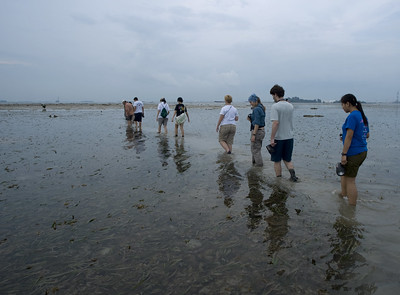
The full team survey this stretch of Pulau Semakau which used to be regularly visited as it is part of the public walk trail. We are trying to check this shore out more regularly.
I checked on the mangroves for the first time in a long while, with the massive reclamation at Pulau Sudong on the horizon. We still find Giant clams, seahorse and other interesting marine life. The rest of the team make all the special finds, I will update with their sighting later on. The corals seem okay. There were lots of lively sharks and sea turtles in the water too. The seagrass situation, unfortunately, remains unchanged.
As usual, the rest of the team make all the special finds. Throughout the trip, there were lots of small sharks cruising the reef edge, probably waiting for probably waiting for the tide to turn. Just as the moment a 'kopi tiam' door opens, the sharks are eager to rush in and be the first to get the fishes.
Richard saw more than 10 along his route, and got this great clip of some of them.
Our sharks are NOT dangerous to humans. It is perfectly safe to be on the shore with them if we respect their space. In fact, they will flee as soon as they notice us. Sharks are a sign of a healthy reef. Many sharks means there is enough fish for them to eat. So let's rejoice when we see sharks on our shores!
Che Cheng found a seahorse! While many saw this zoomy little green fish which is probably a Wrasse. There were also many octopuses seen, as well as the usual nudibranchs and colourful crabs seen on our reefs. At the reef edge, large Diadema sea urchins. Special (for me) was the sighting of the rarely seen Leathery sea anemone and it was nice to know that the Magnificent sea anemones are still there.
.jpg) |
Collage of photos by the team.
Links to their albums below. |
Update on Giant clams seen: 2 live Fluted giant clams, 1 Burrowing giant clam, 2 dead Fluted giant clams. Jason spotted one of the live Fluted giant clams - which we have seen before. While Richard and Che Cheng saw the 2 dead Fluted giant clams. The rest of the clams were sighted by the TMSI Giant clam team.
.jpg) |
Collage of photos by the team.
Links to their albums below. |
The reef edge is rich with corals, but I didn't check it out - but the rest of the team did. They saw large colonies of Anemone coral. And many Circular mushroom corals as well as other kinds of mushroom corals. There were also the usual common corals.
.jpg) |
Collage of photos by the team.
Links to their albums below. |
There have never been a lot of hard corals between the reef edge and the lagoon, there are scattered medium to large corals. Mostly boulder shaped. In the shallow pools, there are also some small corals. As in
Jul 2025, I saw the usual common species and didn't see any that were bleaching. There were a few Branching montipora colonies, but I didn't see any 'fields' of them.
As usual, there were many Boulder pore corals. While most were a normal brown, I saw some that were pale or pinkish (a sign of stress). None were outright bleaching.
I only saw
leathery soft corals closer towards the reef edge. Most colonies were small, although a few larger ones were see right at the reef edge. I didn't see any that were bleaching.
The other most abundant cnidarians remained
Broad feathery soft corals which formed brown patches sprinkled towards the reef edge. There were a few
Haddon's carpet anemones at the mid-shore and more
Giant carpet anemones towards the reef edge. I saw other cnidarians like a
cerianthid,
Frilly anemones,
corallimorphs,
zoanthids. I didn't see any that were bleaching.
On the mid-shore, there were still a wide variety of colourful sponges.
I had a quick look at the narrow line of mangrove trees that have settled on the high shore. The usual common species represented. There were some short
Bakau pasir (
Rhizophora stylosa) but I didn't see any
Api-api jambu (
Avicennia marina). While the trees were tall and well grown, only a few were flowering or producing propagules and some of the
Perepat (
Sonneratia alba) were affected by fluffy white stuff.
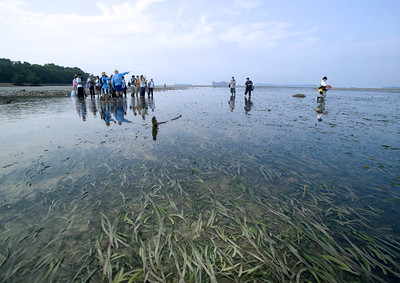
There used to be a large meadow of long Tape seagrass in a long shallow lagoon here. Here's what it looked like when TeamSeagrass started monitoring the seagrasses here in 2007.
The highlight of the public walk in the past was walking through thick growths of very long Tape seagrass, as in this photo taken in 2008.
Today, the middle of the shallow lagoon remains almost completely bare, with very few
Tape seagrasses, all were cropped short and only 2 leaves. Similar to what we saw on our last survey in
Jul 2025,
Jun 2023 and
Jan 2021. Similar to our last survey, There were sprinkles of
Spoon seagrass (small leaves) towards the high shore as well as some
Needle seagrass (narrow leaves). There were also tiny scattered patches of
Sickle seagrass. Today, the seagrasses were mostly not very heavily covered in epiphytes.
Towards and at the reef edge, I saw many more clumps of Tape seagrass with long leaves (about 30cm).
We saw some poles all over the shores including at the reef edge, probably from ongoing experiments. One series of poles were over what used to be the Tape seagrass lagoon. They seem lined up with the Sudong reclamation. So hopefully, there can be some data if there is any impact on Pulau Semakau.
The
ongoing reclamation at Pulau Sudong seems to be in full swing today! With huge piles of sand and heavy equipment on the worksite. Photo by Ian Mun, including the visible intervening large submerged reefs of Beting Bemban Besar, and Terumbu Raya.
But there are other smaller reefs closer to the worksite. We plan to survey Terumbu Bemban and Terumbu Menalung on the next low spring tide at end April.
More about Pulau SemakauIt is NOT true that the construction of the Landfill created the marine life found on Pulau Semakau. The marine life was there long before the Landfill was built.
Just as Changi Airport and Changi Beach are not the same even though they are near one another and share a name, Pulau Semakau is NOT the same as the Semakau Landfill. The Landfill was created by destroying all of Pulau Saking, and about half of the original Pulau Semakau by building a very long seawall. Fortunately, the landfill was constructed and is managed in such a way that the original mangroves, seagrass meadows and reefs on Pulau Semakau were allowed to remain.
What is the fate of Pulau Semakau (West)?These shores are slated for massive reclamation outlined recently in the
Long-Term Plan Review.
The Singapore Blue Plan 2018Pulau Semakau and nearby islands and submerged reefs have been recommended by the Singapore Blue Plan 2018 for Immediate Conservation Priority. The Blue Plan recommends the intertidal and subtidal marine areas of Pulau Semakau and adjacent Pulau Hantu, and Pulau Jong to be designated Marine Reserve.
The Blue Plan highlights that Pulau Semakau and its associated patch reefs comprise many ecosystems: coral reefs, mangrove areas, intertidal sandflats, seagrass meadows, and coral reefs. The subtidal area of Pulau Jong is larger than the terrestrial area. Pulau Hantu is a popular dive site has seen increasing interest in the past decade due to biodiversity awareness. If protection is accorded to these three islands, zonation plans for use can be implemented to manage tourism and human impacts.
DOWNLOAD the Plan, SUPPORT the Plan! More on the
Singapore Blue Plan 2018 site.
Photos by others on this survey


.jpg)
.jpg)
.jpg)
.jpg)
.jpg)
.jpg)
.jpg)
.jpg)
.jpg)
.jpg)
.jpg)


